
Heat and dehydration
The most common thing that catches newcomers out, particularly between March and May.
Climate guide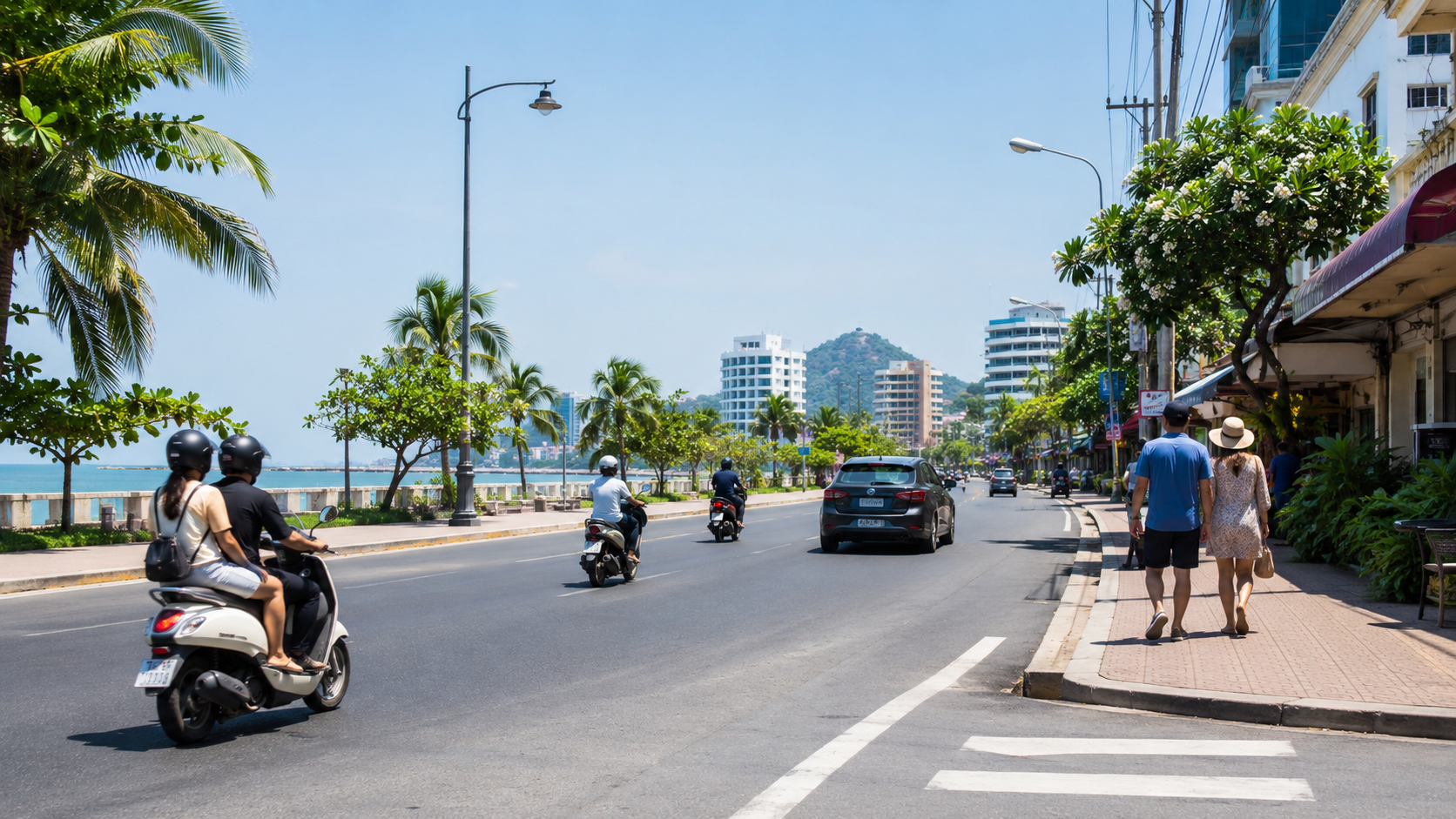
Focus on road safety, fraud and the contacts you may need in an emergency. Start with the practical priorities below.
For most residents, Hua Hin is a place where normal everyday precautions are generally enough. Serious crime should not be dismissed — it happens in every town of this size — but it is usually not the thing that shapes daily routines. Road safety, fraud awareness and sensible choices around transport tend to deserve far more practical attention.
We deliberately avoid publishing a crime score for Hua Hin. There is no complete, current, publicly available local dataset that would support one, and the ratings that circulate online are built from small numbers of self-selected survey responses rather than police records. What we can describe honestly is the shape of the risks residents actually encounter.
A practical prioritisation rather than a statistical probability — this is how we would rank the risks for someone building a life here.
| Risk | Practical weight | Why |
|---|---|---|
| Road safety | High practical relevance | Especially motorcycles. This is the risk most likely to change a resident's life here. |
| Online fraud | High financial relevance | Impersonation, fake payment requests and transfer scams can cost more than anything else on this page. |
| Rental and property mistakes | Medium–high financial relevance | Nobody gets hurt, but the sums involved are often the largest a newcomer moves in their first year. |
| Petty theft | Normal precautions | Opportunistic rather than organised. Treat bags, phones and unlocked homes sensibly. |
| Serious violent crime | Low everyday focus | Possible anywhere and not to be dismissed, but not what residents structure daily routines around. |
High practical relevance
Especially motorcycles. This is the risk most likely to change a resident's life here.
High financial relevance
Impersonation, fake payment requests and transfer scams can cost more than anything else on this page.
Medium–high financial relevance
Nobody gets hurt, but the sums involved are often the largest a newcomer moves in their first year.
Normal precautions
Opportunistic rather than organised. Treat bags, phones and unlocked homes sensibly.
Low everyday focus
Possible anywhere and not to be dismissed, but not what residents structure daily routines around.
This is a Hua Hin Compass practical prioritisation, not a risk score. It reflects how often each issue changes something in a resident's life and how much it tends to cost when it does.
If one section of this guide is worth reading twice, it is this one.
Thailand has one of the highest road death rates in Asia, and motorcycles account for the great majority of it. The Department of Disease Control reported more than 14,000 deaths in motorcycle-related crashes in 2024, and noted that the large majority of injured riders it recorded were not wearing a helmet. Those two facts sit at the heart of everything else on this page: the risk is concentrated in a specific mode of transport, and a significant part of it is addressed by equipment and behaviour rather than luck.
What that means in Hua Hin is straightforward. The roads here are not unusually hostile, and most journeys are short and unremarkable. But the traffic mix is different from what most newcomers are used to, and the adjustment takes longer than people expect.
What the local road environment is like
Phetkasem Road is the main north–south artery and carries everything at once: inter-provincial buses, pickups, delivery bikes and scooters, often at very different speeds in the same space. Because there are few direct right turns, traffic uses U-turns instead, which concentrates crossing movements at specific points.
Away from the main road, side sois join larger roads at shallow angles and with limited sightlines, scooters filter through slow traffic, and pedestrians cross multi-lane roads where there is no crossing nearby. Lighting on smaller roads is patchy after dark, and heavy rain reduces visibility quickly while the surface is at its most slippery in the first minutes of a downpour.
A scooter is one of the easiest ways to get around Hua Hin. It also changes your exposure to road injury more than almost any other everyday transport choice.
Plenty of residents ride every day for years without incident, and this is not an argument against scooters. It is an argument for treating the decision as a real one. The practical questions are whether you are licensed for it, whether you are insured for it, and whether the conditions you plan to ride in — night, rain, the trip home from dinner — are conditions you are genuinely comfortable in.
Licensing matters more than people assume. A car licence, including an International Driving Permit, does not cover a motorcycle unless it carries the motorcycle category. Riding without the right entitlement can also give an insurer grounds to decline a claim, which turns a modest accident into a serious financial problem. The Thai driving licence guide covers the requirements and the process in full.
Everything else is habit. A proper full-face or well-fitted helmet rather than the token one supplied with a rental. Covered arms and legs, or at least shoes rather than flip-flops. No riding after drinking. Extra caution in the first ten minutes of rain, at night, and with a passenger who changes how the bike handles.
Worth being honest with yourself about
Being comfortable on a bicycle is not the same thing as being experienced on a motorcycle. If you have never ridden regularly, learning in unfamiliar traffic is the hardest possible place to start — consider a car, taxis or a slow, deliberate introduction on quiet roads first.
| Option | Practical safety trade-off |
|---|---|
| Car | More physical protection in a collision, though local traffic patterns — U-turns, filtering scooters, side roads joining fast — still take adjustment. |
| Scooter | Extremely convenient and cheap to run, with far greater exposure if something goes wrong. Helmet, speed and night riding matter most. |
| App taxi or taxi | The obvious choice when you have been drinking, don't know the route or simply don't want to drive. Cheap relative to the risk it removes. |
| Walking or cycling | Depends almost entirely on your neighbourhood and route. Excellent in parts of town, awkward where pavements stop and traffic doesn't. |
Car
More physical protection in a collision, though local traffic patterns — U-turns, filtering scooters, side roads joining fast — still take adjustment.
Scooter
Extremely convenient and cheap to run, with far greater exposure if something goes wrong. Helmet, speed and night riding matter most.
App taxi or taxi
The obvious choice when you have been drinking, don't know the route or simply don't want to drive. Cheap relative to the risk it removes.
Walking or cycling
Depends almost entirely on your neighbourhood and route. Excellent in parts of town, awkward where pavements stop and traffic doesn't.
Renting a scooter or car
Before you drive away, photograph the vehicle from every angle and record any existing damage, including the underside of panels and the wheel rims. Ask what insurance is actually included and what the excess is — many rentals cover damage to the other party only, not to the vehicle you are riding.
Keep a copy of the rental agreement and confirm what licence the rental requires. Foreign-government travel advice, including the UK FCDO's Thailand pages, specifically warns against leaving your passport as security for a vehicle; offer a deposit or a photocopy instead.
In the centre, around the night market and along parts of the beach road, walking is pleasant and normal. A few kilometres inland it changes: pavements appear and disappear, drainage covers are uneven, and parked vehicles push pedestrians into the carriageway. Crossing Phetkasem on foot needs patience and a crossing point rather than a gap in the traffic.
Cyclists share the road with everything else, which is manageable in the early morning and much harder in the evening. If you ride after dark, use proper lights front and rear and something reflective — being visible is doing most of the work. Quieter parallel routes usually add a few minutes and remove most of the stress.
If walkability matters to you, choose the neighbourhood accordingly. Our neighbourhood guides score each area on how much daily life you can genuinely do on foot.
Not the tourist-trap list. These are the situations that cost people who are actually moving here money.
Almost every scam that affects residents shares a structure: someone creates urgency, asks you to keep the matter to yourself or bypass a normal process, and then needs a transfer. The subject changes — a rental, a bank account, a parcel, an investment — but the shape does not.
The single rule worth remembering
Urgency + secrecy + a money transfer = stop.
Nothing legitimate collapses because you took an hour to verify it through a channel you chose yourself.
Rental fraud follows a familiar pattern: a listing that is noticeably cheaper than comparable properties, photographs lifted from another advertisement, someone who presents themselves as the owner or an authorised agent, and pressure to secure the place with a deposit today because “another family is viewing this afternoon”.
The defences are simple. Establish who you are actually dealing with and whether they have authority to let the property. View it in person where you can, or have someone you trust view it. Confirm the property exists at the address given and that the person receiving the deposit is connected to it. Get the agreement in writing, including what the deposit covers and when it is returned. And treat urgency itself as the warning sign.
Our housing and renting guide covers contracts, deposits and the questions to ask at a viewing.
When a property deal needs a ‘workaround’
If someone explains that foreigners cannot legally do something and immediately follows it with a structure that “everybody uses”, slow down. A professional-looking corporate arrangement is not automatically a legally safe one, and the person selling you the structure is rarely the person who carries the risk if it is later challenged.
Nominee shareholding arrangements used to hold land have been the subject of enforcement action in Thailand, including in the Prachuap Khiri Khan area. That does not make property here generally unsafe — it means the regulatory risk in these specific structures is real rather than theoretical. Take independent legal advice from someone you appointed, not someone introduced by the seller.
The most financially damaging category on this page, and the one that reaches you wherever you live.
Call-centre fraud is an organised industry in the region and the scripts are well-rehearsed. The caller is a bank, the police, immigration, a courier with a held parcel, a government agency, a technical support desk or a buyer for something you listed. A common version tells you that your account or identity has been linked to a criminal case and that you must transfer your money to a “safe account” while it is investigated. No authority in Thailand works this way.
The practical defences do not require you to identify the scam. Never install remote-access or “verification” software because someone on the phone asked you to. Never read out an OTP — an OTP is a signature. Never move money because of an incoming call or message. Hang up, find the organisation's official number yourself, and call them back.
AOC 1441 — the national online scam line
Thailand operates the Anti Online Scam Operation Center through the 24-hour number 1441, run by the Ministry of Digital Economy and Society with the police and the banks. It handles online fraud reports and can act quickly on suspect accounts.
Official guidance is clear that AOC does not approach people through social media and ask them to move money. Anyone contacting you that way and citing 1441 is part of the problem, not the response to it.
Official cybercrime reporting
Online scams and cybercrime are reported through the Royal Thai Police portal at thaipoliceonline.go.th, which is where a formal case record is created. It is a reporting channel, not an emergency service — if you are in immediate danger, call 191.
Before you pay: large transfers
For a property deposit, a vehicle purchase or a contractor payment, confirm the account details through a second trusted channel before sending anything — a phone call to a number you already had, or in person. Intercepted invoices and altered account numbers are one of the most common ways large sums disappear.
The money transfers guide covers moving funds into Thailand safely.
Someone says they're the police, a bank or immigration
Stay calm and slow the conversation down. Do not transfer money, install an app, or disclose passwords or one-time codes. End the call and contact the organisation yourself on a number you have looked up independently.
If language is the obstacle, Tourist Police on 1155 can help in English and point you to the right service.
Hua Hin's nightlife is comparatively low-key and most evenings out are entirely unremarkable. The sensible habits are the familiar ones: keep an eye on bags and phones in busy places, don't leave a drink unattended, arrange your way home before you start drinking rather than after, and step away from a situation that feels off rather than waiting to be proved right.
Foreign-government travel advice for Thailand notes occasional cases of drink spiking and of counterfeit spirits in some venues. These are not everyday occurrences in Hua Hin, and treating them as such would be misleading — but watching your own drink and sticking to established venues costs nothing.
Most residential theft here is opportunistic — an unlocked door, a ground-floor window, a bag visible in a parked car. Removing the easy opportunity removes most of the problem.
Most snake situations become dangerous only when someone tries to catch or kill the animal themselves. The great majority of species here are harmless, several of the venomous ones are easily confused with harmless lookalikes, and almost every bite that reaches a hospital happened while someone was handling or attacking a snake rather than walking past one.
This is more relevant if you live in a villa, a greener inland neighbourhood, or a development bordering undeveloped land — and largely irrelevant on the tenth floor of a condominium.
If there's a snake in your garden
Keep your distance
Several metres is enough. Most snakes are trying to leave.
Move children and pets indoors
Dogs investigating a cornered snake cause most household incidents.
Don't corner it, and don't try to catch or kill it
This is the point at which people get bitten.
Keep track of where it goes
Only if you can do so safely from a distance.
Call for rescue assistance
Local rescue on 032 514 514, or 199 as the official fallback.
If a snake bites someone
Move away from the snake, keep the person as still and calm as practical, and call 1669 or get to a hospital immediately. Thai hospitals hold antivenom and know how to manage these cases.
Do not cut the wound, try to suck out venom, apply a tight tourniquet, use ice, or rely on folk remedies. Do not go back for the snake. Remove rings and watches from the affected limb in case of swelling.
The most common thing that catches newcomers out, particularly between March and May.
Climate guideDengue is present in Thailand and is a seasonal consideration rather than a constant one.
Healthcare and insuranceEntertaining from a distance, less so when food is visible. Don't feed or tease them.
Khao Takiab guideCurrents and jellyfish vary by season and beach; local flags and advice are worth following.
Beaches guideGive roaming dogs space, especially at night. Any bite or scratch needs medical review for rabies risk.
Healthcare and insuranceTwo situations where knowing the order of actions in advance genuinely changes the outcome.
If you're involved in a road accident
Make the immediate area as safe as you can
Hazard lights, move out of live traffic if the vehicles can be moved.
Call 1669 if anyone is injured
Ambulance and emergency medical response.
Call the police where appropriate
191, or 1193 on highways. Insurers usually need a police record.
Contact your insurer
Many Thai motor insurers send an assessor to the scene.
Photograph everything, if it is safe to do so
Vehicle positions, damage, plates, the road and any signage.
Record who was involved
Names, phone numbers, plate numbers and insurance details.
Do not sign anything you don't understand
Ask for a translation, or for Tourist Police on 1155 to assist.
If money has just left your account
Speed matters more than anything else. In order:
1. Call your bank immediately and ask them to attempt a freeze on the receiving account. 2. Call AOC 1441. 3. File a report through thaipoliceonline.go.th.
Preserve everything: screenshots, chat messages, phone numbers, account numbers, transaction references, URLs and receipts. Nobody can promise you the money back — but the first hour is when recovery is most realistic.
If you need help in English
Tourist Police on 1155 assist foreign visitors and residents, provide language support and can direct you to the right local service. The Tourist Police Bureau also publishes assistance resources and scam alerts.
Save 1155 in your phone before you need it.
Tap to call on mobile. Save the first four now rather than when you need them.
The national emergency police line. Thai-language first; ask for English if you need it.
Fires, and the official fallback for animals in the house when no local rescue team answers.
National emergency medical services. Use it for injuries, collapse, chest pain and snakebite.
English-language assistance for foreign visitors and residents, including help reaching the right service.
Incidents on highways and main inter-provincial roads, including Phetkasem.
The Ministry of Digital Economy and Society 24-hour line for online fraud, including freezing suspect accounts.
Department of Disaster Prevention and Mitigation: flooding, storms and other disaster incidents.
General immigration enquiries. Mainly Thai-language; for anything complex, go to the Hua Hin office in person.
Tourism Authority of Thailand information line — useful for non-emergency questions.
Community rescue foundation used locally for accidents, transfers and animal removal including snakes.
Locally published number rather than a national government line. If nobody answers, call 199 or 1669.
National numbers checked against Thai government and agency sources on 23 August 2026. Local rescue and community contacts change more often than national lines and are reviewed again around November 2026.
Emergencies have a habit of happening when your phone battery is low, the internet is down or nobody can remember the right number. We made a simple one-page emergency contact sheet you can keep nearby.
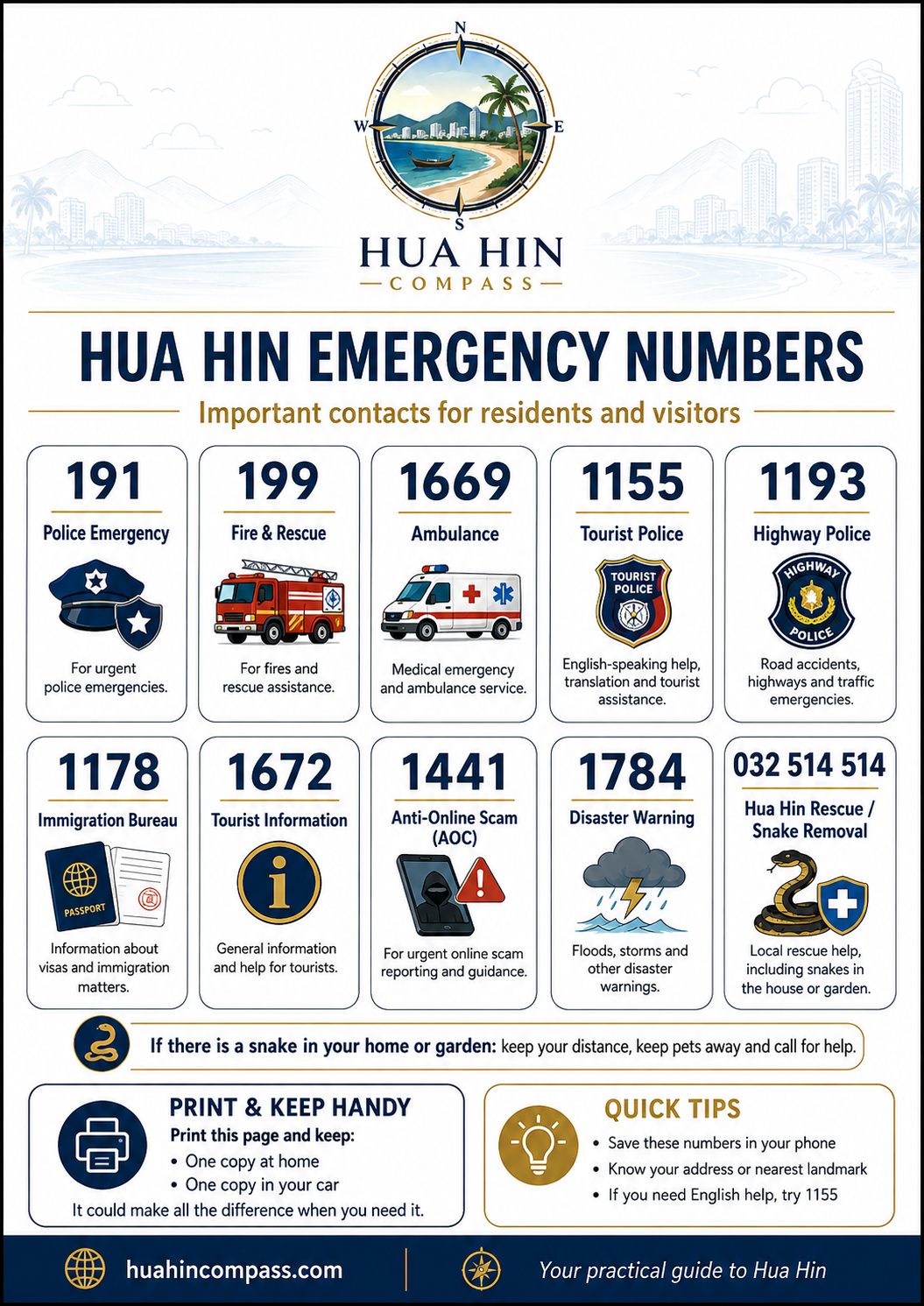
Print one for home. Keep one in the car.
Print two copies: keep one somewhere visible at home and another in the car. Save the most important numbers in your phone as well.
Nothing here is difficult. Together they cover most of what actually goes wrong.
Where the numbers, procedures and reporting channels on this page come from.
Official source
Primary source for
Official source
Primary source for
Official source
Primary source for
Official source
Primary source for
Official source
Primary source for
Official source
Primary source for
Hua Hin Compass verified
Last verified
August 2026
Next scheduled review
February 2027
Sources checked
Checked 23 August 2026. National emergency numbers are taken from Thai government and agency sources rather than from circulated infographics. Road-injury figures are Department of Disease Control data for 2024. Local rescue and community contacts change more often and are reviewed again around November 2026; if a local number does not answer, use the national line. We publish no crime score for Hua Hin because no reliable local dataset supports one.