
AIS Fibre / 3BB Fibre3
AIS and 3BB now sit under the same group, and packages are marketed together as Fibre3. Coverage in Hua Hin is broad, including many inland moo baans.
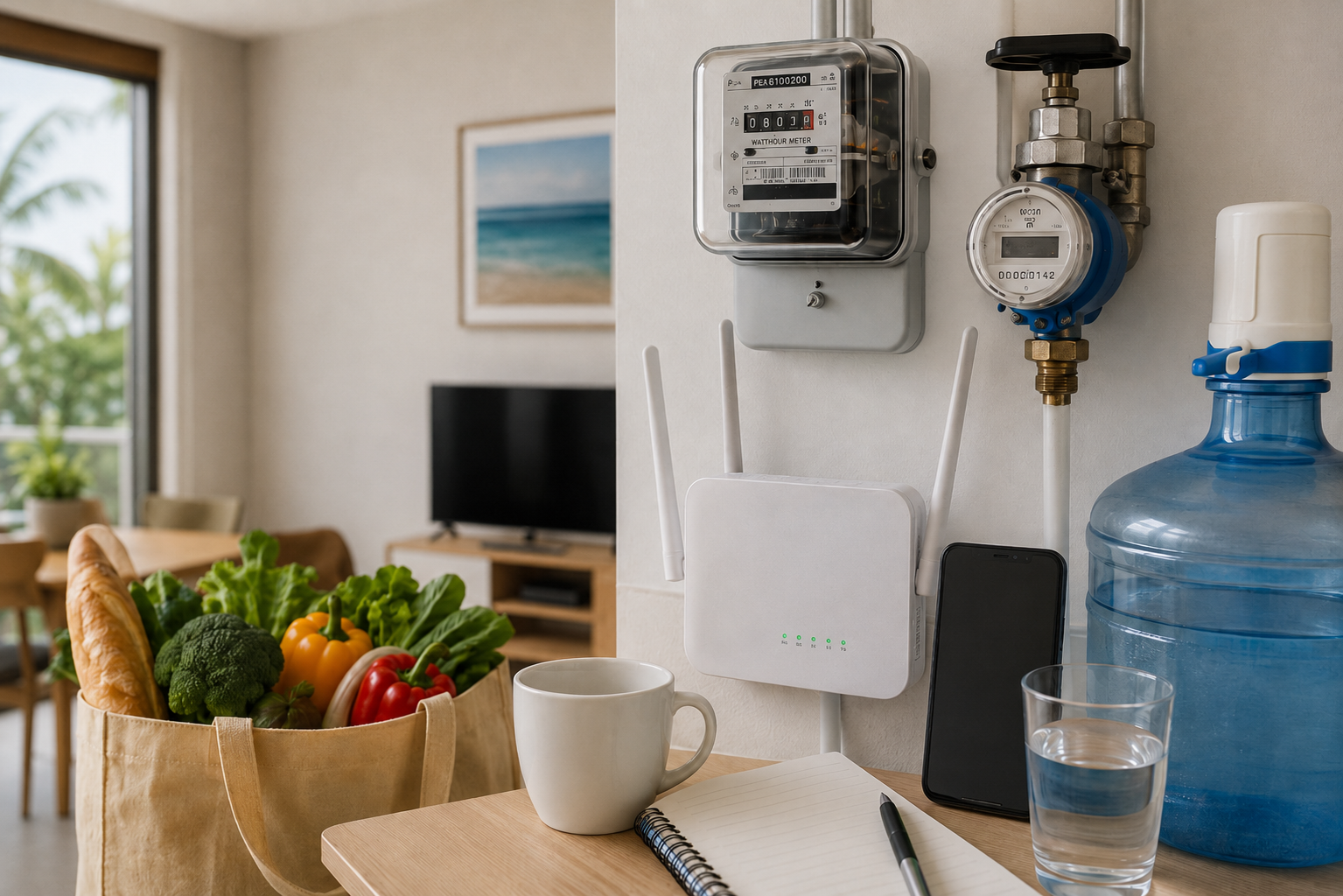
A home in Hua Hin can look completely move-in ready and still leave you sorting out fibre, drinking water, electricity rates and a Thai SIM during your first week. None of it is particularly difficult. It is simply easier when you know which questions to ask before you get the keys.
Freshness by field
Electricity tariff checked: September 2026
Ft period: September–December 2026
Telecom pricing checked: August 2026
| Essential | Typical choice | Indicative cost |
|---|---|---|
| Home internet | Fibre — AIS Fibre / 3BB Fibre3 or TrueOnline | Roughly ฿500–800 a month for a mainstream package |
| Mobile | AIS, True or dtac, prepaid or postpaid | Roughly ฿300–700 a month per person |
| Electricity | Provincial Electricity Authority (PEA) | The variable one — from a few hundred baht to several thousand |
| Water | Provincial Waterworks Authority (PWA), or billed by the building | Usually a small line: often ฿100–500 a month for a household |
| Drinking water | Bottled, 20-litre delivery, refill station or a home filter | From well under ฿100 a month to a one-off filter installation |
| Groceries | Fresh markets and Thai supermarkets, plus imported specialists | Depends almost entirely on how much imported food you buy |
Fibre — AIS Fibre / 3BB Fibre3 or TrueOnline
Roughly ฿500–800 a month for a mainstream package
Provincial Electricity Authority (PEA)
The variable one — from a few hundred baht to several thousand
Provincial Waterworks Authority (PWA), or billed by the building
Usually a small line: often ฿100–500 a month for a household
Bottled, 20-litre delivery, refill station or a home filter
From well under ฿100 a month to a one-off filter installation
Fresh markets and Thai supermarkets, plus imported specialists
Depends almost entirely on how much imported food you buy
Prices and promotions change. Figures in this guide are practical reference points rather than quotations, and we do not reproduce individual telecom package prices because they are rewritten every few months.
Ten minutes of questions at the viewing saves a year of arguing about bills.
Contracts, deposits and what else to check before signing are covered in the housing and renting guide.
Fibre is widely available across the built-up parts of town — but availability is decided at the address, not at the town.
For a town of this size, the internet is good. Fibre reaches most of the coastal strip, the town centre, the established moo baans inland and a great deal of the corridor south towards Pranburi. Mainstream packages comfortably handle video calls, streaming and remote work, and the advertised speeds are broadly what you get on a wired connection.
The variable is your exact property. Coverage is built street by street, so a provider that serves one soi may have nothing on the next. New developments sometimes sit ahead of the network, and older houses occasionally need a physical connection built from the road. Before you sign a lease, get the address checked with each provider rather than trusting a coverage map.
AIS and 3BB now sit under the same group, and packages are marketed together as Fibre3. Coverage in Hua Hin is broad, including many inland moo baans.
The other mainstream option, part of True Corporation. Strong in the town centre and in condominium buildings with a house agreement.
The state operator. Less visible in marketing, but sometimes the provider that actually reaches an outlying address when the others do not.
What a package usually involves
Mainstream residential fibre in Thailand generally means a twelve-month contract, a supplied router included in the monthly fee, and an installation visit within a few days of ordering. Entry-level tiers start in the hundreds of megabits; gigabit tiers are widely sold and priced higher. Mesh Wi-Fi units are usually an optional extra, sometimes loaned as part of a promotion.
Installation is often free on a contract package and chargeable on a shorter one. Ask what happens if you leave early, and — if you are renting — who owns the account and the equipment.
Condominiums add one more constraint. Some buildings have an agreement with a single provider and will not allow another to run cable through the risers, so your choice may already have been made for you. Ask the juristic office, not the letting agent.
Villas have the opposite problem. The connection is usually available, but thick concrete walls and long floor plans defeat a single router. Budget for a mesh set or a cabled access point rather than assuming the supplied router will cover the house.
For remote workers
If your income depends on being online, treat connectivity as two systems rather than one. Fibre as the primary connection, a mobile data plan on a different network as backup, and a small UPS keeping the router and ONT alive through short interruptions. Between them they cover most of what goes wrong on an ordinary working day. None of that is an uptime guarantee — it simply removes the single points of failure you can control.
Take your passport to any provider shop. Registration is a legal requirement and takes a few minutes.
Three mobile brands matter here: AIS, True and dtac, the latter two now part of the same group following the 2023 amalgamation but still sold separately when we last checked. Every mall in Hua Hin has at least one shop for each, and staff are used to registering foreign customers.
All Thai SIMs must be registered to an identified person, which for a foreigner means a passport. Prepaid is the simplest route: buy the SIM, register it at the counter, add a data package and top up as you go. Postpaid gives you a monthly bill and tends to be better value once you use a lot of data, but shops will ask for more paperwork — often a Thai address, sometimes evidence of your permission to stay.
The largest network nationally and a safe default for coverage around Hua Hin and on the Bangkok road.
Both brands belong to True Corporation following the 2023 amalgamation, and both were still being sold separately when we last checked.
Prepaid is easiest. A tourist SIM is fine for the first few weeks, but a standard prepaid line is better value once you stay longer.
Compare an ordinary prepaid data package against postpaid at your real monthly usage. Postpaid usually wins above roughly 30 GB a month.
Keep a second line on a different network. It costs little and turns a fibre outage into an inconvenience rather than a lost day.
Promotions change constantly and vary between shops, so treat any price you read online — including ours — as a reference point rather than a quotation.
Water is usually a relatively small expense. Electricity is the utility worth understanding.
PEA introduced a revised residential electricity structure from the September 2026 billing cycle. The examples below use the current tariff, Ft and VAT and are intended as planning estimates rather than fixed monthly bills.
Hua Hin is served by the Provincial Electricity Authority (PEA), the utility that covers Thailand outside greater Bangkok. Residential supply is billed on a progressive tariff: the first units are cheap, later units cost more, and a small monthly service charge and 7% VAT are added on top.
Most foreign households with air conditioning fall into PEA's over-150 kWh residential category. Its structure is straightforward enough to hold in your head:
PEA residential tariff (over 150 kWh per month, before VAT)
The Ft is a fuel adjustment charge that the regulator resets every four months and applies to every unit you use. It is small relative to the energy charge, but it is the reason two identical months can produce slightly different bills.
| Monthly use | Estimated bill (incl. VAT) | Roughly what that looks like |
|---|---|---|
| 200 kWh | ฿703 | A small condo, one bedroom air conditioner used at night |
| 300 kWh | ฿1,165 | A one-bedroom condo with regular evening cooling |
| 400 kWh | ฿1,628 | A couple in a small house, two units used in the evenings |
| 500 kWh | ฿2,111 | A family house with steady air conditioning in hot season |
| 800 kWh | ฿3,563 | A larger house, several units running for long stretches |
| 1,000 kWh | ฿4,530 | A pool villa in hot season with pumps and multiple units |
200 kWh — ฿703
A small condo, one bedroom air conditioner used at night
300 kWh — ฿1,165
A one-bedroom condo with regular evening cooling
400 kWh — ฿1,628
A couple in a small house, two units used in the evenings
500 kWh — ฿2,111
A family house with steady air conditioning in hot season
800 kWh — ฿3,563
A larger house, several units running for long stretches
1,000 kWh — ฿4,530
A pool villa in hot season with pumps and multiple units
Your bill depends on the meter category, the current tariff, the Ft adjustment and your actual consumption. Households on the under-150 kWh category are billed on a different set of blocks with a lower service charge.
This is the question that decides whether your electricity is reasonable or quietly expensive, and it has nothing to do with how much you use.
Depending on the property, you might receive a PEA bill directly in your own name, pay through a condominium's juristic office, or be billed by a landlord who reads a submeter and applies their own rate per unit. The first is the cleanest. The third is where people are most often overcharged — a flat ฿7 or ฿8 per unit against a PEA rate closer to ฿4 roughly doubles the bill.
Thailand's consumer contract regulations for the residential rental business, issued by the Office of the Consumer Protection Board in 2018, prohibit covered landlords from charging tenants more than the actual utility rate. Whether a particular arrangement falls inside those rules depends on the property and the lease, and we are not in a position to interpret yours. What you can do is ask clearly, before you sign.
A single efficient bedroom unit used mainly at night can add a few hundred baht a month. Several older units running for long stretches in a villa can dominate the electricity bill entirely, to the point where everything else on it becomes a rounding error. The gap between those two households is thousands of baht, and it has very little to do with floor area.
Six things move the number:
One bedroom unit overnight is a modest cost. Four units running from mid-afternoon until morning is a different household entirely.
Older fixed-speed compressors cycle hard on and off. An inverter unit modulates instead, and over a hot season the difference on the bill is real.
An undersized unit never reaches the set temperature and runs constantly. An oversized one short-cycles. Both waste electricity.
Every degree lower costs more. EGAT's own guidance points at around 25–26°C as the sensible balance between comfort and consumption.
West-facing glass, thin roofs, poor insulation and dark walls all push a unit harder. Two identical air conditioners in two different rooms will not cost the same to run.
Clogged filters and dirty coils quietly add to consumption. A clean twice a year is the cheapest efficiency measure available.
Getting the same comfort for less
Thailand's energy efficiency labelling scheme is run by EGAT and known as Label No. 5 — the star-rated sticker you will see on air conditioners, fridges and fans in any Thai appliance shop. Where you have a say in the equipment, it is the simplest signal to use.
Villas run more than air conditioners, and the extra loads are easy to overlook when you are standing in a garden being shown the property.
Property size alone does not predict the bill. A smaller, well-shaded house with modern inverter units can cost far less to run than an older villa with fixed-speed compressors, an oversized pool pump on a long timer and single-glazed west-facing glass. Ask to see a hot-season bill — March to May is the honest test.
Mains water comes from the Provincial Waterworks Authority, though not every household receives a PWA bill directly.
Residential water in Hua Hin is supplied through the Provincial Waterworks Authority (PWA). Houses on their own meter are usually billed directly. Condominiums and many rental properties are billed through the building or the landlord, sometimes on a submeter and sometimes at a flat rate written into the lease.
Like electricity, the tariff is progressive — but it starts low and stays low, which is why water rarely becomes a talking point the way electricity does.
PWA residential block rates (before VAT and service charge)
What that adds up to
10 m³ — about ฿102
One or two people in a condo
20 m³ — about ฿262
A couple in a house, modest garden
30 m³ — about ฿452
A family house with a garden
50 m³ — about ฿876
A villa with lawn irrigation
Figures are the energy-style block calculation only. A small monthly meter service charge and 7% VAT are added, and a household using more than 50 m³ in a month moves onto a higher category. Villas with lawns, gardens and pools sit at the top of that range; a condo rarely gets near it.
The honest answer is more nuanced than the usual advice, and the property matters as much as the supply.
PWA treats water to a published national standard, and Thailand has a programme designating specific areas where tap water meets the drinking-water criteria set by the Department of Health. So the water leaving the treatment plant is not the problem people assume it is.
What arrives at your tap has also travelled through the distribution network and then through the property's own pipework, storage tank and pump. That last stretch is only as good as its maintenance, and in a rented house nobody may have looked inside the tank for years. This is why most long-stay households here use a dedicated source for anything they drink or cook with, regardless of what the treatment standard says.
Everywhere, cheap and requires no setup. It also means carrying and storing bottles, and it produces a steady stream of plastic.
The usual choice for a settled household. A local supplier delivers returnable bottles on a routine, and a dispenser costs very little.
Coin-operated machines are on most residential streets and are inexpensive. Use one that is visibly maintained and busy rather than the nearest.
Under-sink and countertop systems are sold at HomePro and by local installers. Convenient for permanent residents, provided the cartridges are actually changed on schedule.
Running a household here usually means a mix: a supermarket for the weekly shop, a fresh market for produce, and somewhere specific for the imported things you miss.
Everyday groceries. Thai supermarkets cover the bulk of a normal week and are priced accordingly. Fresh markets do the rest — vegetables, fruit, herbs, seafood and prepared food, bought earlier in the day and usually cheaper and better than the supermarket equivalent.
Imported and Western groceries. This is where budgets diverge. Villa Market and the mall supermarkets carry European cheese, familiar cuts of meat, baking supplies and recognisable brands, at prices that reflect the journey they made. A household that cooks mostly Thai ingredients and a household that shops imported can differ by several thousand baht a month on food alone — which is why the cost of living guide treats groceries as a lifestyle choice rather than a fixed number.
Bulk and household setup. Makro sells foodservice pack sizes to anyone who walks in, which suits families and anyone stocking a new kitchen. HomePro is where most new arrivals end up in their first fortnight, buying fans, storage, lighting, extension leads, kitchen equipment and a water filter.
The town's original large mall on Phetkasem Road, with a full supermarket, pharmacy and household basics.
Use it for: The everyday shop, and most of what you need in one stop
Find it on the mapThe newer resort mall behind the centre. Its supermarket has changed operator recently, so check what is trading when you arrive.
Use it for: A wider mix of imported and premium groceries
Find it on the mapThe specialist imported-grocery chain, long established in Hua Hin.
Use it for: European cheese, cuts of meat, baking supplies and familiar brands
Find it on the mapCash-and-carry sizes, aimed at restaurants but open to everyone.
Use it for: Bulk stocking, families, large packs and foodservice quantities
Find it on the mapThe main household and DIY store for the area.
Use it for: Fans, lighting, storage, kitchen equipment, water filters, small repairs
Find it on the mapHua Hin's main daytime fresh market on Phetkasem Road, trading from early morning into the afternoon.
Use it for: Vegetables, fruit, seafood, herbs and prepared food at local prices
Find it on the mapRetail here changes hands regularly — supermarket operators inside the malls have swapped more than once in recent years. Check what is actually trading when you arrive. For eating out rather than cooking in, the lifestyle section covers restaurants and markets properly.
Food delivery through Grab and LINE MAN covers most of Hua Hin, supermarkets and large retailers run their own delivery for bulky orders, and the national e-commerce platforms deliver to the door within a couple of days. For a household without a car in the first weeks, it fills the gap.
The friction is almost never the app. It is the address. Thai addresses use house numbers, moo (village) numbers and soi names in an order that mapping software handles inconsistently, and gated communities and condominiums often route deliveries through a guard house or a parcel room rather than to your door.
Short power interruptions happen, more often during storms and occasionally for scheduled maintenance. Most last minutes rather than hours. They are not frequent enough to plan a life around, but they are frequent enough that anyone working online should have a small UPS under the desk keeping the router and ONT running.
Water is more about the property than the network. Many houses here store mains water in a tank and pressurise it with a pump, which smooths out variations in supply and means you keep water when the mains briefly does not. Condominiums do the same at building scale. Where pressure disappoints people, it is usually an undersized or ageing pump rather than PWA.
Rather than assuming every Hua Hin home behaves the same way, inspect the one you are taking. Find the tank, find the pump, find the consumer unit, and ask who maintains each of them.
Connectivity and utilities only — groceries and rent are a separate conversation.
One bedroom unit used overnight, roughly 200 kWh a month.
Roughly ฿1,700–2,300 a month
Two air conditioners used in the evenings, roughly 400 kWh a month.
Roughly ฿3,200–4,400 a month
Several units running long hours plus a pool pump, roughly 1,000 kWh a month.
Roughly ฿6,400–8,100 a month
Air-conditioning and property type are the main reasons two households in the same town can have very different utility bills. Treat these as shapes, not averages.
Where to confirm the tariffs, labelling and rental rules referenced on this page.
Official source
Primary source for
Official source
Primary source for
Official source
Primary source for
Official source
Primary source for
Hua Hin Compass verified
Last verified
September 2026
Next scheduled review
February 2027
Sources checked
Checked Sep 2026. Electricity tariff checked: September 2026. Ft period: September–December 2026. Telecom pricing checked: August 2026, with the next telecom review around November 2026. Water figures use the published PWA residential tariff. We describe telecom package structures rather than reproducing short-lived promotional prices. Hua Hin Compass is independent and has no telecom, retail or utility partners.