
LivingCornerstone guide

Living in Hua Hin

The complete guide to daily life on this stretch of coast

Hua Hin is a working Thai town that happens to have a beach, a royal history and a long-established foreign community. It is calmer than Phuket, closer to Bangkok than Chiang Mai, and rewards people who want a settled routine rather than constant novelty.

This guide covers what life here actually involves — where people live, how they get around, what healthcare and admin look like, what the seasons do to your month, and the trade-offs nobody mentions in a holiday brochure.

Last verified
Last verified: August 2026
Next review:
February 2027
Reading time:
16 min
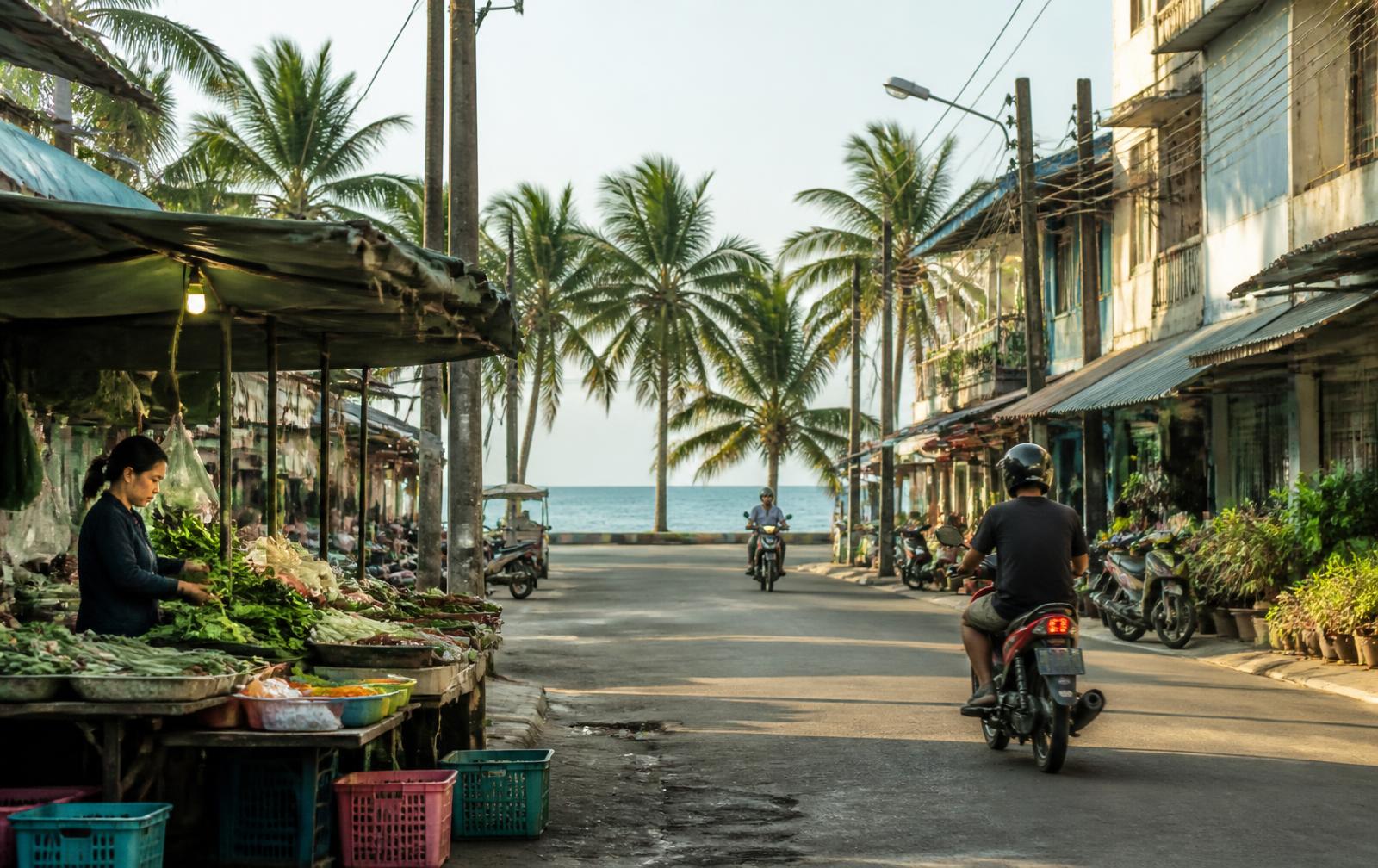
Morning market stall on a quiet street running down to the sea in a Thai coastal town

Quick answer

Hua Hin suits people who want a quiet, comfortable, well-connected base — not people who want a city.

Daily life is easy here: good private healthcare, decent shopping, a real Thai town around the resort strip, and Bangkok a few hours away when you need it. What you give up is choice — fewer restaurants, fewer flights, fewer jobs and a much smaller social scene than Bangkok, Chiang Mai or Phuket. Almost everyone who settles well spends a season here first and rents for a full year before committing.

Hua Hin at a glance

The shape of the place, before the detail.

Orientation

Where it is
West coast of the Gulf of Thailand, south of Bangkok in Prachuap Khiri Khan province
Character
A working Thai town with a long beach, a royal history and an established long-stay community
Best known for
Golf, calm beaches, markets and an unusually settled pace
Getting to Bangkok
Train, coach, minivan or private car — a common day trip for specialist appointments
Typical residents
Retirees, part-year residents, families and a smaller group of remote workers
Language
English is workable in hospitals and business; Thai transforms everyday life

Two towns in one

The beach road and the condo strip are what visitors see. A few streets inland, Hua Hin is an ordinary provincial town with fresh markets, government offices, schools and traffic. Most people who stay end up living far more in the second one.

Who Hua Hin suits — and who tends to leave again

The same town works very differently depending on what stage of life you bring to it.

Retirees and semi-retired couples

The group Hua Hin fits most naturally.

Why it works

  • A calm, low-drama town with private hospitals close by
  • An established long-stay community, so nothing you do is unusual here
  • Golf, walking, swimming and eating out all cost less than at home

What to watch

  • Health cover becomes harder and more expensive to buy with age
  • Long-stay permission depends on meeting financial requirements every year
  • Driving at night and hospital access shape where you should live

First move: Sort health cover and your long-stay route before you sign a lease.

Families with school-age children

Workable, but school choice decides almost everything else.

Why it works

  • Several international and bilingual schools within a short drive
  • Space, gardens and safe residential streets inland for less than coastal rents
  • A short, predictable trip to Bangkok when you need a city

What to watch

  • School fees are usually the largest single line in a family budget
  • Teenage social life is thinner here than in Bangkok or Chiang Mai
  • Your school choice effectively picks your neighbourhood, not the other way round

First move: Shortlist schools first, then look at housing within a sensible drive.

Remote workers and long-stay digital nomads

Comfortable and quiet — deliberately not a nomad hub.

Why it works

  • Fibre internet is widely available in condos and newer developments
  • Costs are lower than Bangkok with a far shorter commute to the sea
  • Bangkok is close enough for client meetings and international flights

What to watch

  • A smaller coworking and professional scene than Chiang Mai or Bangkok
  • Working legally in Thailand is a separate question from being allowed to stay
  • Time zones can make European or American client hours awkward

First move: Confirm the stay route that matches how you actually earn.

Part-year residents and snowbirds

Often the smartest way to start.

Why it works

  • You can live through the cool season before committing to anything
  • Renting seasonally keeps you flexible and out of ownership questions
  • Short stays keep your tax and residency position simple

What to watch

  • Seasonal rents are higher, and the best places are booked early
  • Repeated short entries can attract more scrutiny over time
  • Leaving a property empty in the rainy months needs someone to check on it

First move: Rent for one full season before you plan anything permanent.

The people who leave again are rarely the ones who disliked Thailand. They are usually the ones who needed more around them — work, culture, a bigger circle — and discovered it three months in rather than three weeks in. That is a good argument for renting before you commit to anything.

What daily life is actually like

The week here has a rhythm, and it is set by heat, traffic and the seasons more than by the calendar.

Days start early. By seven the markets are busy, the beach has walkers and swimmers on it, and anyone with a garden is already outside. From late morning until the middle of the afternoon the heat pushes life indoors — errands, air conditioning, lunch somewhere cool — and the town comes back out around five for the evening markets, the sea breeze and dinner.

Shopping splits three ways. Fresh markets for produce and fish, supermarkets for the ordinary weekly shop, and one of the larger stores when you want imported cheese, wine or a specific brand from home. That last category is where budgets quietly inflate. Services — cleaning, laundry, a gardener, someone to fix the air conditioning — are affordable enough that most households use them, and they make a hotter climate considerably easier to live in.

Admin is the part newcomers underestimate. Immigration reporting, bank paperwork, insurance renewals, licence renewals and utility accounts each follow their own rhythm, generally involve a physical visit, and reward the person who brings copies of everything. It is not difficult. It is just never quick.

The six practical pillars

Everything that decides whether life here works comes down to these six. Each has its own detailed guide.

Housing

The biggest line in most budgets, and the decision that quietly sets the shape of your day.

  • · Condos, townhouses, gated developments and standalone villas each suit very different lives
  • · Rent, then buy — if at all. Contracts here are short and supply is generous
  • · Foreign nationals generally cannot own land; condominiums work differently
Read the housing guide

Neighbourhoods

Hua Hin is long and narrow. Price, noise and daily driving all track distance from the sea.

  • · Town centre for walkability, at the cost of traffic and noise
  • · Khao Takiab and the southern beaches for calmer coastal living
  • · Hin Lek Fai for views and cooler evenings, Thap Tai for family space inland
Explore the neighbourhood map

Healthcare and cover

Private care locally is good for most routine needs; complex cases still travel to Bangkok.

  • · Private hospitals handle everyday care, scans and minor procedures well
  • · Specialist and complex treatment often means a trip to Bangkok
  • · Insurance is the real decision — pricing and exclusions change sharply with age
Read the health insurance guide

Getting around

Public transport within town is limited. Almost every resident settles on a car, a scooter or app taxis.

  • · App taxis and songthaews cover the centre; outer areas assume you drive
  • · Road safety, not crime, is the biggest genuine risk to most residents
  • · Bangkok is reachable by train, coach, minivan or private car
Read the transport guide

Climate

Drier than much of Thailand's coast, but still hot year-round and humid for months at a time.

  • · The cool season is why most people fall in love with the town
  • · Hot-season electricity bills surprise people who ran air conditioning lightly at home
  • · Rain here tends to arrive in bursts rather than settling in for days
Read the climate guide

Money and everyday costs

Housing, schooling and healthcare separate a modest life here from an expensive one.

  • · Local food, transport and services are the cheap parts of the month
  • · Imported groceries, alcohol, cars and international schooling are not
  • · Exchange-rate movement matters more than most newcomers expect
See what a month costs

Two things to settle before anything else

Your long-stay permission and your health cover are the foundations. Housing, schools and everything else can be changed later; those two are difficult and expensive to fix once you are already here and something has gone wrong.

The honest trade-offs

Six things worth knowing before you commit — none of them are dealbreakers, all of them catch people out.

It is a quiet town, and it stays quiet

The calm that appeals on a two-week holiday is the same calm that feels small in month eight. People who need variety, nightlife or a large professional scene usually drift towards Bangkok.

You will probably need to drive

Outside the centre, daily life assumes a vehicle. If you are not comfortable driving here — and many people are not, at first — factor app taxis into the budget or live somewhere genuinely walkable.

Nothing about your stay is permanent

Long-stay permission is renewed, not granted once. Rules, financial requirements and paperwork change, and your plan should survive that rather than depend on the current position holding.

Healthcare is good until it is complicated

Routine care locally is straightforward. Serious or specialist treatment often means Bangkok, and without insurance a single admission can undo years of savings on living costs.

The season changes the town

Between roughly November and February the town is busy, prices firm up and traffic thickens. In the low months some venues quieten right down. Visit in both if you can.

Language sets your ceiling

You can live comfortably in English. You cannot get far into local life, admin or friendships without some Thai, and the people who settle best are usually the ones who tried.

A realistic first 90 days

The order below keeps the expensive commitments last, when you know enough to make them well.

  1. 1

    Arrive with short-term accommodation only

    Four to six weeks in a rental you can walk away from is worth more than any amount of research from abroad.

  2. 2

    Test two or three areas properly

    Drive the school run, the hospital route and the supermarket trip at the times you would actually make them.

  3. 3

    Sort health cover before you need it

    Cover is easiest to arrange while you are healthy. Existing conditions are usually excluded once declared.

  4. 4

    Open a Thai bank account

    Requirements vary by branch and by your stay route. It is far simpler once you have a lease and a long-stay permission in hand.

  5. 5

    Sign a twelve-month lease

    By now you know which area you want. Take dated photographs of the property and the meters at handover.

  6. 6

    Put the annual admin in a calendar

    Permission-to-stay extensions, address reporting, insurance renewals and licence expiry dates all arrive on their own schedule.

Worth doing in the first month

  • Get a Thai SIM and a local number for deliveries and appointments
  • Register with a private hospital and find a clinic you like
  • Learn the routes you will drive daily, in daylight and after dark
  • Find your fresh market, your supermarket and your imported-goods stop
  • Note the immigration reporting dates that apply to your stay route
  • Meet people outside the expat bar circuit — sport, classes and volunteering all work

Common questions

The questions people ask before they decide.

Next steps

Three decisions carry most of the weight: where you live, what it costs and how you stay.

Official and primary sources

Where to confirm the rules referred to on this page. If a source below contradicts this guide, the source is right.

Official source

Ministry of Foreign Affairs, Thailand

Primary source for

  • · Visa categories
  • · Consular requirements
Open the MFA site

Hua Hin Compass verified

Last verified

August 2026

Next scheduled review

February 2027

Sources checked

  • · Thai Immigration Bureau
  • · Ministry of Foreign Affairs, Thailand
  • · Thai Meteorological Department
  • · Thai Department of Lands

Checked Aug 2026. Hua Hin Compass is independent. This guide describes how everyday life here generally works — it is not legal, tax, medical or financial advice, and requirements can change before the next review.