
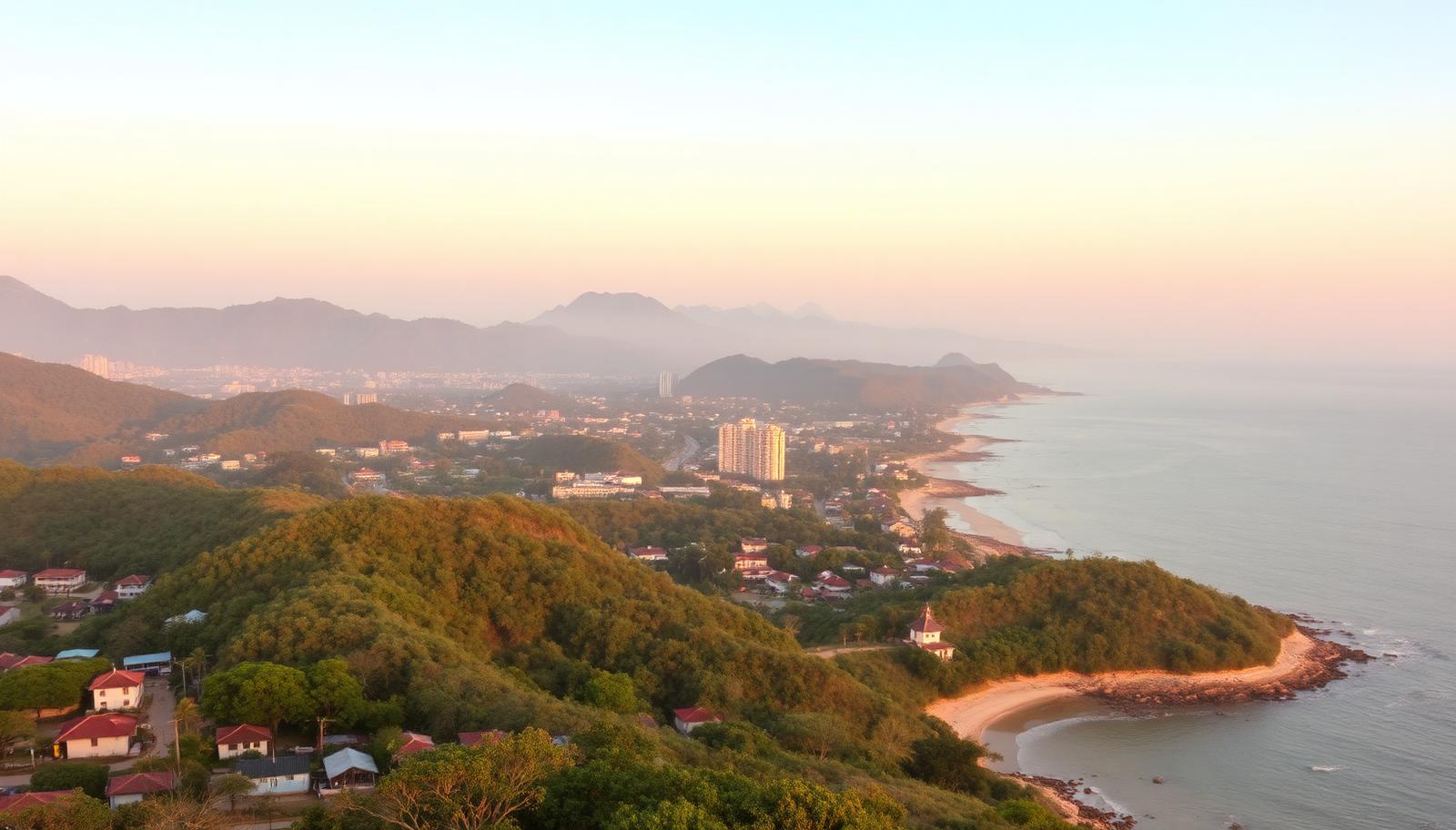
Hua Hin vs Bangkok, Chiang Mai and Phuket
Compare housing, healthcare, schools, air quality and travel across four places to live in Thailand.
- Last verified
- Last verified: August 2026
- Next review:
- February 2027
- Reading time:
- 11 min
The four cities side by side
A quick read before the detail. Rent bands are indicative Compass estimates for a comparable one-bedroom on a long lease.
| Dimension | Hua Hin | Bangkok | Chiang Mai | Phuket |
|---|---|---|---|---|
| Typical 1-bed rent (12-month) | ฿10k–25k | ฿18k–45k | ฿7k–18k | ฿15k–40k |
| Pace of life | Calm, small-town | Fast, dense | Relaxed, creative | Seasonal, touristic |
| International schools | Short list | Widest choice | Good choice | Good choice |
| Specialist healthcare | Routine local, Bangkok for complex | Deepest in Thailand | Strong regional | Large private hospitals |
| Air quality concern | Low | Seasonal urban pollution | Spring burning season | Low |
| International flights | Via Bangkok | Two international airports | Own airport, regional focus | Own airport, direct long-haul |
| Beach access | Walkable town beach | None | None | Among Thailand's best |
| Best fit | Retirees, families, remote workers wanting calm | Careers, schools, medical depth | Budget-focused, culture, nomads | Beach life with infrastructure |
Scroll the table sideways on a phone, or read the city-by-city sections below where the same points are set out in full.
How to compare honestly
Cost figures here are indicative planning estimates
Compare the same household, housing standard, insurance and transport assumptions in every city. Holiday prices are a poor guide to a long-term budget.
Check housing space, access to care, schools if needed, and the air, noise and traffic you would experience on an ordinary day.
Hua Hin vs Bangkok
The capital's depth and connections against a quieter coast two hours away
Bangkok is the only place in Thailand where you never have to compromise: the widest choice of hospitals, international schools, offices, restaurants, direct flights and English-speaking professional services sits within one metropolitan area. What you give up is calm, air quality and, in the areas most foreigners actually want to live, a good deal of money per square metre.
Hua Hin is close enough to keep Bangkok useful. Roughly 200 kilometres south, it is a two-and-a-half to three-and-a-half hour drive depending on traffic, which means specialist appointments, embassy visits and airport runs stay realistic without living in the city.
Bangkok at a glance
- Setting
- Dense capital city versus a low-rise coastal town
- Distance from Hua Hin
- Around 200 km; typically 2.5–3.5 hours by road
- Airports
- Bangkok has two international airports; Hua Hin flies via Bangkok
- Best suited to
- Bangkok for work and medical depth, Hua Hin for daily quality of life
| What you are comparing | Hua Hin | Bangkok | Our read |
|---|---|---|---|
| Housing | Sea-view condos and houses with gardens at prices that would buy a small central Bangkok apartment. | More stock and more quality at the top end, but you pay for location and get far less floor area. | Hua Hin, unless you specifically need a central Bangkok address. |
| Healthcare | Solid private hospitals for everyday care and most routine procedures; complex cases are referred onwards. | The deepest concentration of specialists and tertiary hospitals in the country. | Bangkok, clearly — but Hua Hin's proximity softens the gap. |
| Schools | A small number of international and bilingual options; realistically you choose from a shortlist. | Dozens of international schools across every curriculum and price band. | Bangkok if the school decides the move. |
| Work and business | Suits remote work, retirement and small local businesses more than corporate careers. | Where the offices, clients, recruiters and professional networks are. | Bangkok for employment, Hua Hin for remote and self-directed work. |
| Getting around | Scooter or car; no mass transit, but short distances and easy parking. | BTS, MRT and abundant taxis, offset by heavy traffic and long journey times. | A genuine draw — different problems rather than a better answer. |
| Air and environment | Coastal breeze and generally better air, with occasional regional haze. | Recurring seasonal pollution episodes in the cooler months. | Hua Hin. |
| Social life | A smaller, older, more settled foreign community; easy to meet people, narrower in range. | Every scene, every age group, every nationality — but harder to feel part of a neighbourhood. | Depends entirely on what you are looking for. |
Housing
- Hua Hin
- Sea-view condos and houses with gardens at prices that would buy a small central Bangkok apartment.
- Bangkok
- More stock and more quality at the top end, but you pay for location and get far less floor area.
- Our read
- Hua Hin, unless you specifically need a central Bangkok address.
Healthcare
- Hua Hin
- Solid private hospitals for everyday care and most routine procedures; complex cases are referred onwards.
- Bangkok
- The deepest concentration of specialists and tertiary hospitals in the country.
- Our read
- Bangkok, clearly — but Hua Hin's proximity softens the gap.
Schools
- Hua Hin
- A small number of international and bilingual options; realistically you choose from a shortlist.
- Bangkok
- Dozens of international schools across every curriculum and price band.
- Our read
- Bangkok if the school decides the move.
Work and business
- Hua Hin
- Suits remote work, retirement and small local businesses more than corporate careers.
- Bangkok
- Where the offices, clients, recruiters and professional networks are.
- Our read
- Bangkok for employment, Hua Hin for remote and self-directed work.
Getting around
- Hua Hin
- Scooter or car; no mass transit, but short distances and easy parking.
- Bangkok
- BTS, MRT and abundant taxis, offset by heavy traffic and long journey times.
- Our read
- A genuine draw — different problems rather than a better answer.
Air and environment
- Hua Hin
- Coastal breeze and generally better air, with occasional regional haze.
- Bangkok
- Recurring seasonal pollution episodes in the cooler months.
- Our read
- Hua Hin.
Social life
- Hua Hin
- A smaller, older, more settled foreign community; easy to meet people, narrower in range.
- Bangkok
- Every scene, every age group, every nationality — but harder to feel part of a neighbourhood.
- Our read
- Depends entirely on what you are looking for.
Rent, compared like for like
Compass estimate for a comparable, well-kept one-bedroom rented on a 12-month contract: roughly ฿10,000–฿25,000 in Hua Hin against roughly ฿18,000–฿45,000 in central Bangkok districts popular with foreigners. Space, not the headline rent, is usually the bigger difference.
Choose Hua Hin if
- · You work remotely, are retired, or run something location-independent
- · You want outdoor space, sea air and short daily distances
- · You value a calmer pace more than choice and nightlife
- · You accept travelling to Bangkok a few times a year for specialists or flights
Choose Bangkok if
- · Your income depends on being physically in Bangkok
- · You need a specific school, curriculum or specialist medical pathway
- · You fly internationally often enough that a two-hour transfer becomes a burden
- · You want the depth of a large city: culture, food, professional services, community
The real trade-off: You are trading breadth for calm. Bangkok answers almost every question; Hua Hin answers most of them well and asks you to drive for the rest.
Hua Hin vs Chiang Mai
Northern culture and low costs against a coast without a burning season
Chiang Mai is the standard comparison for anyone whose priority is value. Rents and everyday costs are among the lowest of Thailand's major expat destinations, the cultural life is genuinely rich, the cool season is pleasant, and the remote-work community is large and well established.
The recurring objection is air quality. Agricultural and forest burning across northern Thailand and neighbouring countries produces a smoke season, broadly February to April, when air quality in the Chiang Mai valley regularly reaches levels that people with respiratory or cardiac conditions are advised to take seriously. Many residents plan to leave for part of it. That single seasonal factor is what sends a large share of would-be Chiang Mai residents to the coast instead.
Chiang Mai at a glance
- Setting
- Inland northern valley city versus a coastal town
- Distance from Hua Hin
- Around 700 km; a flight via Bangkok rather than a drive
- Seasonal issue
- Northern smoke season, broadly February to April
- Best suited to
- Chiang Mai for cost and culture, Hua Hin for air and sea
| What you are comparing | Hua Hin | Chiang Mai | Our read |
|---|---|---|---|
| Everyday cost | Moderate; housing is the main line and beachfront carries a premium. | Generally lower across rent, food and services. | Chiang Mai, by a meaningful but not dramatic margin. |
| Air quality | Coastal ventilation; no equivalent annual smoke season. | A well-documented burning season each spring. | Hua Hin, and for some people this settles the whole question. |
| Climate | Hot and humid year-round, moderated by sea breeze; a relatively dry stretch by Thai standards. | A genuinely cool season, a hot season and a wet season — more variation. | Chiang Mai if you want seasons, Hua Hin if you want the sea. |
| Healthcare | Good private hospitals for routine and mid-level care, with Bangkok two to three hours away. | Strong regional hospitals and a large medical sector. | Chiang Mai has more depth locally; Hua Hin has faster access to Bangkok. |
| Schools | A short list of international and bilingual schools. | A larger and more varied international school sector. | Chiang Mai for families wanting choice. |
| Community | Older, more retirement- and family-weighted, with a strong Scandinavian and Northern European presence. | Younger, more remote-work and digital-nomad weighted. | Different crowds rather than better ones. |
| Travel | Bangkok's two international airports by road; no regular international flights locally. | An international airport in the city with regional connections. | Chiang Mai for convenience, Hua Hin for route choice via Bangkok. |
Everyday cost
- Hua Hin
- Moderate; housing is the main line and beachfront carries a premium.
- Chiang Mai
- Generally lower across rent, food and services.
- Our read
- Chiang Mai, by a meaningful but not dramatic margin.
Air quality
- Hua Hin
- Coastal ventilation; no equivalent annual smoke season.
- Chiang Mai
- A well-documented burning season each spring.
- Our read
- Hua Hin, and for some people this settles the whole question.
Climate
- Hua Hin
- Hot and humid year-round, moderated by sea breeze; a relatively dry stretch by Thai standards.
- Chiang Mai
- A genuinely cool season, a hot season and a wet season — more variation.
- Our read
- Chiang Mai if you want seasons, Hua Hin if you want the sea.
Healthcare
- Hua Hin
- Good private hospitals for routine and mid-level care, with Bangkok two to three hours away.
- Chiang Mai
- Strong regional hospitals and a large medical sector.
- Our read
- Chiang Mai has more depth locally; Hua Hin has faster access to Bangkok.
Schools
- Hua Hin
- A short list of international and bilingual schools.
- Chiang Mai
- A larger and more varied international school sector.
- Our read
- Chiang Mai for families wanting choice.
Community
- Hua Hin
- Older, more retirement- and family-weighted, with a strong Scandinavian and Northern European presence.
- Chiang Mai
- Younger, more remote-work and digital-nomad weighted.
- Our read
- Different crowds rather than better ones.
Travel
- Hua Hin
- Bangkok's two international airports by road; no regular international flights locally.
- Chiang Mai
- An international airport in the city with regional connections.
- Our read
- Chiang Mai for convenience, Hua Hin for route choice via Bangkok.
Rent, compared like for like
Compass estimate for a comparable one-bedroom on a 12-month contract: roughly ฿10,000–฿25,000 in Hua Hin against roughly ฿7,000–฿18,000 in Chiang Mai. Chiang Mai is usually the cheaper city overall, but the gap is smaller than the internet suggests once you compare like-for-like buildings.
Choose Hua Hin if
- · Air quality matters to your health or peace of mind
- · You want to be at the sea rather than in the mountains
- · You want to reach Bangkok by road without booking a flight
- · You prefer a settled, quieter community over a nomad-heavy one
Choose Chiang Mai if
- · Your budget is the deciding factor and every thousand baht counts
- · You want cool-season weather and mountain landscapes
- · You want a large, active remote-work and coworking scene
- · Temples, crafts and northern food culture are a real draw for you
The real trade-off: Chiang Mai gives you more culture and a lower cost of living for nine or ten months of the year. Hua Hin costs a little more and gives you twelve.
Hua Hin vs Phuket
Island scale and international infrastructure against mainland practicality
Phuket is the most internationally developed place on this list after Bangkok: an international airport with direct long-haul and regional routes, large private hospitals, a broad international school sector, world-class beaches and a property market built around foreign buyers. It is also the most expensive of the three comparisons, and the most seasonal.
Hua Hin's argument against Phuket is practicality. It is a mainland town of ordinary Thai scale where you can reach Bangkok by car, where traffic and tourism pressure are lower, and where the cost of the same lifestyle is generally lower. Phuket's argument is that if you want island living with real infrastructure, there is nowhere else in Thailand that combines the two so completely.
Phuket at a glance
- Setting
- Large tourist island versus a mainland coastal town
- Distance from Hua Hin
- Roughly 900 km by road; realistically a flight via Bangkok
- Airport
- Phuket has its own international airport with direct routes
- Best suited to
- Phuket for beaches and connections, Hua Hin for calm and value
| What you are comparing | Hua Hin | Phuket | Our read |
|---|---|---|---|
| Housing cost | Lower for equivalent quality; long-term contracts are the norm. | Higher, with landlords weighing short-term holiday income against long leases. | Hua Hin. |
| Beaches | Long, flat, walkable and calm; better for daily use than for photographs. | Among the best in Thailand, with clearer water and dramatic bays. | Phuket, without argument. |
| International access | All flights route through Bangkok, two to three hours away by road. | Direct international and regional flights from the island. | Phuket, especially if family visit often. |
| Healthcare | Reliable private hospitals locally, with Bangkok reachable by road for complex care. | Large international private hospitals on the island itself. | Phuket locally; Hua Hin compensates through proximity to Bangkok. |
| Tourism pressure | Busy in Thai weekends and holidays, but a working town year-round. | Strongly seasonal, with high-season traffic, crowding and price increases. | Hua Hin for a quieter everyday life. |
| Getting around | Short distances; a scooter covers most of daily life. | Long distances between areas, hilly roads and higher transport costs. | Hua Hin. |
| Weather pattern | East coast; relatively drier than the Andaman side in the mid-year months. | Andaman monsoon brings a distinctly wetter, rougher-sea season. | Hua Hin if a long wet season would bother you. |
Housing cost
- Hua Hin
- Lower for equivalent quality; long-term contracts are the norm.
- Phuket
- Higher, with landlords weighing short-term holiday income against long leases.
- Our read
- Hua Hin.
Beaches
- Hua Hin
- Long, flat, walkable and calm; better for daily use than for photographs.
- Phuket
- Among the best in Thailand, with clearer water and dramatic bays.
- Our read
- Phuket, without argument.
International access
- Hua Hin
- All flights route through Bangkok, two to three hours away by road.
- Phuket
- Direct international and regional flights from the island.
- Our read
- Phuket, especially if family visit often.
Healthcare
- Hua Hin
- Reliable private hospitals locally, with Bangkok reachable by road for complex care.
- Phuket
- Large international private hospitals on the island itself.
- Our read
- Phuket locally; Hua Hin compensates through proximity to Bangkok.
Tourism pressure
- Hua Hin
- Busy in Thai weekends and holidays, but a working town year-round.
- Phuket
- Strongly seasonal, with high-season traffic, crowding and price increases.
- Our read
- Hua Hin for a quieter everyday life.
Getting around
- Hua Hin
- Short distances; a scooter covers most of daily life.
- Phuket
- Long distances between areas, hilly roads and higher transport costs.
- Our read
- Hua Hin.
Weather pattern
- Hua Hin
- East coast; relatively drier than the Andaman side in the mid-year months.
- Phuket
- Andaman monsoon brings a distinctly wetter, rougher-sea season.
- Our read
- Hua Hin if a long wet season would bother you.
Rent, compared like for like
Compass estimate for a comparable one-bedroom on a 12-month contract: roughly ฿10,000–฿25,000 in Hua Hin against roughly ฿15,000–฿40,000 in the western Phuket areas most foreigners choose. Villas widen the gap further, and Phuket landlords are more likely to price around high-season potential.
Choose Hua Hin if
- · You want the same lifestyle for less, and lower housing costs above all
- · You prefer a town that works year-round to one that swings with the season
- · Reaching Bangkok by car matters more than reaching Europe directly
- · You want short distances and easy daily logistics
Choose Phuket if
- · Beaches and water are the reason you are moving to Thailand
- · You need direct international flights from where you live
- · You want large international hospitals and schools on your doorstep
- · You are comfortable paying a clear premium for island infrastructure
The real trade-off: Phuket sells the postcard and charges for it. Hua Hin sells the routine — and for people who are actually living here rather than holidaying, the routine is usually what decides.
Deciding between them
A shortlist is not a decision. These four questions usually produce one.
Start with the constraint you cannot negotiate. If someone in the household has a condition that needs a named specialist, Bangkok decides itself. If a child needs a particular curriculum or exam pathway, the school list decides it. If asthma or heart disease is in the picture, the northern smoke season decides it. Only when nothing is fixed do preferences — beach, budget, pace — get to choose.
Then test the choice against an ordinary week rather than a good one. Where do you buy groceries, how far is the hospital, what does the commute look like in the rain, and how do you feel about that on a Wednesday in September? Cities are sold on their best days and lived on their average ones.
Finally, give yourself an exit. A twelve-month lease and a visa route you can change cost far less than certainty. Plenty of people who now live in Hua Hin started somewhere else in Thailand, and plenty of Hua Hin residents eventually move on. Both are normal, and neither is a failure of planning.
Next steps
Hua Hin Compass verified
Last verified
August 2026
Next scheduled review
February 2027
Sources checked
- · Hua Hin Compass cost model and local rental observations
- · Published long-term rental listings in each city
- · Publicly reported seasonal air-quality patterns in northern Thailand
Comparative judgements on this page are editorial. Cost bands are indicative estimates rather than published statistics, and are reviewed twice a year.