
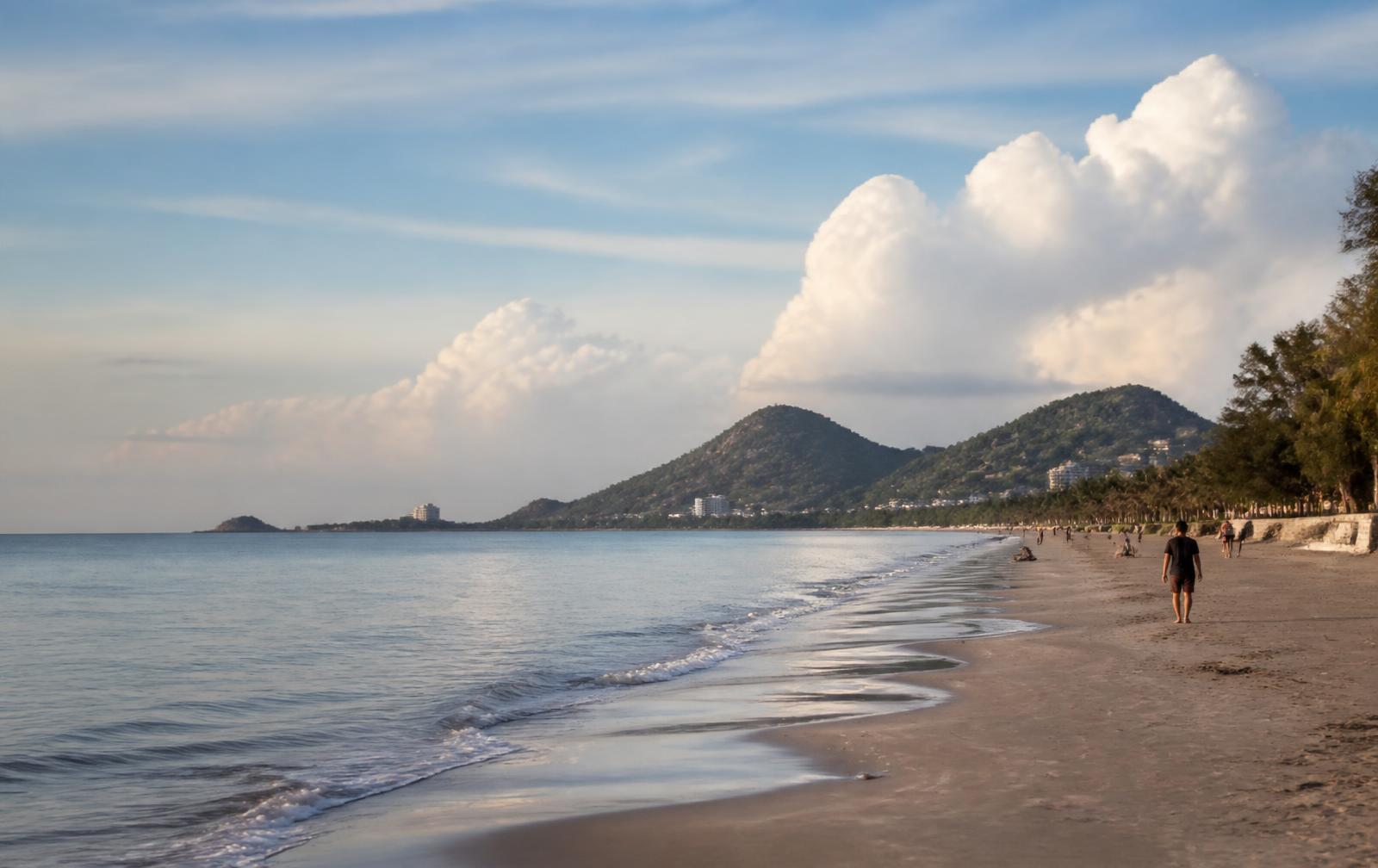
Hua Hin climate in 30 seconds
- Climate
- Tropical, coastal
- Warmest month
- April
- Most comfortable
- December to February
- Wettest months
- September and October
- Annual rainfall
- About 1,200 mm
- Outdoor life
- Year-round
Gulf of Thailand, on the western shore
Average high around 34°C
Driest, least humid, breeziest
Around 190–215 mm each
Modest for coastal Thailand
Timing matters more than the month
The year at a glance
Twelve months of long-term averages in one view. Warmer colour means a higher average daily high; the grey bar shows monthly rainfall.
Colour intensity shows average daily high in °C; the grey bar shows average monthly rainfall in mm. Select a month for detail.
January
- Average high
- 30°C
- Average low
- 22°C
- Rainfall
- 20 mm
- Wet days (5 mm+)
- 1
- Humidity
- 67%
- Wind (daily max)
- 14 km/h
The easiest month of the year for outdoor life. Mornings can feel genuinely fresh by tropical standards, the sea breeze keeps the coast moving, and rain is rare enough that plans hold. Afternoons are still warm in direct sun, but shade works. Golf, running and long walks all fit comfortably into the day rather than being squeezed into dawn.
Hua Hin month by month
Select a month for the long-term figures and what they mean in practice.
January
What January feels like
The easiest month of the year for outdoor life. Mornings can feel genuinely fresh by tropical standards, the sea breeze keeps the coast moving, and rain is rare enough that plans hold. Afternoons are still warm in direct sun, but shade works. Golf, running and long walks all fit comfortably into the day rather than being squeezed into dawn.
- Average high
- 30°C
- Average low
- 22°C
- Rainfall
- 20 mm
- Wet days (5 mm+)
- 1
- Humidity
- 67%
- Wind (daily max)
- 14 km/h
Heat, rain and outdoor comfort are Hua Hin Compass editorial ratings based on the long-term figures shown, not meteorological classifications.
Hua Hin climate data by month
| Month | Avg high | Avg low | Rainfall | Wet days (5 mm+) | Humidity | Wind (daily max) |
|---|---|---|---|---|---|---|
| January | 30°C | 22°C | 20 mm | 1 | 67% | 14 km/h |
| February | 32°C | 23°C | 17 mm | 1 | 68% | 14 km/h |
| March | 33°C | 25°C | 59 mm | 3 | 69% | 14 km/h |
| April | 34°C | 26°C | 76 mm | 5 | 69% | 13 km/h |
| May | 33°C | 26°C | 143 mm | 11 | 74% | 12 km/h |
| June | 32°C | 26°C | 112 mm | 8 | 75% | 14 km/h |
| July | 32°C | 25°C | 141 mm | 9 | 76% | 14 km/h |
| August | 31°C | 25°C | 144 mm | 9 | 77% | 14 km/h |
| September | 31°C | 25°C | 189 mm | 13 | 81% | 11 km/h |
| October | 29°C | 24°C | 214 mm | 13 | 84% | 10 km/h |
| November | 29°C | 24°C | 59 mm | 3 | 75% | 14 km/h |
| December | 29°C | 23°C | 16 mm | 1 | 66% | 16 km/h |
About the climate data
Figures on this page are 1991–2020 climate normals calculated for the Hua Hin coastline (12.57°N, 99.96°E) from the ERA5 reanalysis produced by the Copernicus Climate Change Service, accessed through the Open-Meteo historical archive. Temperatures are rounded to whole degrees and rainfall to whole millimetres, because the underlying datasets do not justify finer precision. “Wet days” counts days receiving 5 mm or more, which reflects rain you would notice rather than a trace. Thai Meteorological Department climate statistics for the same period were used as a cross-check on the annual pattern.
Long-term averages describe typical conditions. They do not predict any individual year, and no metric is published here that we could not source.
It is warm all year — but not equally comfortable
Average daily highs move between roughly 29°C and 34°C. That five-degree spread understates how differently the months feel.
Long-term monthly averages, 1991–2020 climate normals for the Hua Hin coastline. See the methodology note below.
The number that matters most is not the average, it is the afternoon. An average daily high of 34°C in April means most afternoons reach that level in full tropical sun, while the overnight low of around 26°C means the house never properly cools down between them. In December the same house loses heat overnight and starts the day fresh.
Mornings are where the difference is most obvious. A January walk at seven o'clock is genuinely pleasant. In April the same walk needs to happen earlier, or it becomes a different kind of activity. Near the seafront a steady breeze takes the edge off; a few kilometres inland, in a compound with little shade, the same afternoon feels considerably heavier.
Heat changes your schedule, not your plans
Most long-term residents drift towards the same rhythm without deciding to: exercise and errands before ten, indoor or shaded time through the middle of the day, and outdoor life again from late afternoon. Golfers book early tee times from March. Cyclists head out at first light. Nobody follows one universal timetable, but almost everyone ends up using the cooler ends of the day.
When does it actually rain?
About 1,200 mm falls in an average year — modest by Thai coastal standards — and it is concentrated firmly in the second half of the year.
Average monthly rainfall, millimetres.
Average monthly rainfall, 1991–2020 normals. December and February are the driest months; October is the wettest.
Two things stand out. First, the dry months really are dry: December, January and February each average under 25 mm, which is close to nothing. Second, the wet peak arrives late. September and October, not July and August, are the wettest months here, which catches out people who have holidayed elsewhere in Thailand.
A rainy day is also not what most Europeans picture. Rain in Hua Hin usually arrives as a defined episode — a heavy shower, a thunderstorm that clears within an hour, or a grey stretch of a few hours before the sky opens up again. Longer, steady rainfall does happen, particularly in October, but weeks of continuous drizzle are not part of the local pattern. Individual years vary a great deal, and a wet October in one year tells you very little about the next.
“Rainy season” is an oversimplification
Thailand does not have one rainfall pattern. Hua Hin sits on the western shore of the Gulf of Thailand, in the lee of the Tenasserim range along the Myanmar border, which shelters it from the full force of the southwest monsoon. Phuket, on the exposed Andaman side, receives several times as much rain over the same months. Koh Samui runs on a different rhythm again, with its wettest weather around November and December, when Hua Hin is drying out.
If your expectations were formed on another Thai coast, reset them here. The practical version: Hua Hin's wet season is real, but it is shorter and lighter than most of the country's.
What wet weather actually changes
Roads and drainage
Heavy falls can leave water standing on low-lying streets and underpasses for an hour or two. It usually clears quickly, but it changes how you plan a school run or an airport transfer during the wettest weeks.
Houses
Plot elevation relative to the road, roof drainage and the condition of gutters matter far more here than in a temperate climate. A property that looks fine in February can behave very differently in October.
Outdoor plans
Golf, cycling and beach days need a fallback rather than a cancellation. Most wet-season rain falls in defined episodes, so shifting an activity by a few hours often solves it.
Humidity indoors
Wardrobes, shoes, leather, camera gear and closed guest rooms all suffer if air never moves through them. Ventilation and occasional air-conditioning do most of the work.
The landscape
Inland Prachuap Khiri Khan turns green within weeks. Reservoirs fill, the hills behind town soften, and the countryside looks entirely different from the dry-season version most visitors see.
Humidity matters more when you live here
Average relative humidity runs from around 66% in December to around 84% in October. Visitors barely register the difference; residents live with it indoors.
Humidity is the part of the climate that turns into household maintenance. It makes 32°C feel heavier, it makes air-conditioning work harder, and above all it finds anywhere in your home that air does not reach. Wardrobes against an external wall, shoes in a closed cupboard, leather bags, camera equipment, guest bedrooms kept shut and bathrooms without extraction are the usual casualties.
This is also why properties left empty for the wet months so often greet their owners with a smell rather than a welcome. It is manageable, but it needs a small amount of deliberate attention rather than none at all.
Living comfortably with humidity
- Run air-conditioning periodically in rooms you rarely use — it dehumidifies as much as it cools
- Leave wardrobe and cupboard doors open when a property is empty for a few days
- Check bathrooms for extraction or an opening window before signing a lease
- Keep leather, camera equipment and documents in ventilated storage, not sealed boxes
- Inspect ceilings, skirting and wardrobe backs for existing mould before you rent
- A dehumidifier is worth it in a poorly ventilated condo, not in most airy houses
Sun, sea and windThree things that shape outdoor comfort as much as the temperature does.
Sunshine is only part of the story
The dry months are reliably bright; the wet months bring more cloud, which is part of why October's daytime temperatures sit below April's. Tropical UV is strong whenever the sun is out, including on hazy or overcast days, so hats, shade and sun protection are ordinary daily habits here rather than holiday precautions.
Is the sea warm all year?
Yes. This part of the Gulf stays warm enough for swimming in every month, and water temperature is rarely the deciding factor. Sea conditions are. Wind, chop, seasonal jellyfish and murkier water after heavy rain matter far more than the thermometer, and the calmest swimming days cluster in the dry months.
Wind changes the feel of the coast
Breeziest around November to February, when the northeast flow keeps the seafront comfortable even on warm afternoons, and lightest in September and October. That windier stretch is also why the kitesurfing scene concentrates in the cool season, and why an exposed fairway plays differently in January than in a still September.
Three ways the year feels different
Weather patterns transition gradually and individual years vary — treat these as periods, not dates.
Roughly late November to February
Cooler and drier
The period that sells Hua Hin. Rainfall is minimal, humidity drops to its lowest, and the northeast breeze keeps the coast moving.
- · Mornings and evenings are comfortable outdoors without planning around them
- · Golf, cycling and running work at almost any hour of the day
- · Air-conditioning use falls, and some homes barely need it overnight
- · It is also high season: busier restaurants, firmer rents and more traffic on Phetkasem
Roughly March to May
Hot
Temperatures peak in April, with average highs around 34°C and nights that no longer cool down much.
- · Midday outdoor activity becomes genuinely uncomfortable for most people
- · Electricity bills climb as air-conditioning runs for longer each day
- · Pools, shade and sea breeze do more for comfort than the thermometer suggests
- · The first convective storms arrive from March, usually short and late in the day
Roughly May to October, peaking September and October
Wetter and monsoon-influenced
Rainfall roughly triples compared with the dry months, though it tends to arrive in episodes rather than settling in for days.
- · September and October are the wettest months on long-term averages
- · Humidity peaks — mould, damp storage and slow-drying laundry become real household issues
- · Daytime temperatures are lower than in April, so it is often more bearable than expected
- · Drainage, plot elevation and roof condition show their true colours
Which months are best for you?
There is no single best time to be here. It depends on what you want the weather to do for you.
Outdoor life generally
December to February
Low rainfall, the lowest humidity of the year and a steady breeze. The only real trade-off is that everyone else has worked this out too.
Golf
November to February, then early mornings year-round
Cooler months make a full round comfortable at almost any tee time. From March onwards, early tee times matter more than the calendar month.
Beach and swimming
December to April
The sea is warm all year, so this is about wind and cloud rather than water temperature. Calmer, brighter conditions are more common in the dry months.
If you dislike extreme heat
Avoid late March to May
April is the peak. October also has lower daytime temperatures than most people expect, though the humidity is at its highest.
Quiet season
June to September
Cheaper accommodation, easier restaurant tables and a calmer beach. In exchange you accept more rain, more humidity and some venues running at low season pace.
House-hunting
See a shortlist in both September or October and in the dry season
The wet months expose drainage, damp and noise from rain on roofs. The dry months show you the light, the heat load and how a west-facing terrace really behaves.
The move itself
November to February, if you have the choice
Unpacking, shipping and setting up a home are all easier without daily storms or April heat. It is convenience rather than a rule — plenty of people arrive in July and are fine.
Air quality: how much should you worry?
Hua Hin is generally better placed than Thailand's northern and urban hotspots, but “coastal” does not mean “clean all year”.
Thailand's PM2.5 problem is strongly seasonal and strongly regional. The worst of it sits in the north — Chiang Mai and the upper provinces — during the burning season, typically February to April, and in Bangkok during still winter conditions when traffic emissions have nowhere to go. Hua Hin has neither the large-scale upland burning nor the urban density, and the sea breeze helps.
That said, readings here do rise during the dry season, when regional haze, agricultural burning and calm conditions coincide. Some days in the January to April window are noticeably hazier than the postcard version of the town. The honest position is that air quality is usually good and occasionally moderate, and that anyone with a respiratory condition should look at live readings rather than a general reassurance.
Check current air quality
Air4Thai is the Pollution Control Department's official monitoring network, with stations across Prachuap Khiri Khan province. Live readings are separate from the long-term climate figures on this page.
Open Air4ThaiFlooding: what residents should actually check
For most people this is a property question rather than a regional risk.
There is a difference between the large regional flooding that makes international news elsewhere in Thailand and what Hua Hin residents actually deal with. Here the common experience is localised: a heavy downpour overwhelming drains for an hour, water standing on a low-lying street, or a garden that does not drain because the plot sits below the road. Individual developments differ enormously, sometimes within the same neighbourhood.
That makes it a due-diligence issue. It is one of the few climate questions you can settle almost entirely before you sign anything.
Before renting or buying
- Ask the agent and the neighbours whether the street has flooded before
- Compare the plot level with the road and the surrounding land
- Look at where water leaves the garden, not just where it arrives
- Check ceilings, skirting boards and wardrobe backs for water marks or fresh paint
- Look at roof drainage, gutters and downpipes rather than only the roof itself
- If you can, walk the neighbourhood within a day of heavy rain
Your house experiences the climate tooThe building decisions that matter here are not the ones that matter in a temperate country.
Air-conditioning and zoning
Cooling the rooms you use, rather than the whole house, is the single biggest lever on running costs. Inverter units, closed doors and clean filters all help. Servicing matters more here than the manuals suggest.
Orientation and shade
West-facing glass turns a living room into an oven by four o'clock. Roof overhangs, mature trees and a shaded terrace change how usable a property is from March to May. View a house at the hour you would actually be in it.
Ventilation and moisture
Cross-ventilation, bathroom extraction and airflow behind wardrobes prevent most damp problems. A condo with one aspect and sealed windows needs more active management than an airy house.
Outdoors and coastal exposure
Pools, gardens and outdoor furniture all need year-round attention, and salt air close to the sea is hard on metal fittings, air-conditioning units and hinges. Budget for maintenance rather than treating it as an occasional surprise.
The climate changes when you do things, not whether you canGolf, running, cycling, padel, hiking and the beach all work twelve months a year. The hour is what moves.
In the cool months, almost any tee time or ride works. From March the calculation changes: an eight o'clock round is comfortable, a one o'clock round in April is an endurance event. Cyclists and runners shift to first light, walkers to the seafront in the late afternoon when the breeze comes in. In the wet months the question becomes the sky rather than the heat, and most people simply keep an eye on the radar and stay flexible.
This is the part newcomers most often get wrong. They assume some months are written off. In reality it is the middle of the day that gets written off, and only for part of the year.
Climate with children
School runs land at two of the hotter parts of the day, so an air-conditioned car and window shades stop being a luxury. Sport moves to early morning or late afternoon; pools carry much of the load in April and May. Sun protection becomes a daily routine rather than a beach-day one, and families quickly build a mental list of indoor options for the wet-season afternoons when the sky closes in.
What do people actually wear?
Everyday clothing here is chosen for heat, humidity and strongly air-conditioned interiors, in that order: lightweight breathable fabrics, sandals or shoes that cope with a sudden downpour, a hat, and a light layer for restaurants and cinemas that treat 21°C as a target. A compact umbrella and a light rain layer earn their space from May onwards. Almost everything else can be bought locally.
How Hua Hin's climate comparesThailand does not have one climate. If you are choosing between places, the differences are larger than the map suggests.
| Place | Heat | Rainfall pattern | Humidity | Worth knowing |
|---|---|---|---|---|
| Hua Hin | Hot, peaking April | Modest, around 1,200 mm; wettest September–October | High, peaking in the wet months | Sheltered west-coast Gulf position, steady sea breeze, short dry-season haze episodes |
| Bangkok | Hotter, less coastal relief | Higher than Hua Hin; wettest around September | High year-round | Urban heat and traffic pollution; no sea breeze to soften afternoons |
| Chiang Mai | Cooler nights in winter, very hot April | Concentrated May–September | Lower in the cool season | Well-documented burning-season air quality problems, typically February–April |
| Phuket | Steady, less seasonal variation | Far higher; long southwest monsoon May–October | High year-round | Andaman coast, exposed to the southwest monsoon and heavier swell |
| Koh Samui | Steady year-round | Different rhythm — wettest around November–December | High year-round | East-coast Gulf island; its wet season barely overlaps with Hua Hin's |
Qualitative comparison based on published national climate statistics. We do not score destinations against each other.
Climate myths worth forgetting
“Rainy season means it rains all day”
Even in October, the wettest month, meaningful rain falls on roughly thirteen days. Most of it comes in episodes, and long bright spells between them are normal.
“Thailand is equally hot all year”
Average highs in Hua Hin range from about 29°C in December to about 34°C in April, and humidity swings from the high sixties to the mid eighties. That is a much bigger difference than the numbers suggest.
“December is cool”
Cool by Thai standards. Average highs are still around 29°C. What changes is the humidity, the breeze and how much the nights drop.
“The weather is the same everywhere in Thailand”
Hua Hin receives roughly a third of Phuket's annual rainfall and sits in the shelter of the Tenasserim range. Regional patterns differ enormously.
“Average temperature tells you how comfortable it will feel”
Humidity, direct sun, shade and wind change perceived comfort more than a degree or two on the thermometer.
What the climate means if you are moving to Hua HinSix conclusions that follow from everything above.
You will reorganise your day
Most long-term residents end up doing anything strenuous before ten and after five. Nobody decides this deliberately; it happens within the first hot season.
Shade matters more than newcomers expect
A shaded terrace, a roof overhang or mature trees change a property more than an extra bedroom does. Orientation is worth checking at the time of day you would actually use the space.
The cheapest house to rent is not always the cheapest to live in
High ceilings, single glazing, west-facing glass and a large pool all add to the monthly running cost. Ask about typical electricity bills before signing.
Drainage belongs on your viewing checklist
Plot elevation, gutters and where water leaves the garden are easy to check and expensive to ignore.
Humidity is a household issue, not just a weather statistic
Ventilation, occasional air-conditioning and open wardrobes prevent most of the mould problems people complain about.
Weather changes the timing, rarely the plan
Golf, cycling, the beach and eating outdoors all remain available twelve months a year. What changes is the hour, not whether it happens.
So, is Hua Hin's climate comfortable?
That depends largely on your tolerance for tropical heat. Hua Hin never becomes cool in the European sense, April genuinely takes some adjustment, and the wet months ask more of your house than most people expect. But the coastal air, the relatively modest rainfall by Thai standards and the ability to shift outdoor life towards mornings and evenings make it workable for a great many long-term residents.
The biggest adjustment is usually not learning to live with bad weather. It is learning to organise ordinary life around tropical weather — and that takes about one hot season.
Climate is not today's weather
Everything on this page describes long-term averages over 1991–2020. Individual years vary: unusually wet Octobers, dry Septembers and hot Februaries all happen. Climate normals are a baseline for planning, not a forecast, and they should never be read as a prediction of the week you happen to arrive.
Averages also shift. Baselines calculated from more recent decades run warmer than older ones, and regional assessments for Thailand and the Gulf point towards continued warming and more variable rainfall. We rebuild these figures when a new normal period is published.
Data and sources
Thai Meteorological Department
Copernicus Climate Change Service — ERA5 reanalysis
Open-Meteo historical weather archive
Air4Thai — Pollution Control Department
Hua Hin Compass verified
Last verified
August 2026
Next scheduled review
August 2027
Sources checked
- · Thai Meteorological Department
- · Copernicus Climate Change Service — ERA5 reanalysis
- · Open-Meteo historical weather archive
- · Air4Thai — Pollution Control Department
Climate normal period: 1991–2020. Where a metric could not be sourced reliably for Hua Hin — monthly sea temperature and sunshine hours among them — we describe it qualitatively rather than publishing a number.
Common questions
What is the best time of year to be in Hua Hin?
For comfort, December to February: rainfall is minimal, humidity is at its lowest and a steady breeze keeps the coast pleasant. It is also the busiest and most expensive period, so June to September suits anyone who prefers a quieter town and can work around more rain.
Does Hua Hin have a rainy season?
It has a wetter period, roughly May to October, peaking in September and October. Even then, meaningful rain falls on around thirteen days a month and usually arrives in episodes rather than lasting all day. Annual rainfall of about 1,200 mm is modest for coastal Thailand.
How hot does Hua Hin get?
April is the hottest month, with average daily highs around 34°C and nights that stay near 26°C. December is the mildest, with average highs around 29°C. Humidity and shade change how those figures feel more than a degree or two does.
Is Hua Hin's climate the same as Phuket's?
No. Hua Hin sits on the western shore of the Gulf of Thailand, sheltered by the Tenasserim range, and receives roughly a third of Phuket's annual rainfall. Koh Samui's wettest months barely overlap with Hua Hin's at all.
Is mould a problem in Hua Hin homes?
It can be in the wet months, when average humidity reaches the mid eighties. Ventilation, occasional air-conditioning in unused rooms and open wardrobes prevent most problems. Check bathrooms, wardrobe backs and skirting for existing damp before signing a lease.
Where to go next
Explore everyday life
Choose where to live
Understand your budget
Planning the move?