
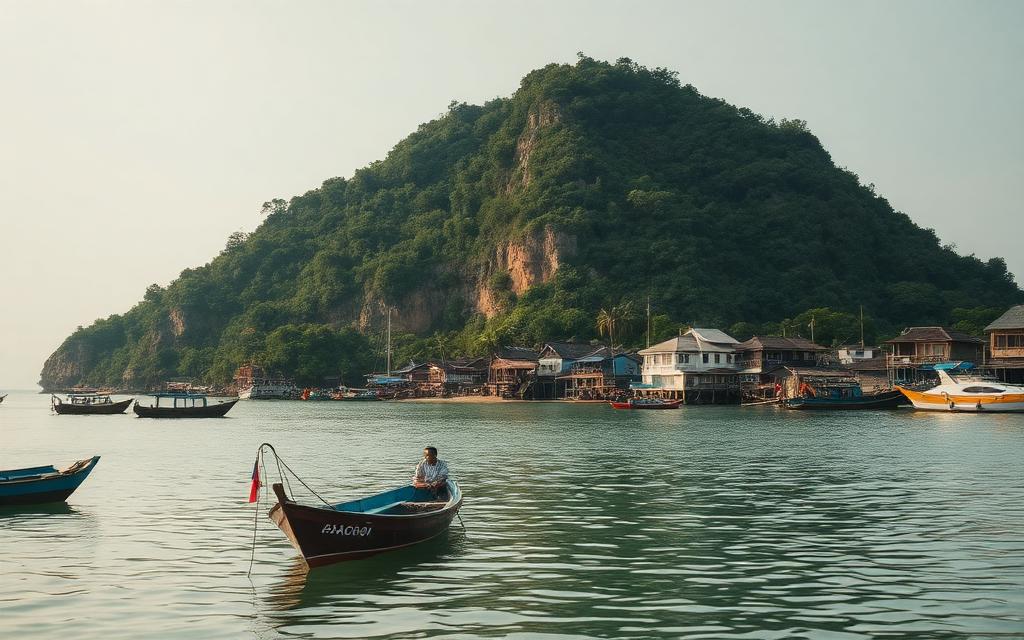
Khao Takiab
Beach living at the southern headland, quieter than the centre but still close enough that town never feels far away.
- Last verified
- Last verified: August 2026
- Next review:
- February 2027
- Reading time:
- 8 min
The short verdict
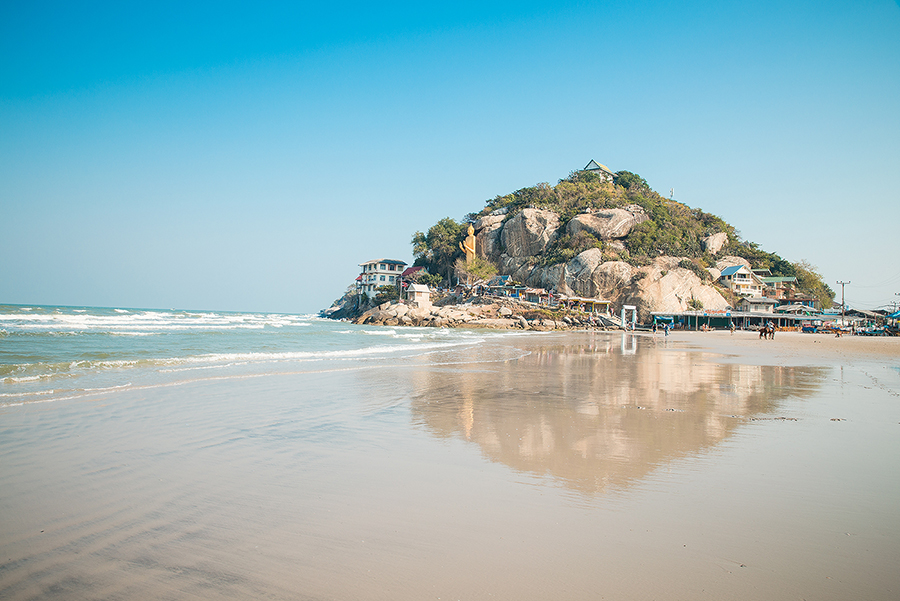
Khao Takiab is where a lot of long-stay residents end up when they want the beach to be part of ordinary life rather than a weekend trip. The headland with its temple closes off the southern end of Hua Hin's bay, and the strip of road behind the sand carries condo buildings, small restaurants and seafood places rather than hotels and nightlife.
Daily life is calmer than the centre and noticeably cheaper for the same amount of space, but it is not remote: central Hua Hin is a short drive up the coast road, and the shopping centres sit roughly halfway between.
The catch is that convenience drops off quickly as you move inland from the beach road. A condo two hundred metres from the sand and a house a kilometre behind it are very different propositions, and only one of them works without a vehicle.
How we define this area
For comparison purposes, Hua Hin Compass treats Khao Takiab as the beach and headland area around the temple hill and Takiab Road, with Nong Kae to the north and Suan Son to the south.
At a glance
Khao Takiab in summary
- Best for
- Beach routine, long-stay residents, retirees
- Less suited to
- Nightlife, families needing school proximity
- Area character
- Residential seaside, low-rise and low-key
- Typical housing
- Condos near the beach, houses inland
- Beach access
- Direct — the reason most people move here
- Walkability
- Good along the beach road, poor inland
- Car needed?
- Not always, but strongly recommended inland
- To the centre
- Around 6 km, roughly 15 minutes by road
- Families
- Possible, though school runs mean driving
- Retirement
- One of the most popular choices in Hua Hin
Comparison scores used by Neighbourhood Compass
- Families
- 6/10
- Retirement
- 9/10
- Nightlife
- 4/10
- Walkability
- 6/10
- Transportation
- 6/10
- Shopping
- 6/10
- Schools
- 5/10
These scores exist so areas can be ranked against each other in Neighbourhood Compass. They are relative, not measurements — the sections below explain what sits behind them.
What living here actually feels like
The day starts on the sand. Walkers, swimmers and a few horses use the beach early, the coffee places open, and the road behind is quiet enough to cross without thinking about it.
Middays are hot and slow. The area empties out — people are indoors, at the pool or in town — and the restaurants that stay busy are the ones with regulars rather than the ones with sea views.
Evenings are domestic. Seafood restaurants near the temple fill up, a handful of bars stay open, and the noise stops early. This is not a nightlife address, and residents who want a late evening drive into the centre or to the weekend markets nearby.
Weekends and Thai public holidays are the exception: the beach and the temple hill draw day visitors, and parking near the pier and the market gets tight. It resets by Monday morning.
Where within the area?
Whether Khao Takiab works for you depends almost entirely on how far back from the sand you end up.
The beach road
Condos and small restaurants with direct access to the sand. The most walkable option and the one that justifies the area's reputation, at the highest prices.
Around the temple and the pier
Seafood restaurants, the local market and the steps up the headland. Busiest at weekends, and where the monkeys are most active.
Inland towards Phetkasem
Houses, older Thai streets and quieter developments. More space and lower rents, but car-dependent and further from anything walkable.
South towards Suan Son
A quieter, greener stretch of coast with a mix of condos and resorts, still within easy reach of the shopping centres.
Who this area suits
Retirees and long-stay residents
A predictable, walkable daily routine around the beach, with condo living that needs little maintenance and a lower cost base than the centre.
People who want the sea in daily life
Swimming or walking before breakfast is realistic here in a way it is not from inland areas, and the beach is wide and usable most of the year.
Couples testing a longer stay
Condo turnover is high and furnished units on six- or twelve-month leases are common, so it is an easy place to try Hua Hin before committing to a house.
Budget-conscious households
For the same money you generally get more space, or a better building, than in the centre — particularly a street or two back from the sea.
Think twice if…
- You want restaurants, bars and services on your doorstep after dark. The choice here is small and closes early compared with the centre.
- Your children attend an international school. Most campuses are inland or south-west, so expect a daily drive.
- You are considering a house set back from the beach without a vehicle. Inland Khao Takiab has few pavements and long, hot walks.
- You are sensitive to the monkeys around the temple hill. They are part of life here and the streets nearest the headland need food, bins and balconies handled carefully.
- You expect the whole area to feel beachfront. Older inland streets are ordinary Thai residential roads and can flood in heavy rain.
Housing and what you tend to find
Condominiums dominate the coastal strip, from small older blocks to larger developments with pools and gyms. Sea-facing units are the premium; the same building's rear-facing units are usually much cheaper.
Move inland and the stock changes to standalone houses, small gated projects and older Thai homes on larger plots. That is where the space is, but also where the car becomes non-negotiable.
Beachfront condos
Direct access to the sand and a short walk to restaurants. Check building age, maintenance charges and how the sea air has been treated in older blocks.
Second-line condos
A street or two back, usually noticeably cheaper for a similar unit, still walkable to the beach.
Houses and small gated projects inland
Garden, parking and more rooms for the money, at the cost of walkability. Ask about drainage and access roads.
Older Thai housing
The cheapest way to live here, generally unfurnished, with fewer international-standard fittings and rarely marketed in English.
Indicative rents
Listings in this area commonly sit around ฿10,000 – ฿35,000 a month for long-term rentals. Proximity to the sand and whether a unit faces the sea are the two biggest price drivers; distance inland does more for your budget than negotiating does.
Rental prices vary substantially by property type, condition, location and season. Figures are indicative rather than quotations.
Daily life
Groceries
Small local markets and convenience stores cover the daily basics near the beach, with the supermarkets at Market Village and BluPort a short drive north for a full weekly shop.
Food
Mostly Thai and seafood, with a modest international layer aimed at long-stay residents. For breadth of choice, people drive into town or to the weekend markets nearby.
Healthcare
Clinics and pharmacies handle everyday problems locally; hospitals — Hua Hin Hospital, Bangkok Hospital Hua Hin and San Paulo — are all in or just north of town, a manageable but real drive.
Schools
There are Thai schools nearby, but international and bilingual campuses are inland and south-west, so families here build their week around a school run.
Everyday services
Banks, larger pharmacies and most administrative errands mean a trip towards the shopping centres or the centre of town.
Remote work
Fibre is common in newer condo buildings. Café options for working outside the home are limited compared with the centre.
Can you live here without a car?
Possible, depending on the exact street
If you live on or just behind the beach road, you can cover food, coffee, the beach and a small supermarket on foot, and use songthaews along the coast road or Grab for trips into town. Plenty of residents manage with a scooter and nothing else.
Inland it is a different area. Distances stretch, pavements disappear and the heat makes even a fifteen-minute walk unappealing for most of the year. A car or motorbike becomes the default.
Either way, expect to drive or ride for hospital appointments, the larger supermarkets, school runs and anything in central Hua Hin.
Travel times are approximate and vary with traffic and your exact starting point. See the transport guide and Thai driving licence guide.
Beach life
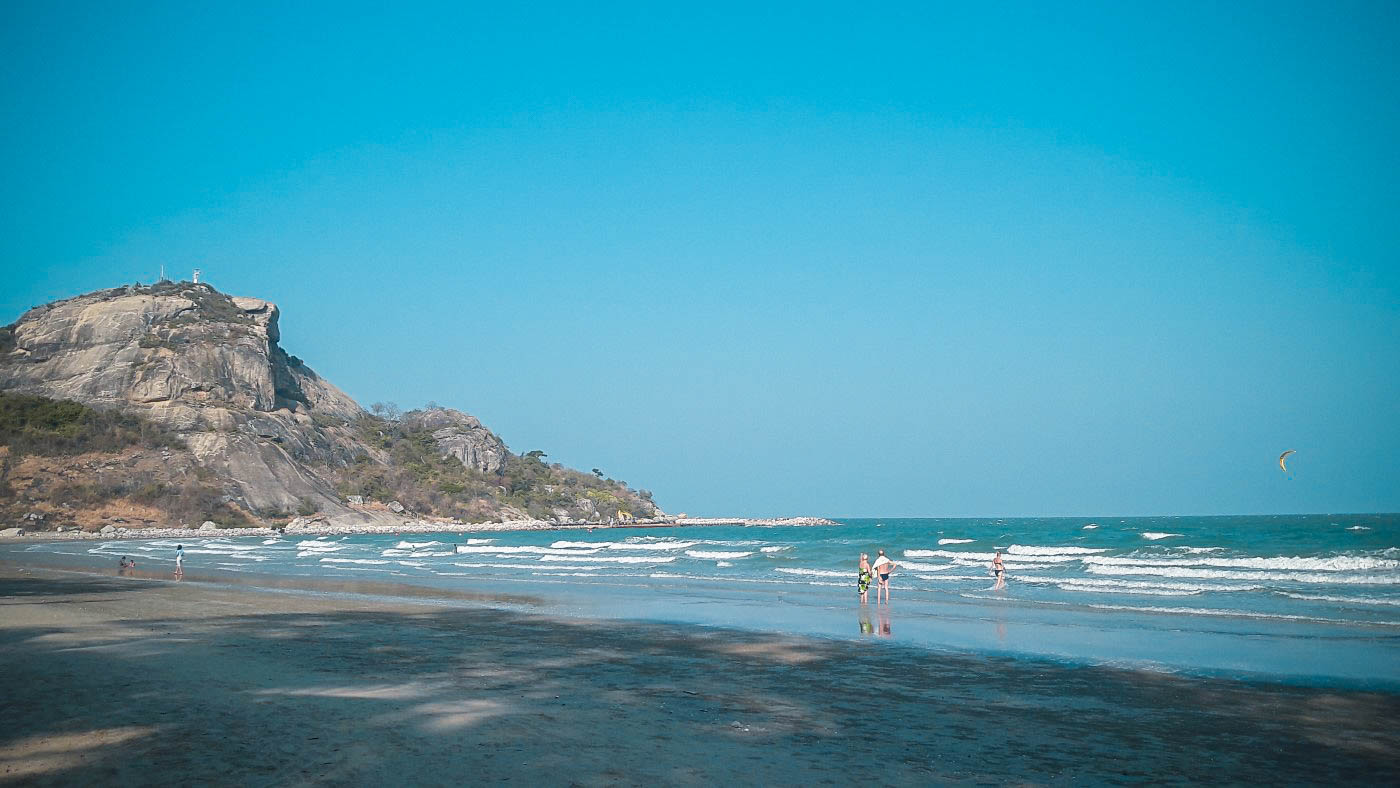
This is one of the few Hua Hin addresses where the beach genuinely shapes the day. The sand is wide, the water is calmer than at the northern end of the bay, and the headland gives the whole stretch a defined edge.
The section nearest the temple and the pier is the busiest, with boats, restaurants and weekend visitors. Walk north and it quickly becomes quiet, particularly midweek.
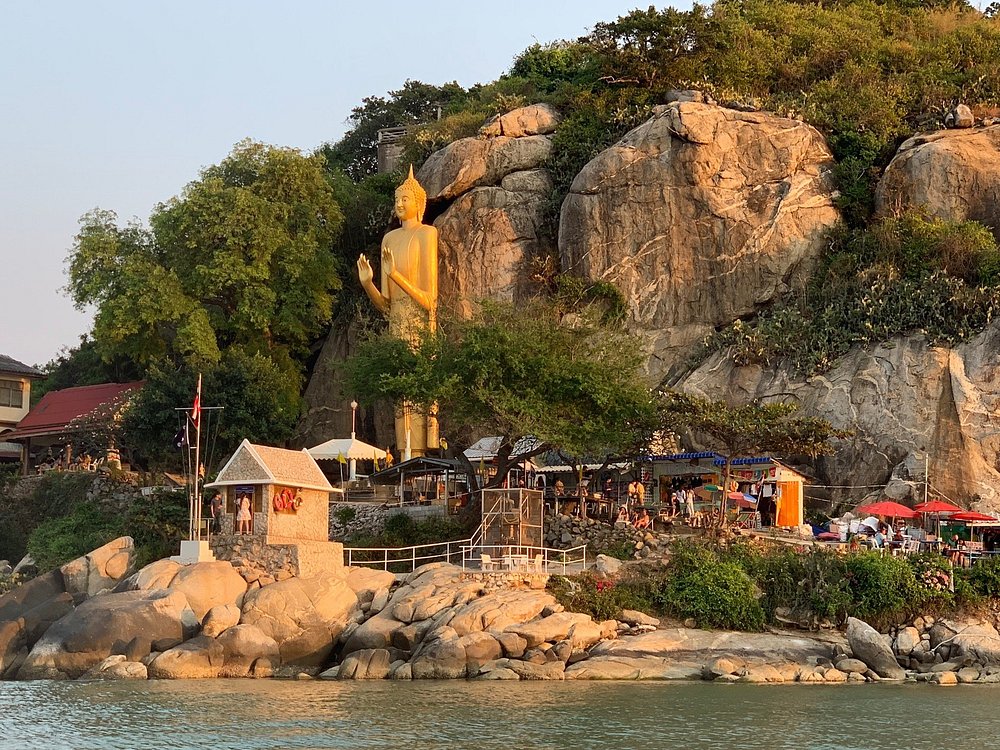
The standing Buddha and the temple on the hill are a fixed part of the view and a regular walk for residents. The macaques on the headland are also part of the deal: don't carry visible food, and keep balconies closed on the streets nearest the hill.
Community and social life
Social life here is loose and beach-shaped: the same faces on the morning walk, a regular restaurant, a pool in the building. It is a comfortable place to be quietly settled and a slower place to build a wide circle from scratch.
There is a long-established international presence, weighted towards retirees and seasonal residents, but organised group life — sports clubs, charity work, golf societies — mostly happens in town or in the inland villa areas, which means driving to it.
What becomes part of life hereNot a list of attractions — the places residents actually end up using.
Khao Takiab Beach
The wide beach immediately north of the Khao Takiab headland.
The reason people choose the area: swimmable, walkable and quiet outside weekends.
Read moreWat Khao Takiab
The temple complex on the headland, with steps up to viewpoints over the bay.
A short, steep walk that many residents do regularly — and the home of the monkeys the area is known for.
The seafood cluster by the pier
Small restaurants and stalls at the foot of the headland.
The default evening out for residents who don't want to drive into town.
Suan Son Pradipat
A shaded, pine-backed beach directly south of Khao Takiab.
The quieter alternative when the main beach fills at weekends.
Read moreCicada and Tamarind markets
Weekend art, food and music markets a few minutes north.
The main weekend routine here, and a rare late-evening option that doesn't need a trip into the centre.
Market Village and BluPort
The town's two shopping centres, roughly midway to the centre.
Supermarkets, cinema and services — the weekly stock-up run for most households in the area.
Where it is
An approximate living area rather than an administrative boundary.
How it compares
The areas people usually weigh against this one.
Versus Nong Kae
Better everyday convenience and closer to the shopping centres and hospitals, but the beach stops being something you walk to from most streets.
Nong Kae guideVersus Hua Hin Centre
Far more restaurants, services and evening life within walking distance, in exchange for noise, crowds and less space for the money.
Hua Hin Centre guideVersus Pak Nam Pran
Quieter still, with more space and a stronger nature setting, but far enough south that every hospital visit or big shop becomes a planned trip.
Pak Nam Pran guideNot sure which of these fits your household? Answer nine questions and see how they rank for you.
Compare this area in Neighbourhood CompassBefore signing a lease here
Questions people ask about living here
Is Khao Takiab a good place to live?
How far is Khao Takiab from central Hua Hin?
Can you live in Khao Takiab without a car?
Are the monkeys a problem for residents?
Is Khao Takiab cheaper than central Hua Hin?
Is it suitable for families?
Hua Hin Compass verified
Last verified
August 2026
Next scheduled review
February 2027
Sources checked
- · Hua Hin Compass area visits and photography
- · Hua Hin Compass beaches guide research
- · Hospital and shopping-centre websites
- · Current rental listings across major Hua Hin agencies
Local business and price information on this page is reviewed roughly every six months; geographic and character descriptions annually.
Where to go next
Compare areas
Housing and cost
Family and health
Everyday life