Moving · Visas & residency

Thailand Retirement Visas: Non-O and O-A Explained

For people aged 50 and over who want to settle in Thailand long term, and who would rather understand the annual routine before they commit to it.

Thailand has no single document called a retirement visa. What people mean by the term is one of two routes: a Non-Immigrant O-A Long Stay visa arranged in your home country, or a Non-Immigrant O visa followed by annual extensions of stay granted here for retirement purposes. Both lead to roughly the same life in Hua Hin. They differ in where the paperwork happens and how much of it there is.

The part that surprises most newcomers is that retirement in Thailand is an annual arrangement. You are not granted residency. You are granted another year, one year at a time.

Last verified
Last verified: August 2026
Next review:
November 2026
Reading time:
17 min
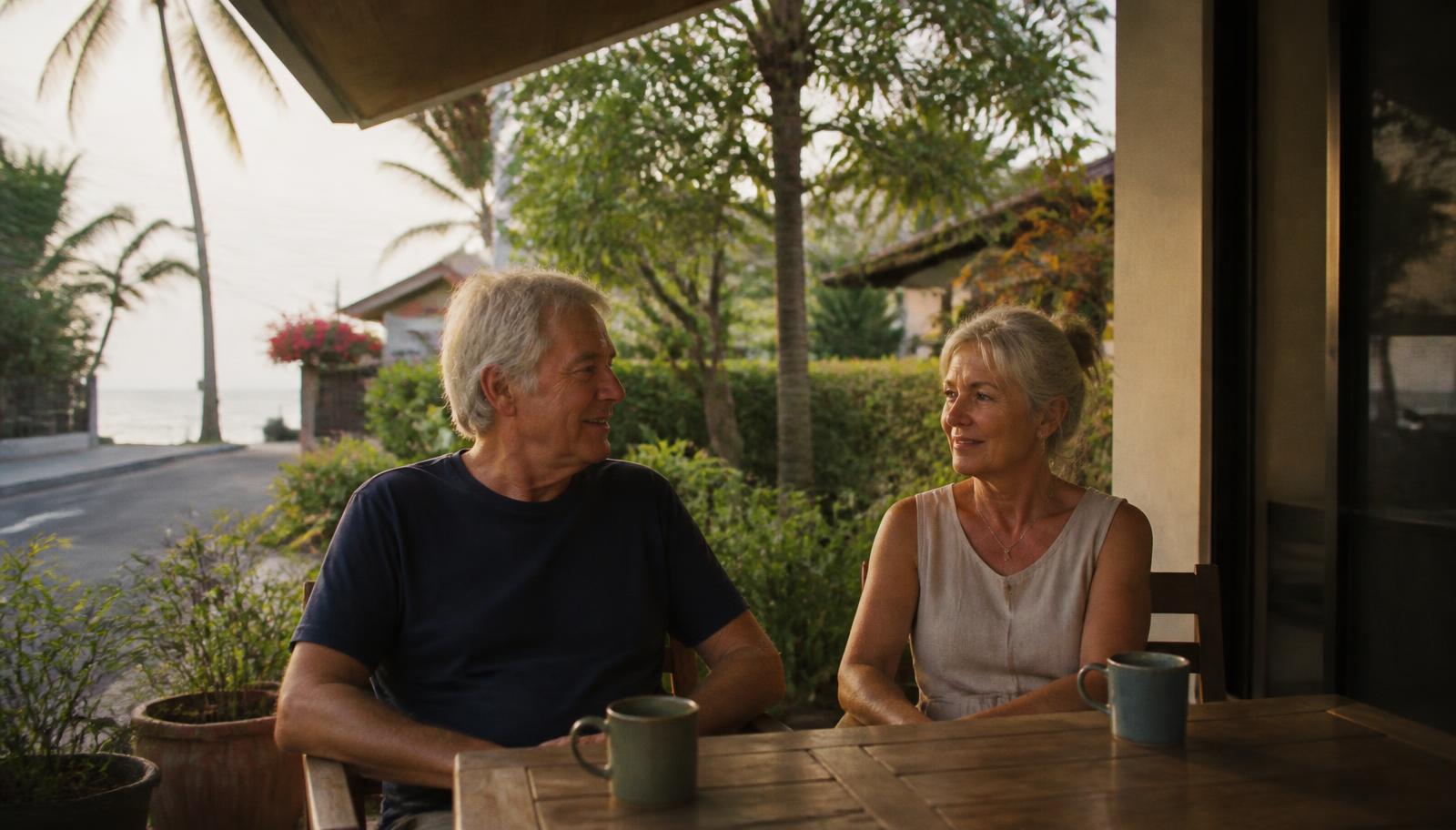
A retired couple sitting on the shaded terrace of a Hua Hin home in the late afternoon

National rules, local checklists

The financial thresholds and the age requirement are set nationally. The documents you must produce, the forms, the photocopy conventions and the exact day counts applied to your bank balance are handled by the Immigration Office or Thai mission processing your case, and practice does vary. Confirm the current requirements with them before you move money or book flights.

This is general relocation information, not immigration, legal or tax advice, and no guide can promise that an application will be approved.

Last checked: August 2026

Retirement visa in 30 seconds

Thailand retirement routes at a glance

Minimum age
50
Two main routes
Non-Immigrant O plus extensions, or O-A Long Stay
Where you apply
O-A abroad; Non-O extensions in Thailand
Renewal cycle
Annual extension of stay
Money test
800,000 THB in a Thai bank, 65,000 THB monthly income, or a combination
Insurance
Required on the O-A route; check the current minimum
Working
Not permitted on retirement grounds
Ongoing admin
90-day reporting, TM30, re-entry permits

One number does most of the work

Almost every retirement application turns on the same question: can you evidence either 800,000 THB in a Thai account or a qualifying monthly income. Everything else is procedure around that answer.

Visa, permission to stay, extension

Three words that get used interchangeably and mean quite different things.

How the pieces fit together

  1. 1

    The visa

    Issued by a Thai embassy, consulate or the e-Visa system. It gives you the right to travel to Thailand and ask to be admitted.

  2. 2

    Permission to stay

    Granted by the immigration officer at the airport, stamped in your passport. This is the date that actually governs how long you may remain.

  3. 3

    The extension of stay

    Applied for inside Thailand, at your local Immigration Office, usually in the final month before your permitted stay expires. Granted for one year at a time on retirement grounds.

This is why two retirees who describe themselves as having the same visa can be on completely different timetables. The visa in the passport is the start of the story, not the whole of it.

Non-O versus O-A

The practical differences that matter once you are living here, not the ones that look impressive on a comparison table.

Non-Immigrant O, then annual extensions

  • Lighter document file at the outset — no police clearance or medical certificate at the consular stage
  • No consular insurance condition attached to the category itself
  • Depends on getting a Thai bank account open and seasoned before you can extend
  • Everything happens at your local Immigration Office, on Thai timetables
  • Suits people already in Thailand, or comfortable arranging the money here

Non-Immigrant O-A Long Stay

  • Arranged before you move, so you arrive with a long-stay category already granted
  • Heavier file: police clearance, medical certificate and qualifying health insurance
  • Financial evidence can be shown in your home country at the application stage
  • Still converges on the same annual extension routine once you are living here
  • Suits people who want the starting position settled before they leave

Which route fits your situation?

Read the line that sounds like you.

I want the simplest route to maintain once I live here

The Non-O route followed by annual retirement extensions is usually the one to investigate first. Fewer documents up front, but the maintenance work happens in Thailand every year.

I want a dedicated long-stay retirement visa arranged before I move

The O-A is worth comparing. It is issued in your home country and gives you a settled starting position, at the price of a heavier document file including police clearance, a medical certificate and qualifying insurance.

I am still working remotely

Retirement routes are not built around continuing to earn. Compare the DTV, and the LTR if your income is substantial.

Read the DTV guide

I think I qualify for LTR

Compare it properly before defaulting to retirement. LTR is harder to qualify for but its long-stay structure and reporting obligations work differently.

Compare LTR

I would rather pay for convenience than manage annual extensions

Thailand Privilege is a paid membership route. Expensive, but it removes much of the annual immigration routine.

Compare Thailand Privilege

I am under 50

The retirement routes on this page will not apply yet. Look at the family, work, study, DTV or Privilege categories instead.

Compare all routes

The financial requirement

Three accepted ways to show you can support yourself, and one recurring source of trouble.

For the annual retirement extension, Thai Immigration has long published three qualifying methods: a deposit of 800,000 THB held in a Thai bank account in your own name, a monthly income of 65,000 THB, or a combination of deposit and annual income that together reach 800,000 THB. The income method depends on evidence your own embassy or pension provider is willing to issue, and what counts as acceptable proof has changed over the years for several nationalities.

Treat these figures as the current published baseline rather than a permanent fixture. They have been stable for a long time, but the evidence rules around them are exactly the sort of detail that is tightened quietly at office level.

Whose account?

The qualifying deposit is normally expected to be in a Thai bank account in the applicant's own name. A joint account or a partner's account is not a safe assumption, and a couple where both partners qualify separately is treated as two applications, not one.

The 800,000 THB timing rule

The money question is not only how much, but for how long, and on which dates.

If you use the deposit method, the funds must sit in the account for a seasoning period before you apply, remain there for a further period after the extension is granted, and then not fall below the required level between renewals. In practice the account, not your calendar, sets the earliest date you can file.

The day counts applied to each of those stages are set out in immigration orders and are applied at office level, and they are the single most commonly misremembered detail in this whole process. Confirm them with the office handling your extension before you transfer anything, and keep the bank book updated so the balance history is easy to evidence.

Plan the transfer, not just the amount

People routinely arrive with the right money at the wrong time and lose months. If your extension is due in March, the transfer is a decision you take the previous year, not that spring.

Last checked: August 2026

Opening a Thai bank account

The quiet bottleneck of the whole Non-O route.

A retirement extension that depends on a Thai deposit cannot start until a Thai bank will open an account for you, and banks apply their own onboarding requirements independently of immigration. Branches differ, documentation expectations differ, and what worked for a neighbour last year is not a guarantee.

Give this step real time in your plan. It is also worth transferring in a way that leaves a clean record of funds arriving from abroad, since that history can matter later for both immigration and property transactions.

The annual extension, step by step

What the yearly routine actually looks like once you live here.

  1. 01

    Prepare the file

    Passport, photos, application form, address evidence, bank book and a bank letter dated close to the application.

  2. 02

    Apply before expiry

    Applications are normally made in the final weeks before your current permission to stay ends.

  3. 03

    Attend the office

    Hua Hin retirees deal with the local Prachuap Khiri Khan immigration service rather than Bangkok.

  4. 04

    Keep the balance

    The account is expected to stay above the required level after approval and between renewals.

What people usually forget

  • A bank letter dated within the window the office accepts
  • Updated bank book showing the full seasoning period
  • Proof of your Hua Hin address, in the form your office expects
  • TM30 filed for your current address
  • A re-entry permit before any trip abroad
  • Photocopies signed as the office requires

Re-entry permits

The mistake that costs people an entire year.

An extension of stay is tied to your presence in Thailand. Leaving the country without the appropriate re-entry permission ends it, and no amount of explaining at the airport on your way back will restore it. Single and multiple-entry permits are available, and the multiple version is usually the sensible choice for anyone who travels home once a year or takes regional trips.

Permits are obtained before you travel, normally at your local immigration office.

Single vs multiple, fees and what to check before booking

90-day reporting

Separate from your extension, on its own clock.

Anyone staying in Thailand on a long-stay permission must report their address every 90 days. The count restarts each time you re-enter the country, which is why people who travel often lose track of it. Reports can be made in person, by post, or online, and the online system has a reputation for being temperamental close to the deadline.

It is an address report, not a renewal. Filing it does not extend your stay, and missing it does not shorten your stay, but it does create a fine and a note on your record that is easier to avoid than to explain. Our 90-day reporting guide walks through the counting, the filing window and what to do when you are late.

TM30 and proof of address

Your landlord's obligation that quietly becomes your problem.

TM30 is the notification that a foreigner is staying at a particular address, filed by the property owner or manager. Most Hua Hin landlords and condo offices handle it routinely, but not all do, and immigration offices frequently want to see it when you apply for an extension, a re-entry permit or a residence certificate.

Ask about it when you sign a lease rather than the week before your extension. Re-filing is also needed after you move, and sometimes after longer trips away.

Health insurance

Compulsory on one route, sensible on both.

Thai missions have required qualifying health insurance for O-A applicants since 2019, and the minimum inpatient cover was raised in 2021. Policies generally have to come from an accepted insurer and be evidenced in the format the mission specifies. The domestic Non-O retirement extension has not carried the same consular insurance condition, which is one of the reasons people choose it.

That distinction is administrative, not medical. Private hospital care in Thailand is good and it is not cheap, and cover becomes both more expensive and more restricted the later in life you buy it. Retiring here without insurance is a decision about risk, not about paperwork.

Can you work on a retirement route?

Short answer: no.

Retirement extensions are granted on the basis that you are not working in Thailand. Paid work requires the appropriate visa category and a work permit, and the line Thai law draws around work is wider than most newcomers expect. Informal arrangements that look harmless — helping in a friend's business, taking local clients — sit on the wrong side of it.

If you intend to keep earning, even remotely, look at the DTV or the LTR before defaulting to retirement.

Retirement and Thai tax

Your visa category does not decide your tax position.

Tax residency in Thailand is a question of days, not documents. Spending 180 days or more in a Thai tax year makes you tax resident regardless of which visa you hold, and the treatment of foreign income remitted into Thailand has been the subject of significant reinterpretation in recent years.

Pensions add a further layer, because double taxation agreements treat different kinds of pension income differently depending on your home country. This is one of the few areas where paying for advice early is usually cheaper than not.

Read the tax residency section of the moving guide

Couples where only one partner is 50

Common in practice, and rarely explained clearly.

Where one partner qualifies on age and finances and the other does not, the younger partner is normally considered as a dependant rather than as a retiree in their own right. The dependant route is well established alongside the O-A visa. Whether it is available where the older partner holds a domestic retirement extension instead can depend on the mission or office you are dealing with, so it is worth asking directly rather than assuming.

Couples should also check whether the financial requirement is assessed once or per person on the arrangement they intend to use. Getting that wrong is an expensive way to discover the answer.

Retiring in Hua Hin specifically

Why the town suits this stage of life, and where it can frustrate.

Hua Hin has a long-established retired population, which shows in ordinary ways: an unusual concentration of private clinics and hospitals for a town of its size, golf within easy reach, walkable neighbourhoods, and a social scene that does not depend on nightlife. Bangkok's hospitals are a few hours away by road when something genuinely serious comes up.

The limitations are equally real. Public transport is thin, so most retirees end up driving; medical specialisms are more limited than in Bangkok; and the town is quieter in the low season than the brochures suggest. None of that is a reason not to retire here. It is a reason to spend a full season in town before signing anything long.

Mistakes people make

Almost all of them are timing mistakes rather than eligibility mistakes.

Confusing the visa with the extension

A visa gets you to Thailand. An extension of stay is a separate application made here, on its own timetable and with its own paperwork.

Moving the money too late

If your route depends on funds held in a Thai account, the account sets your earliest possible application date — not your diary.

Assuming every Immigration Office works identically

The national rules are the same everywhere. The documentary checklist, the forms and the queueing system are local matters.

Leaving Thailand without checking re-entry permission

Departing on an extension of stay without the appropriate re-entry permission can end that permission to stay.

Leaving banking until you arrive

Opening an account has become less predictable, and banks apply their own onboarding requirements. Do not assume it happens in week one.

Forgetting 90-day reporting

An annual extension does not replace address reporting. They are separate obligations with separate deadlines.

Assuming retirement status settles your tax position

It does not. Immigration status and tax residency are decided by different rules.

Treating insurance as optional because nobody asked for it

Whether immigration requires cover on your route and whether going without it is sensible are two different questions.

Compared with the other long-stay routes

Retirement is the default for the over-50s, but it is not always the best fit.

If you are still earning, the DTV usually deserves a look first. If your income and assets are substantial, the LTR offers a longer horizon and a lighter reporting routine. If you would rather pay to avoid the annual cycle altogether, Thailand Privilege exists and is priced accordingly. And if you have a Thai spouse, the family route is often simpler than either retirement option.

Questions people ask

Short answers. The detail sits in the sections above.

Is there such a thing as a Thai retirement visa?

Not as a single named product. In practice people mean one of two things: a Non-Immigrant O-A Long Stay visa obtained from a Thai embassy or consulate before moving, or a Non-Immigrant O visa followed by annual extensions of stay granted in Thailand for retirement purposes. Both are commonly described as retirement visas.

How old do I have to be?

Both routes are for applicants aged 50 and over. A younger spouse is normally considered separately, usually as a dependant rather than in their own right.

How much money do I need?

For the annual extension of stay, Thai Immigration has long published three qualifying methods: 800,000 THB held in a Thai bank account, a monthly income of 65,000 THB, or a combination of deposit and annual income reaching 800,000 THB. Confirm the current figures and evidence rules with the office handling your application before you move money.

Do I have to keep 800,000 THB in the bank all year?

Not the whole amount all year, but the account is not a one-day exercise either. Immigration applies a seasoning period before the application and a further period afterwards during which the balance must be maintained, and it expects the account not to fall below the required level between renewals. Check the exact day counts applied by your office before planning withdrawals.

Is health insurance compulsory?

For the O-A route, Thai missions have required qualifying health insurance since 2019, with a minimum inpatient cover that was raised in 2021. The domestic Non-O retirement extension has not carried the same consular insurance condition. Either way, going without cover at retirement age in Thailand is a financial risk rather than only an administrative one.

Can I work on a retirement visa?

No. Retirement routes are granted on the basis that you are not working in Thailand. Employment requires the appropriate visa category and a work permit. If you intend to keep earning, compare the DTV or the LTR instead.

Can my wife or husband come with me if they are under 50?

Usually as a dependant rather than as a retiree. The dependant route is well established for O-A holders; whether it is available where the older partner holds a domestic retirement extension can depend on the mission or office involved. Ask the specific embassy or Immigration Office before assuming.

Does retiring here make me a Thai tax resident?

Tax residency is decided by days present in Thailand, not by your visa category. Spending 180 days or more in a Thai tax year makes you tax resident, whatever route you are on. Take advice on your own position.

Can I do everything in Hua Hin, or do I have to go to Bangkok?

Annual extensions, re-entry permits and 90-day reporting are handled by the Prachuap Khiri Khan immigration service covering Hua Hin, so most retirees never deal with Bangkok. Services are split across locations and have moved before, so confirm which office handles your application before travelling.

Official sources and verification

Where to confirm anything on this page. If a source below contradicts this guide, the source is right.

Hua Hin Compass verified

Last verified

August 2026

Next scheduled review

November 2026

Sources checked

  • · Thai Ministry of Foreign Affairs
  • · Thailand Immigration Bureau
  • · Thai e-Visa
  • · Royal Thai Embassy, Brussels

Financial thresholds, insurance minimums, seasoning periods and office procedures can change. Where a figure is applied locally rather than published nationally, this guide points you to the office rather than quoting a number we cannot stand behind.

This guide is general relocation information, not immigration, legal or tax advice. It cannot confirm your eligibility, and no guide can promise an application will be approved. Confirm your own situation with the relevant Thai authority, the mission handling your application, or a qualified adviser.

Planning a retirement move to Hua Hin?

Add the bank timing, document preparation and extension dates to your own relocation plan.

Continue planning your move