Physical folder
- Originals that are difficult or slow to replace.
- One or two paper copies of the documents you will use repeatedly.
- A few passport photographs.
- Carried in hand luggage — never in the hold, never in a shipping container.
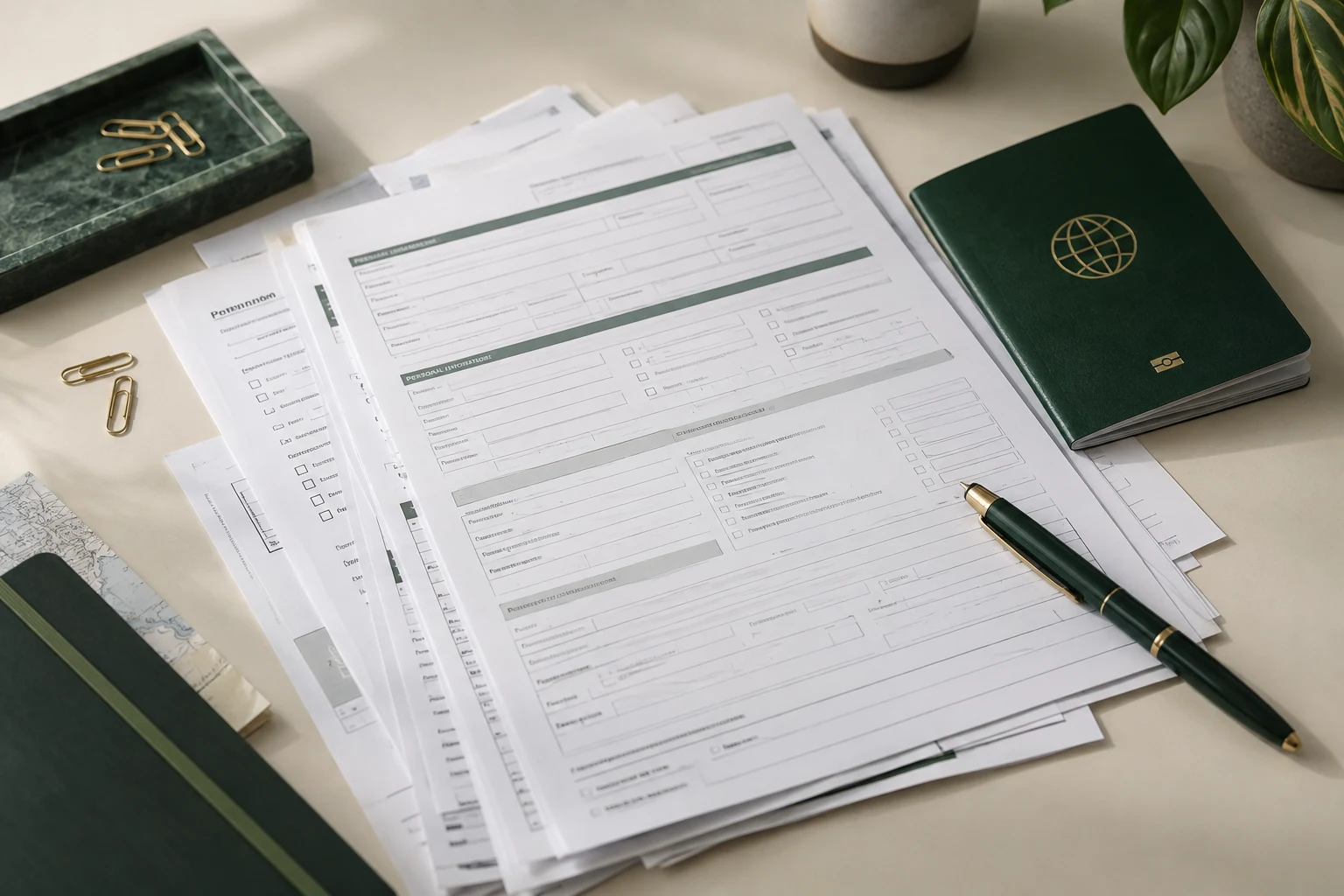
Collect records that are difficult to obtain from abroad, then check what your visa route and receiving authority actually require.
Quick answer
Prepare the documents that are slow to obtain from abroad, and scan everything else.
In practice that means civil-status records, school files, a medical summary, several years of financial statements and your driving paperwork. Everything else can usually wait until an authority actually asks for it.
Not everything on this page deserves the same attention.
Slow or awkward to obtain once you are living in Thailand.
Depends on your visa route, household, work or family situation.
Rarely demanded, but sensible to have within reach.
The labels appear beside every document below. If you only have one free afternoon before the move, spend it on the arrange before leaving group.
Filter by category, then work through what actually applies to your household.
| Document | Who may need it | Original | Digital copy | Legalisation | Translation | Priority |
|---|---|---|---|---|---|---|
| Passport | Everyone | Yes | Yes | No | No | Arrange before leaving |
| Passport photographs | Everyone | A few prints | Yes | No | No | Useful backup |
| Birth certificate | Anyone with children, a Thai family route, or a possible future civil-status matter | Usually | Yes | May be required | May be required | Arrange before leaving |
| Marriage certificate | Married couples, especially on a spouse-based route | Usually | Yes | May be required | May be required | Bring if relevant |
| Divorce decree or death certificate of a spouse | If applicable | If applicable | Yes | May be required | May be required | Bring if relevant |
| Name-change documentation | Anyone whose documents do not all carry the same name | If applicable | Yes | May be required | May be required | Bring if relevant |
| Police clearance certificate | Certain visa routes and some employers | If required | Yes | Check requirements | Check requirements | Bring if relevant |
| Supporting evidence for your visa route | Everyone applying for a long-stay route | Depends on authority | Yes | Depends on authority | Depends on authority | Arrange before leaving |
| Bank statements and account access | Everyone | No | Yes | No | No | Arrange before leaving |
| Proof of income or pension | Retirees and anyone on an income-based route | Usually | Yes | May be required | May be required | Bring if relevant |
| Tax records from your home country | Most people | No | Yes | No | No | Useful backup |
| Health insurance policy documents | Everyone | Copy is usually enough | Yes | No | No | Arrange before leaving |
| Medical summary from your doctor | Anyone with ongoing treatment | Usually | Yes | No | If not in English | Arrange before leaving |
| Prescriptions and medication names | Anyone taking regular medication | Usually | Yes | No | No | Arrange before leaving |
| Vaccination records | Families in particular | Usually | Yes | No | If not in English | Bring if relevant |
| School reports and transcripts | Families with school-age children | Usually | Yes | Check with the school | If not in English | Arrange before leaving |
| Leaving certificate or reference from the current school | Families with school-age children | Usually | Yes | Check with the school | If not in English | Bring if relevant |
| Custody or parental-authority documents | Separated or single parents | If applicable | Yes | May be required | May be required | Bring if relevant |
| National driving licence | Anyone who will drive | Yes | Yes | No | May be required | Arrange before leaving |
| International Driving Permit | Anyone driving on arrival | Yes | Yes | No | No | Arrange before leaving |
| Insurance no-claims history | Anyone insuring a vehicle here | No | Yes | No | No | Useful backup |
| Diplomas and professional qualifications | Anyone who may work, teach or open a business here | Usually | Yes | May be required | May be required | Bring if relevant |
| Employment references and CV history | Anyone likely to be employed in Thailand | No | Yes | Check requirements | Check requirements | Useful backup |
| Power of attorney for your home country | Anyone leaving property, a business or open admin behind | If applicable | Yes | May be required | No | Bring if relevant |
| Will and estate documents | Anyone with assets in more than one country | Usually | Yes | No | No | Useful backup |
| Home-country property and tenancy records | Owners and outgoing tenants | No | Yes | No | No | Useful backup |
| Pet vaccination and health records | Anyone moving with animals | Yes | Yes | Check requirements | Check requirements | Bring if relevant |
Everyone
Everyone
Anyone with children, a Thai family route, or a possible future civil-status matter
Married couples, especially on a spouse-based route
If applicable
Anyone whose documents do not all carry the same name
Certain visa routes and some employers
Everyone applying for a long-stay route
Everyone
Retirees and anyone on an income-based route
Most people
Everyone
Anyone with ongoing treatment
Anyone taking regular medication
Families in particular
Families with school-age children
Families with school-age children
Separated or single parents
Anyone who will drive
Anyone driving on arrival
Anyone insuring a vehicle here
Anyone who may work, teach or open a business here
Anyone likely to be employed in Thailand
Anyone leaving property, a business or open admin behind
Anyone with assets in more than one country
Owners and outgoing tenants
Anyone moving with animals
Where a cell says “may be required” or “check requirements”, the answer genuinely depends on the authority, the school or your nationality. We do not turn those into a yes.
Requirements vary — check before you certify anything
What a Thai authority, embassy, school or employer requires depends on your nationality, your visa route and the office in front of you. Confirm the exact requirement with the body that will receive the document, rather than certifying everything in advance. Hua Hin Compass provides general information, not legal or immigration advice.
Five words that get used interchangeably and mean quite different things.
An original is the document issued by the authority itself. Some offices want to see it, hand it back, and keep a copy; others accept a copy alone. Originals that are hard to replace — passports, certificates, diplomas — belong in your hand luggage.
A certified copy is a copy confirmed as a true likeness by a notary, solicitor, municipality or embassy, depending on your country. It is only worth arranging when the receiving party specifically asks for one.
A translation may be required when a document is not in English or Thai. Some authorities accept an English document as it stands; others want a Thai translation, and some want that translation certified.
Legalisation is the chain that makes a foreign document recognisable in Thailand. Thailand is not a party to the Apostille Convention, so an apostille alone is generally not the route: documents are usually authenticated in the issuing country, then through the Thai embassy or consulate, and often translated and submitted to the Thai Ministry of Foreign Affairs. The Department of Consular Affairs sets out how this works.
Every visa application, border crossing, bank counter and rental contract starts here. Visa rules commonly require a comfortable margin of remaining validity, so check the requirement for your route before you travel.
Typically relevant to: Everyone
Thai application forms still ask for physical photos. They are easy to have taken locally, so bring a few rather than a stack.
Typically relevant to: Everyone
Used for school enrolment, family-based immigration routes and civil registration. Ordering a recent copy from your home registry is far simpler before you leave.
Typically relevant to: Anyone with children, a Thai family route, or a possible future civil-status matter
Requested for family visa routes, some insurance and inheritance matters, and occasionally by landlords or schools.
Typically relevant to: Married couples, especially on a spouse-based route
Needed if you plan to marry in Thailand, and sometimes for pension, insurance or custody questions.
Typically relevant to: If applicable
Mismatched names between a passport, a diploma and a birth certificate cause more delays than almost anything else on this list.
Typically relevant to: Anyone whose documents do not all carry the same name
Names have to match
A diploma in a maiden name, a passport in a married name and a birth certificate in a third spelling will eventually collide at a counter. Carry whatever links them.
Which documents you need depends entirely on the route you choose, and those requirements change. The Thailand Visa Guide covers the routes in detail; this section is only about what to have prepared before you travel. If you have not settled on a route yet, the Visa Compass narrows the field in a few minutes.
Some long-stay and work-related routes ask for a criminal-record check from your home country. Requesting one from abroad is possible but slow.
Typically relevant to: Certain visa routes and some employers
Remote-work contracts, pension statements, proof of funds, employment letters or enrolment letters, depending entirely on the route you choose.
Typically relevant to: Everyone applying for a long-stay route
The awkward part of financial paperwork abroad is not producing it — it is reaching it. Home banks sometimes restrict logins from overseas, close accounts held by non-residents, or move older statements behind a request form. Download what you may need while everything still works normally.
Historical statements are painless to download while you still have full access, and awkward once a home bank flags an overseas login or closes a non-resident account.
Typically relevant to: Everyone
Pension award letters and income statements support visa applications and sometimes rental or insurance applications.
Typically relevant to: Retirees and anyone on an income-based route
Useful for residency questions, cross-border filings and any later conversation with an adviser. This is general information, not tax advice.
Typically relevant to: Most people
Hospitals in Thailand want to see cover and a policy number before treatment, not after. Some visa routes also require insurance meeting specific conditions.
Typically relevant to: Everyone
A short English-language summary of diagnoses, treatment history and current medication saves a great deal of guesswork at a new hospital.
Typically relevant to: Anyone with ongoing treatment
Brand names differ in Thailand. Record the generic name and dose, and keep a prescription with you for medication you carry in.
Typically relevant to: Anyone taking regular medication
Schools commonly ask for an immunisation history at enrolment, and reconstructing one from abroad is tedious.
Typically relevant to: Families in particular
Cover itself is a separate decision, and a consequential one — the health insurance guide works through the options and what they exclude.
Schools in Hua Hin set their own admission requirements, and they differ: some ask for two years of reports and an immunisation record, others add assessments, references or an interview. Ask each shortlisted school for its list before you request anything, then collect it while you still have a relationship with the current school.
Most international schools want to see recent reports, and some ask for records covering several years. Request them before you deregister.
Typically relevant to: Families with school-age children
Some schools ask for confirmation that a child left in good standing, along with any assessment or support reports.
Typically relevant to: Families with school-age children
Relevant when one parent relocates with a child, and sometimes requested for enrolment or travel consent.
Typically relevant to: Separated or single parents
Compare the options and their intake requirements in the schools section, or shortlist with the School Finder. The wider family picture — school timing, neighbourhood and the first term — is covered in moving with children.
Your home licence is the starting point for both an International Driving Permit and any later Thai licence application. Renew it before you leave if it expires soon.
Typically relevant to: Anyone who will drive
An IDP is issued only in the country of your licence, has a limited validity, and is only valid alongside the licence itself. Check the permit type your country issues and how long it lasts.
Typically relevant to: Anyone driving on arrival
Occasionally accepted by insurers as evidence of driving history. Worth downloading, not worth chasing.
Typically relevant to: Anyone insuring a vehicle here
An International Driving Permit is a translation of your licence, not a licence in its own right, and it is valid for a limited period only. It cannot be issued once you have left, so arrange it before departure if you intend to drive on arrival. Rules on how long a foreign licence or permit can be used, and what a Thai licence application requires, are set by the Department of Land Transport and are worth confirming at the time.
Some Thai administrative processes require locally issued proof of your Thai address after arrival. One common example is a residence certificate from immigration, which you can only obtain once you have an address here. Residence certificate in Hua Hin.
It is also worth keeping an additional government-issued ID from home, your tax identification details and recent financial records within reach. Banks and other institutions here may ask for them during post-arrival administration. Opening a Thai bank account in Hua Hin.
Work permit applications and employers commonly ask for degree certificates. Replacing a lost original from overseas is slow.
Typically relevant to: Anyone who may work, teach or open a business here
Some work permit files include evidence of relevant experience.
Typically relevant to: Anyone likely to be employed in Thailand
Lets someone you trust sign for you at home without an international courier round trip. Arrange it while you are still there.
Typically relevant to: Anyone leaving property, a business or open admin behind
A move abroad is a sensible moment to check that an existing will still does what you think it does.
Typically relevant to: Anyone with assets in more than one country
Mortgage statements, deeds and the final settlement of a tenancy are easier to collect before the move than after.
Typically relevant to: Owners and outgoing tenants
Import requirements are time-sensitive and tied to specific vaccination dates, so they are planned months out with a vet.
Typically relevant to: Anyone moving with animals
Two folders, one physical and one digital, cover almost every situation.
A short pass through the items that are hardest to fix from a distance.
For where each of these sits in the wider sequence, see the Complete Moving Guide or track them alongside everything else in the Moving Compass. For the non-document side of departure — banking, insurance overlap, post and contracts — see before you leave.
Official references used while checking the procedural points on this page.