
Cha-Am
A Thai beach town north of Hua Hin with a long shoreline, lower housing costs and a slower weekday rhythm — and a very different weekend.
- Last verified
- Last verified: August 2026
- Next review:
- February 2027
- Reading time:
- 8 min
The short verdict
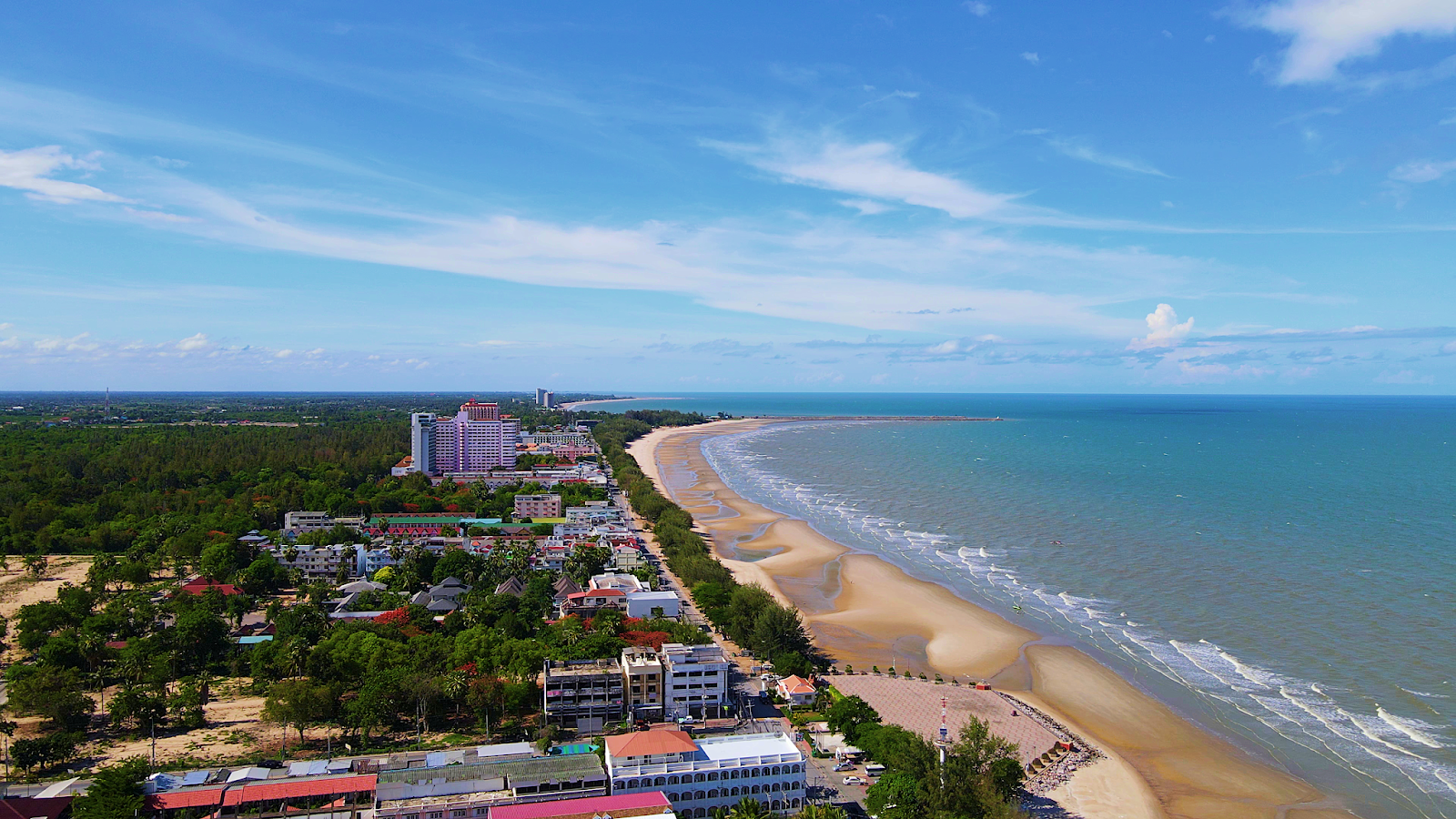
Cha-Am is its own town, not a suburb of Hua Hin. It sits in Phetchaburi province about twenty-five kilometres north, built along a long, straight beach with a beach road of seafood restaurants, deckchairs and small hotels behind it.
Day to day it is quieter, cheaper and more Thai than Hua Hin. The international community is smaller, English is less widely spoken away from the beach road, and the daily routine tends to be simpler: the market, the beach, a local restaurant.
Weekends flip the town. Cha-Am is a long-standing domestic holiday destination, and Bangkok visitors fill the beach road on Saturdays and public holidays. Midweek and weekend Cha-Am are different enough that visiting only once tells you very little.
How we define this area
Cha-Am is in Phetchaburi province rather than Prachuap Khiri Khan, so it is a separate municipality from Hua Hin with its own services. For comparison purposes, Hua Hin Compass treats Cha-Am as the town and its coastal strip, from the northern beach down towards the Cha-Am–Hua Hin boundary.
At a glance
Cha-Am in summary
- Best for
- Lower costs, quiet weekdays, a Thai beach-town life
- Less suited to
- Families needing international schools, medical complexity
- Area character
- Thai seaside town with weekend tourism
- Typical housing
- Beach condos, older houses, some newer projects
- Beach access
- Direct along the beach road
- Walkability
- Good near the beach road, low inland
- Car needed?
- Recommended, unless you live on the beach road
- To Hua Hin centre
- Roughly 25 km, usually 30–40 minutes
- Families
- Workable, but schooling means commuting to Hua Hin
- Retirement
- Popular with budget-conscious long-stay residents
Comparison scores used by Neighbourhood Compass
- Families
- 6/10
- Retirement
- 8/10
- Nightlife
- 4/10
- Walkability
- 6/10
- Transportation
- 5/10
- Shopping
- 5/10
- Schools
- 4/10
These scores exist so areas can be ranked against each other in Neighbourhood Compass. They are relative, not measurements — the sections below explain what sits behind them.
What living here actually feels like
On a weekday morning Cha-Am is quiet enough that the beach road feels almost closed. Locals run the shops, a few residents walk the sand, and the seafood restaurants set up for a trade that may not arrive until the weekend.
The town behind the beach is unpretentious and functional: a fresh market, banks, small shops, schools, temples, and traffic that never really builds. It reads as a working Thai town that happens to have a beach, rather than a resort.
Then Friday evening comes. Cars with Bangkok plates arrive, the deckchairs fill, music plays along the beach road, and the seafood restaurants run at capacity into the night. By Sunday evening it empties again.
That rhythm is the defining feature of living here. Residents plan around it: shopping and beach walks midweek, and either joining the weekend crowd or staying clear of the beach road.
Where within the area?
Cha-Am changes noticeably between the beach road, the town behind it and the quieter stretches at either end.
The central beach road
Deckchairs, seafood restaurants, small hotels and condos. Walkable and lively; also the noisiest and busiest place to live at weekends.
The town inland
The fresh market, banks, schools and everyday shops. Cheaper housing, ordinary Thai streets, and very little tourism.
North Cha-Am
Quieter stretches of coast with resorts and residential pockets, and a longer drive to both the market and Hua Hin.
South towards Hua Hin
The coast between Cha-Am and Hua Hin, with resorts, newer projects and Mrigadayavan Palace. Better placed for commuting to Hua Hin, further from Cha-Am's own services.
Who this area suits
Budget-conscious long-stay residents
Housing, food and daily costs are generally lower than in Hua Hin, and the gap is large enough to change what kind of home you can afford.
People who want a Thai town rather than an expat one
The international scene is small. For some that is the appeal: a more local daily life, and Thai spoken everywhere.
Retirees who value calm
Midweek Cha-Am is genuinely slow, flat and easy to get around, with the beach as the centre of the routine.
People who don't need Hua Hin every day
Hua Hin's hospitals, shopping and restaurants are half an hour away, which is fine occasionally and tiring daily.
Think twice if…
- You need frequent access to private hospitals or specialists. Cha-Am has clinics and a local hospital; serious or specialist care means Hua Hin, Phetchaburi city or Bangkok.
- You have school-age children in international education. The campuses families usually consider are in the Hua Hin area, which makes a daily commute.
- You want a large international social scene. It exists but is small, and many people end up driving to Hua Hin for it.
- You dislike crowds and noise at weekends. The beach road at a Thai public holiday is loud and full.
- You want modern condo stock with good facilities. Choice is much narrower than in Hua Hin.
Housing and what you tend to find
Cha-Am's housing stock is older and more mixed than Hua Hin's. Along the beach road there are condominium buildings of varying age and quality; behind the town you find Thai houses, townhouses and a smaller number of newer projects.
Rents are generally lower than for equivalent property in Hua Hin, which is the main financial argument for moving here. Standards vary widely, and sea air is hard on older beachfront buildings, so condition matters more than the price difference.
Beach-road condos
Sea views and walkable beach access at prices below Hua Hin's beachfront. Check building age, maintenance and weekend noise.
Houses in town
Ordinary Thai homes with parking, cheap by Hua Hin standards, usually unfurnished and rarely marketed in English.
Newer projects and pool villas
A smaller market than in Hua Hin, mostly inland or towards the south, and often aimed at holiday rentals.
Resort-style developments along the coast
Between Cha-Am and Hua Hin, with facilities and beach access, but isolated from both towns' daily life.
Indicative rents
Listings in this area commonly sit around ฿8,000 – ฿30,000 a month for long-term rentals. The gap with Hua Hin is real, but compare like with like: an older Cha-Am beachfront unit is not the same product as a newer Hua Hin building at a similar rent.
Rental prices vary substantially by property type, condition, location and season. Figures are indicative rather than quotations.
Daily life
Groceries
The fresh market is the centre of everyday shopping, supported by supermarkets and convenience stores in town. For a large international shop, most residents drive towards Hua Hin.
Food
Strongly Thai and strongly seafood, concentrated along the beach road and in town. The international restaurant scene is a fraction of Hua Hin's.
Healthcare
Local clinics and a community hospital handle everyday needs. Private hospitals and specialists are in Hua Hin, Phetchaburi city or Bangkok — a factor worth taking seriously if you have ongoing medical needs.
Schools
Thai schools serve the town. Families looking at international or bilingual education generally commute towards Hua Hin, which shapes the whole week.
Everyday services
Banks, post, repairs and administrative errands are all available locally. Immigration matters for the Hua Hin area are handled at the provincial immigration office, so check which office covers your address before you plan a trip.
Getting to Bangkok
Cha-Am sits north of Hua Hin, so road trips to Bangkok are marginally shorter. There are bus and rail services, though most residents drive.
Can you live here without a car?
Possible, but limiting
If you live on or just behind the beach road, daily life is walkable: market, beach, restaurants and shops are all close, and a bicycle covers the rest of the flat town.
Anything beyond Cha-Am — hospitals, larger shopping, international schools, most of the region's social life — means driving. Public transport between Cha-Am and Hua Hin exists but is slow and inconvenient for regular use.
Most residents keep a car or a scooter. Without one, Cha-Am becomes a small world: pleasant, but noticeably smaller than Hua Hin's.
Travel times are approximate and vary with traffic and your exact starting point. See the transport guide and Thai driving licence guide.
Beach life
Cha-Am Beach is long, flat and shallow, backed by casuarina trees and the beach road. Deckchairs and food vendors line the central section; walk north or south and it thins out quickly.
For residents the beach is a daily fixture rather than an outing — early walks, swimming, cycling along the road behind it. Midweek you often have long stretches to yourself.
At weekends the central beach becomes a Thai family day out, with mats, food, inner tubes and music. It is one of the most sociable beaches on this coast, and one of the busiest.
Community and social life
The international community in Cha-Am is small and mostly long-established, weighted towards retirees and people who have deliberately chosen a lower-cost, quieter base. Social life tends to run through a handful of restaurants and bars rather than clubs and societies.
Because the town is compact and Thai-speaking, people who make an effort with the language integrate locally more easily than in Hua Hin. Those who want a large international circle usually end up driving south for it.
What becomes part of life hereNot a list of attractions — the places residents actually end up using.
Cha-Am Beach
The town's long shoreline, backed by pine trees and the beach road.
The daily anchor of life here, and the clearest difference between a midweek and a weekend Cha-Am.
Read moreCha-Am fresh market
The daily market in the town centre.
Where most residents shop for food, and the practical centre of town life away from the beach.
The Wednesday night market
A weekly evening market in town.
A fixed point in the local week and a good measure of how residential the town is behind the tourist strip.
The fishing harbour and seafood restaurants
The working fishing side of Cha-Am and the restaurants it supplies.
The town's strongest food identity, and considerably cheaper than equivalent seafood in Hua Hin.
Mrigadayavan Palace
The teak seaside palace between Cha-Am and Hua Hin, open to visitors.
The area's main cultural landmark and a regular walk for residents, not only a tourist stop.
Cha-Am Forest Park
A coastal park area north of town.
Shade, quiet and a change from the beach road — useful when the weekend crowd arrives.
Where it is
An approximate living area rather than an administrative boundary.
How it compares
The areas people usually weigh against this one.
Versus Hua Hin Centre
Far more restaurants, international services, private healthcare and social life, at noticeably higher housing costs and with more traffic.
Hua Hin Centre guideVersus Khao Takiab
A comparable beach-focused daily routine but inside the Hua Hin area, so hospitals, schools and shopping stay close. Housing costs more.
Khao Takiab guideVersus Pak Nam Pran
The southern equivalent: also quiet and coastal, greener and more upmarket, and further from Bangkok rather than closer.
Pak Nam Pran guideNot sure which of these fits your household? Answer nine questions and see how they rank for you.
Compare this area in Neighbourhood CompassBefore signing a lease here
Questions people ask about living here
Is Cha-Am cheaper than Hua Hin?
Can you live in Cha-Am without a car?
Is Cha-Am good for retirees?
How far is Cha-Am from Hua Hin?
What is Cha-Am like at weekends?
Are there international schools in Cha-Am?
Hua Hin Compass verified
Last verified
August 2026
Next scheduled review
February 2027
Sources checked
- · Hua Hin Compass area visits
- · Phetchaburi provincial and municipal tourism information
- · Mrigadayavan Palace official information
- · Current rental listings across Cha-Am and Hua Hin agencies
Local business and price information on this page is reviewed roughly every six months; geographic and character descriptions annually.
Where to go next
Compare areas
Housing and cost
Family and health
Everyday life