Moving · Visas & residency

Thailand Guardian & Dependant Visa (Non-Immigrant O)

How a parent stays with a child in school here, and how a spouse or child stays with someone working here.

Most families arrive at this page having discovered the same uncomfortable thing: the part of the move they thought was solved is not solved at all. The school place is confirmed, the job offer is signed, the child's status is straightforward — and then somebody asks what visa the accompanying parent or spouse is actually on.

Thai immigration treats each family member as a separate application, even when the family plainly moves as one unit. There are two derived routes that solve this: a parent staying with a student, and a spouse or child staying with a foreigner permitted to work here. They look similar from the outside and are governed by different clauses, with different money tests.

Last verified
Last verified: August 2026
Next review:
November 2026
Reading time:
14 min
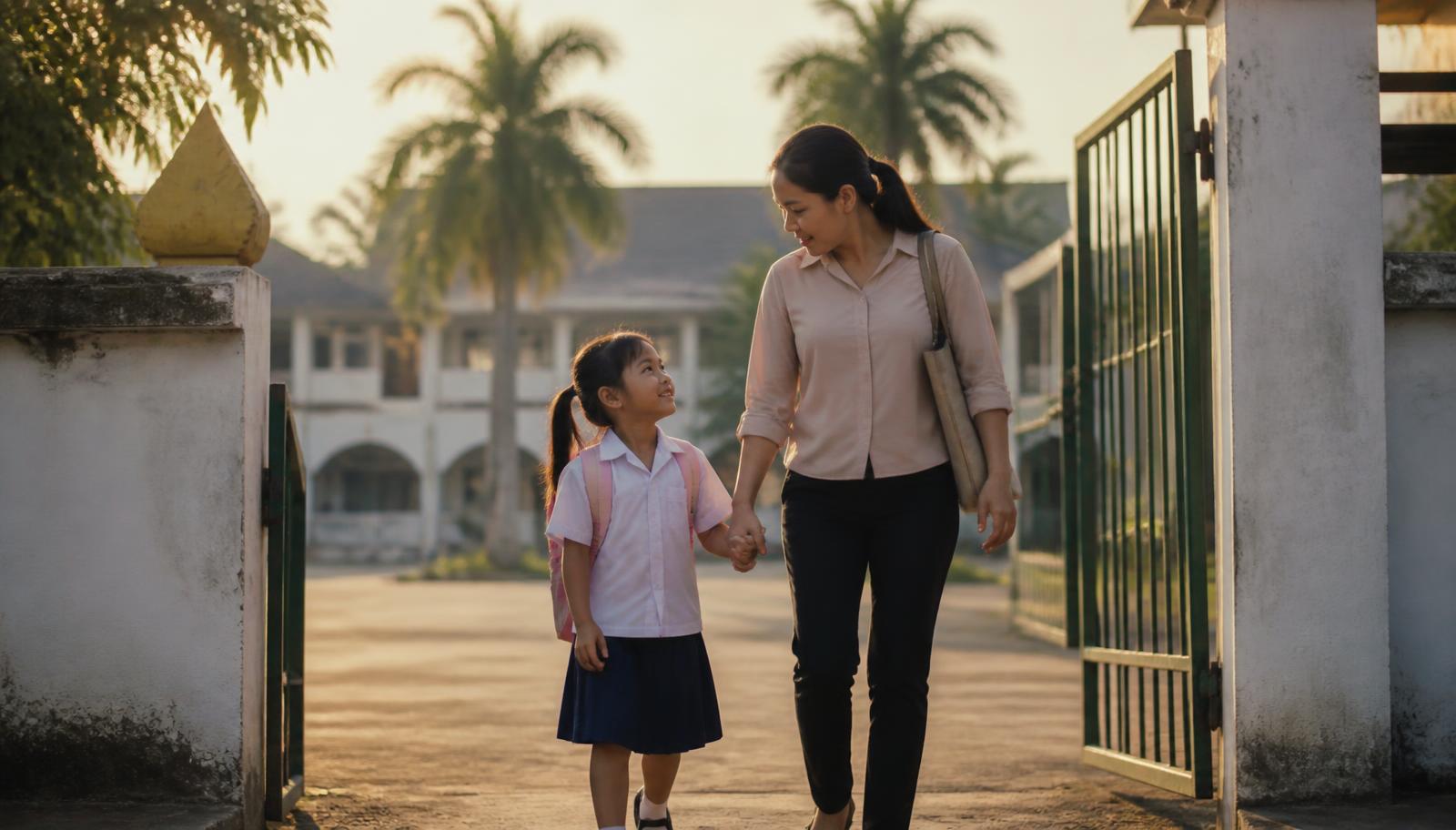
A parent and a child in school uniform walking through a school gate in Thailand

National criteria, local practice

The criteria on this page come from Immigration Bureau Order 327/2557, which is the document immigration officers apply when granting these extensions. What varies is everything around it: which supporting documents a particular office wants, how a two-parent family is handled, and how strictly the household conditions are read. Confirm the current requirements with the office that will process your application.

This is general relocation information, not immigration or legal advice, and no guide can promise that an application will be approved.

Last checked: August 2026

The short answer

Guardian and dependant routes at a glance

Visa category
Non-Immigrant O, then an extension of stay inside Thailand
Guardian route
Parent of a family member permitted to stay for study
Dependant route
Spouse or child of a foreigner permitted to stay to work
Money test (guardian)
500,000 THB in a Thai bank account in the father's or mother's own name
Money test (dependant)
None in the clause itself — it sits with the principal applicant's category
Length of each permission
No more than one year at a time
Working
No work right on either route
Ongoing admin
TM30, 90-day reporting, re-entry permit before leaving Thailand

The sentence that saves families the most trouble

A child's school place solves the child's status and nothing else. The parent's permission to stay is a separate application with its own 500,000 THB requirement, and that money has to have been sitting in a Thai bank account before you file — not on the day you file.

Two routes that get confused with each other

Both are commonly called a 'Non-O dependant visa'. They are governed by different clauses.

Guardian of a student

Who it is for
A parent whose child (or whose adult student family member) is in Thailand on a study status.
Derived from
The student's own permission to stay for study.
Money
For a father or mother: 500,000 THB held in a Thai bank account in their own name. No deposit requirement is written into this clause for a spouse or child.
Clause
Order 327/2557, Clause 2.11

Dependant of a working foreigner

Who it is for
A spouse or child of a foreigner already permitted to stay in Thailand to work, invest, teach or on certain other statuses.
Derived from
The principal applicant's own approved status and its financial criteria.
Money
No separate deposit is written into this clause. The financial evidence sits with the principal applicant's category, not with the dependant.
Clause
Order 327/2557, Clause 2.20

The distinction matters because the money follows the clause. A parent applying because a child studies here has to show funds personally. A spouse applying because their partner works here does not — the financial evidence lives with the working partner's own category, whether that is employment, investment, teaching or retirement.

01

Your child is at school here

You are looking at the guardian route, and you should plan the 500,000 THB deposit months before you need it.

Read the education visa guide

Parent of a student

The route that families relocating to Hua Hin for schooling usually need.

Under Clause 2.11 of Order 327/2557, the family of a foreigner permitted to stay for study can apply for their own extension of stay. Eligible family members are the parents, the spouse, children, adopted children and a spouse's children. The parent category is the one that carries the money test.

This is a derived status. It exists because the student's status exists, and it ends when the student's status ends. That sounds obvious until a course finishes early or a school place is not renewed, at which point the parent's permission to stay is suddenly resting on nothing.

A school place is not a family immigration plan

Enrolment secures the child's study status. Everything else — which parent applies, on what basis, with what money, and what the other parent does — is a separate planning exercise. Start it at the same time as the school search, not after the offer letter arrives.

The 500,000 THB deposit, precisely

This is the single most misquoted number in family relocation to Thailand.

Clause 2.11(5) requires that, in the case of parents, funds of no less than 500,000 THB are deposited in a bank in Thailand under the father's or the mother's name, and have been maintained for the past three months. For the first year only, the applicant must show the amount maintained for no less than 30 days before the filing date.

Read that sequence carefully, because it runs in the direction people do not expect. The first application is the easy one: thirty days. It is the renewals that tighten to three months. Families who move the money out after approval, then move it back shortly before the next renewal, run into exactly the problem the clause is designed to catch.

How to time the money

  1. 1

    Open a Thai bank account in the applying parent's own name

    Not joint, not the working spouse's account, not a company account. The clause names the father or the mother.

  2. 2

    Fund it at least 30 days before the first application

    Build in a buffer. Thirty days is a minimum, not a target.

  3. 3

    Leave the balance in place

    Each renewal requires the amount to have been maintained for the past three months, so treat it as money you cannot use.

  4. 4

    Collect an updated bank letter and passbook for each application

    Offices generally want a letter dated close to the filing date.

Practical example

A family arriving for the August school year

Child
Enrolled, Year 5, international school
Parent applying
Mother, as guardian
Deposit
500,000 THB, her own account
Funded by
Early July
First application
Mid-August
Next renewal
Balance untouched throughout

The deposit is funded a comfortable six weeks before filing, which clears the 30-day requirement without depending on a transfer landing on time. Because the balance is never drawn down, the three-month condition at the first renewal takes care of itself.

Spouse or child of a foreigner working here

The route for families following someone into a job, an investment or a teaching post.

Clause 2.20 covers the family of a foreigner permitted to stay under the work, business, investment, teaching and certain other categories. The same family members qualify — spouse, children, adopted children and a spouse's children — and the permission is again granted for no more than one year at a time.

No separate deposit appears in this clause. That does not make it the easy option: the whole application depends on the principal applicant's status being properly in order, so a delay to a work permit or an extension cascades directly onto the rest of the family.

Sequence matters more than money here

The principal applicant's status has to be settled before the dependants' can be. In practice that means the person taking the job travels and files first, and the family's timing is set by how quickly that goes.

Age and household conditions for children

Three conditions, all of which have to hold at the time of application.

A child dependant must be

  • Unmarried
  • Living with the family as part of the household
  • Not over 20 years of age

The dependant-of-a-working-foreigner clause adds one exception: a child with illness or disability who cannot live without the support of a parent. That exception is not written into the study-guardian clause.

Twenty arrives faster than families expect. A child who finishes school here at eighteen and stays on has perhaps two years before this route closes, and the obvious successor — their own study status, or a route of their own — takes planning rather than a same-week decision.

No student age cap in the national order — but consulates differ

The national criteria set no maximum age for the student the guardian is accompanying. Some Thai missions publish narrower wording of their own; the Royal Thai Embassy in Singapore, for example, refers to parents of students under 20. If you are the parent of an adult student, ask the mission handling your application how it applies the category before you build a plan on it.

How the process actually runs

Two stages, in a fixed order: entry first, then the extension inside Thailand.

  1. 1

    The principal's status is established first

    The student is enrolled and holds a study status, or the working parent holds their approved status and permit.

  2. 2

    Apply for a Non-Immigrant O

    Usually from outside Thailand through the e-Visa system or the relevant Thai mission, on the family or guardian basis.

  3. 3

    Enter Thailand and get an entry stamp

    The stamp — not the visa validity — sets your current permission to stay. Photograph it on day one.

  4. 4

    File the extension of stay at Immigration

    This is where the 500,000 THB deposit or the principal's documentation is assessed. Granted for up to one year.

  5. 5

    Keep it current

    TM30 address reporting, 90-day reporting, and a re-entry permit before any trip abroad.

Documents you will be asked for

The exact list is set locally. These are the items that appear in almost every case.

Guardian of a student

  • Passport with the current entry stamp and TM6/departure card where issued
  • The student's enrolment confirmation and their own status documents
  • Birth certificate or other proof of the parent–child relationship, translated and legalised where required
  • Thai bank passbook in the parent's own name, plus a bank letter confirming the balance
  • Evidence the balance has been maintained for the required period
  • TM30 address registration and proof of residence

Spouse or child of a working foreigner

  • Passport with the current entry stamp
  • Marriage certificate or birth certificate, translated and legalised where required
  • The principal applicant's passport, visa, extension and work documentation
  • The employer's supporting documents, where the principal is employed
  • TM30 address registration and proof of residence
  • Photographs and the completed application form for the office concerned

Legalisation of foreign civil documents is the step that catches people out. Birth and marriage certificates usually need translation and authentication before a Thai office will accept them, and that process is far easier to complete in your home country than remotely from Hua Hin.

Can a guardian or dependant work?

No — and this is not a grey area worth testing.

Neither clause carries any permission to work. Any employment in Thailand requires separate work authorisation regardless of which visa you hold, which in practice means obtaining a work permit and usually changing category to Non-Immigrant B.

For a trailing spouse this is often the real constraint on the move, and it is worth confronting early. Remote work for an overseas employer sits in a different discussion again, and the DTV is generally the route people look at for it.

What this status does give you

  • Lawful long-term presence alongside your family
  • Extensions of up to one year at a time
  • The ability to open the everyday accounts and services long-stay residents need
  • A stable base while you decide on a longer-term route

What it does not give you

  • Any right to work or take employment in Thailand
  • Any independent status if the principal's status ends
  • Permanent residence or a path to it by itself
  • Freedom from TM30, 90-day reporting or re-entry permits

When another route fits better

A derived status is convenient, but it is not always the strongest option available to you.

01

You are 50 or over

A retirement extension in your own name is independent of anyone else's status, which is a meaningful advantage over a derived one.

Retirement visa guide
02

You work remotely for foreign clients

The DTV is designed for this and does not depend on a family member's status remaining in place.

DTV guide
03

You are married to a Thai national

The Thai spouse route is a different, generally more durable family category with its own criteria.

Spouse and family guide
04

You want to study yourself

An accompanying parent who enrols in a genuine course has a status of their own rather than a derived one.

Education visa guide

It is also worth saying plainly: 500,000 THB locked in a Thai account is real money doing nothing. If you qualify for a route in your own name, compare the two properly rather than defaulting to the guardian option because it is the one the school mentioned.

Life after approval

The obligations are the same as every other long stay, and they start immediately.

01

TM30 address reporting

Your address has to be reported, and reported again after certain trips. Landlords do not always do it for you.

TM30 guide
02

90-day reporting

A routine notification of your address every 90 days, with real consequences for missing it.

90-day reporting guide
03

Re-entry permits

Leaving Thailand without one cancels your permission to stay, extension included.

Re-entry permit guide

Doing this from Hua Hin

Practical notes for families based here rather than in Bangkok.

Applications for people living in Hua Hin are handled by the local immigration office in Prachuap Khiri Khan province. Smaller offices are generally more pleasant to deal with than Bangkok, but they also process fewer guardian applications, so it is worth asking specifically what they want for your category rather than assuming a checklist you found online applies.

Bank onboarding is the other local variable. Opening a Thai account as a newcomer is achievable but not instant, and it is the step to start first if a 500,000 THB deposit has to be seasoned before you file.

Mistakes families make

Almost all of them are timing or naming problems rather than eligibility problems.

Assuming a school place covers the parents

Enrolling a child gives the child a study status. It does not give either parent permission to stay. The guardian extension is a separate application, with its own money test.

Depositing the money too late

The funds must already have sat in a Thai account for a set period before you file — 30 days for a first application, three months at each renewal. Money that arrived last week does not qualify.

Holding the account in the wrong name

The clause requires the account to be in the father's or mother's own name. A joint account, a company account or a spouse-only account creates avoidable problems at the counter.

Treating the dependant status as a work permit

Neither route carries any right to work. Working on either one without separate authorisation is a serious problem, not an administrative slip.

Forgetting the child turns 20

Child dependants must be unmarried, living with the family and not over 20. Families who have not planned the next step arrive at that birthday with no route in place.

Overlooking the reporting obligations

Guardians and dependants carry the same TM30, 90-day reporting and re-entry permit duties as everyone else on a long stay.

Questions people ask

The questions that come up most often when a family works this out for the first time.

Does my child's school place give me a visa?

No. The child's study status and the parent's permission to stay are handled separately. A parent applies for their own extension of stay as the father or mother of a student, which under Immigration Bureau Order 327/2557 requires 500,000 THB held in a Thai bank account in the parent's own name.

How long is the 500,000 THB deposit required to sit in the account?

For a first application the funds must have been maintained for no less than 30 days before the filing date. At each subsequent renewal the order requires the balance to have been maintained for the past three months.

How long is each permission granted for?

Order 327/2557 allows an extension of stay of no more than one year at a time, for both the study-guardian category and the dependant-of-a-working-foreigner category.

Can a guardian or dependant work in Thailand?

Not on that status alone. Neither clause carries a work right. Any employment requires separate work authorisation and usually a change of visa category, most commonly to Non-Immigrant B.

How old can a child dependant be?

The order describes children, adopted children and a spouse's children as needing to be unmarried, living with the family, and not over 20 years of age. For the dependant-of-a-working-foreigner category the order adds an exception for a child with illness or disability who cannot live without the support of a parent.

Is there a maximum age for the student the guardian is accompanying?

No student age cap appears in the national Immigration Bureau order. Some Thai missions publish their own wording — the Royal Thai Embassy in Singapore, for example, refers to parents of students under 20 — so consular practice can be narrower than the national criteria. Confirm with the mission handling your application.

Can both parents get the guardian status?

The clause is written around the father or the mother. In practice families are commonly told that one parent applies as guardian while the other needs a route of their own, and offices vary. Ask your local office how it treats a two-parent application before you plan around it.

What happens if the child stops studying?

The guardian status is derived from the student's status. If the study status ends, the basis for the parent's extension ends with it, and you should expect to need a different route quickly.

Official sources and verification

Where to confirm anything on this page. If a source below contradicts this guide, the source is right.

Hua Hin Compass verified

Last verified

August 2026

Next scheduled review

November 2026

Sources checked

  • · Immigration Bureau Order 327/2557, Clauses 2.11 and 2.20
  • · Thai Immigration Bureau public criteria handbook
  • · Ministry of Foreign Affairs visa-types table
  • · Royal Thai Embassy Singapore and Fukuoka visa pages

The 500,000 THB parent deposit, the 30-day and three-month seasoning periods, the one-year maximum per permission and the age and household conditions are quoted from Immigration Bureau Order 327/2557, Clauses 2.11 and 2.20. The absence of a work right is implicit in Thai law rather than stated in a single clause. No maximum age for the student appears in the national order, although some Thai missions publish narrower wording, so that point is presented as consular practice rather than a codified criterion.

Hua Hin Compass uses official Thai government sources as the primary reference and reviews this guide periodically. It is general relocation information, not immigration or legal advice, and it cannot confirm your eligibility or promise that an application will be approved. Confirm your own position with the relevant Thai authority or a qualified adviser.

Moving as a family?

Put the school dates, the bank account and each family member's application into one plan, in the order they actually have to happen.

Continue planning your move