
School-age education
Elementary and secondary schooling at a recognised institution. This is the route most relevant to families relocating with children.
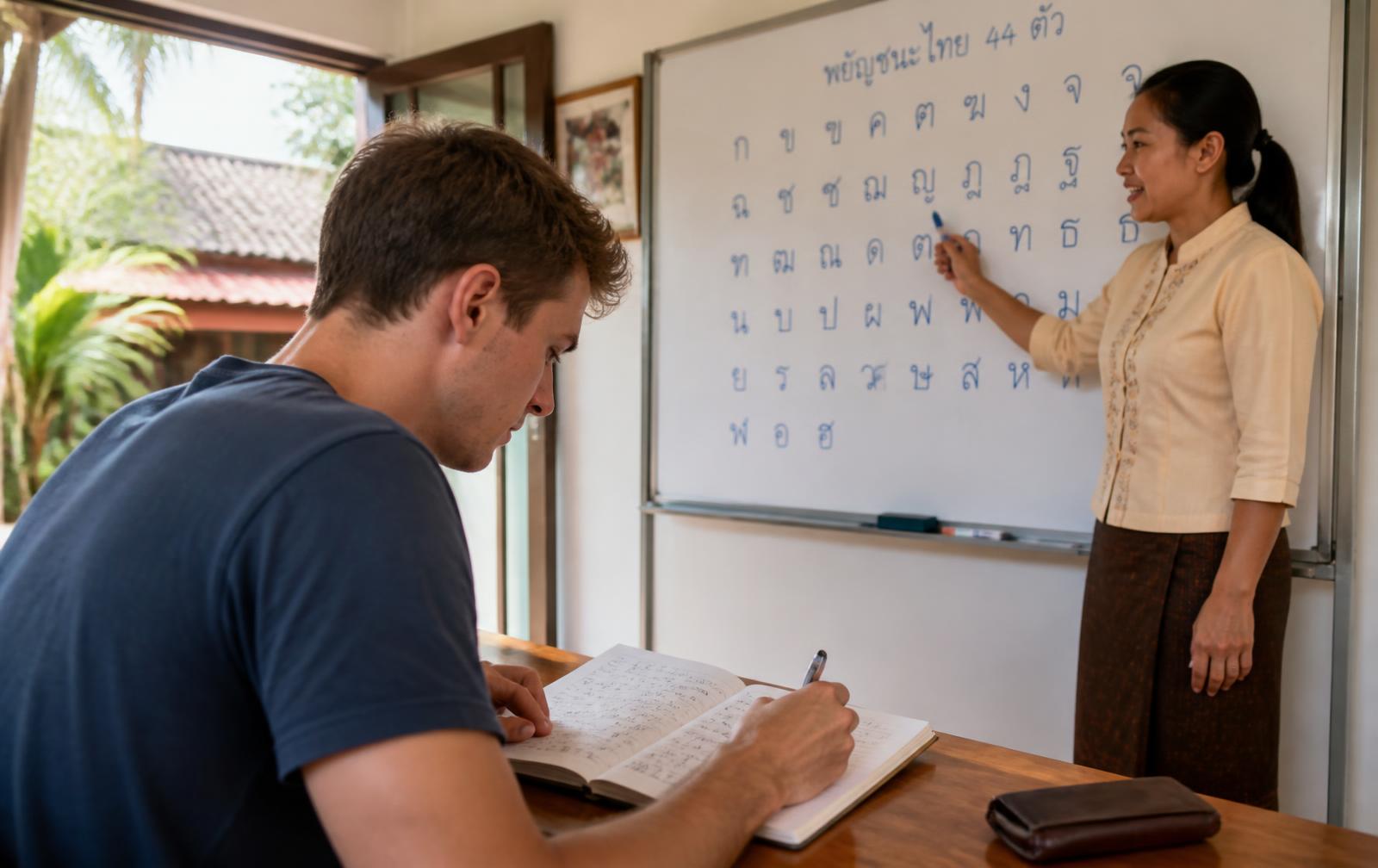
A guide for genuine study: choosing a school or course, preparing the application and keeping your stay in order.
Non-Immigrant ED at a glance
The sentence that saves the most confusion
A twelve-month course does not produce twelve months of permission to stay. The visa gets you here, the entry stamp sets your current stay, and everything beyond that is a sequence of extension applications supported by your school. People who understand this before enrolling have a far better first year than people who discover it at an Immigration counter.
National categories, local documentation
The study categories, visa validity and permitted stay are set nationally and published by the Ministry of Foreign Affairs. Almost everything after that — which documents an office wants, how a school's paperwork is assessed, how long an extension is granted and how attendance is reviewed — is handled locally and by your institution, and practice genuinely varies. Confirm the current requirements with the Thai mission or e-Visa system handling your application, and with Immigration for anything after arrival.
This is general relocation information, not immigration or legal advice, and no guide can promise that an application will be approved.
Last checked: August 2026
The official category is broader than most people assume, and narrower than the marketing suggests.
The Ministry of Foreign Affairs publishes the list of purposes that fall under ED. It is worth reading the whole list before deciding what your plan is, because several people arrive convinced they need a language course when a different sub-category describes their situation more accurately.
Elementary and secondary schooling at a recognised institution. This is the route most relevant to families relocating with children.
Bachelor's degree and above at a Thai university or higher-education institution. This group is also the one ED Plus was built for.
Vocational, technical and university diploma programmes below bachelor's level appear as their own listed purpose on the current MFA table.
The classic language-school route, provided the institution and the specific programme are recognised and able to support the immigration paperwork.
Listed on the MFA table alongside short language courses, so it is a genuine ED purpose — but only through a provider whose programme actually qualifies.
An internship that forms part of an educational programme sits under ED. An ordinary internship that is not part of a curriculum does not.
Where run under an international organisation or government programme, and only within the current official category wording.
Your institution is not a supplier. For as long as you hold this status, it is part of it.
An ED application rests on documentation the institution produces, and the extensions that follow rest on documentation it keeps producing. This is why the choice of school deserves more thought than the choice of visa. A well-run provider will explain what it issues, when, and what it needs from you. A weak one will talk about immigration outcomes it cannot control and go quiet when the paperwork is due.
Recognition is the second half of it. Not every school teaching Thai, and not every gym teaching Muay Thai, can support this route. Ask which authority recognises the programme and confirm it independently before money changes hands.
Learning Thai changes life here more than almost anything else you can do in your first two years. Reading a menu, holding a conversation at the market, understanding what is being said around you at the hospital — none of that is available through translation apps in the way people hope. If you intend to stay long term, this is a genuinely good use of your time, and the immigration route exists precisely because the study is real.
Be realistic about the commitment. Structured language study means scheduled classes you are expected to attend, and a school that can confirm you are attending. People who treat the course as background noise tend to have trouble at exactly the moment they need their school's support.
Practical example
One enrols because she wants to speak Thai with her partner's family, attends consistently and builds a relationship with the school office. The other enrols because the stay looked convenient, stops attending in month two, and discovers that the school is unwilling to confirm progress it cannot see.
This is where the old reputation of the ED visa collides with how it is administered now.
Attendance and progress can be reviewed, usually through what your institution records and reports. Specific thresholds — the widely quoted attendance percentages you will find on agency websites — are repeated so often that they read like official policy, but we have not been able to verify a published government document setting them. We are not going to print a number we cannot stand behind.
The practical guidance does not depend on the number. Attend, keep up, and stay on good terms with the office that handles your file. If you need to miss a stretch of classes, tell the school in advance rather than afterwards.
Commonly reported, not confirmed
Attendance percentages, the exact schedule of extension lengths for language students and the extension application fee are all quoted confidently across the internet. We could not confirm them in a published official source, so this guide explains the mechanism instead and points you to Immigration and your school for current figures.
The part of the process that determines whether a long course becomes a long stay.
Enrol and get documented
Your institution issues the enrolment and supporting documents the application needs.
Obtain the ED visa
Applied for through a Thai mission or the e-Visa system before you travel.
Enter and receive your stay
The stamp on arrival sets how long you may currently remain — read it carefully.
Extend from inside Thailand
Applications at Immigration with fresh school documentation, repeated as your course continues.
Extensions are not automatic and not guaranteed. Each one is a fresh application assessed on your continued, genuine study, and the length granted depends on the route, the programme and current practice at the office handling it. Language students in particular should ask their school directly what pattern of extensions its students currently receive, rather than relying on figures written years ago.
Applications stall far more often over missing institutional paperwork than over anything personal.
Ask for the school's document list in writing early. If it cannot produce one, that is information about how the rest of the relationship will go.
A short shared list, then one institutional document that depends on what you are studying.
Whatever you are studying, the official e-Visa page for this category asks for the same personal basics: a passport, a recent photograph, evidence of where you currently are, and financial evidence. Bank statements and a sponsor letter are given as examples of financial evidence rather than as a required pair, and no amount is published on that page. The mission handling your application sets the exact form, so check its own current instructions and note the date you checked.
On top of those basics, each study purpose has its own institutional or authority document. Asking for that document is not the same as holding it, and some of them take weeks. Start them first.
For degree study, the Ministry of Foreign Affairs document list names a letter from the university as that institutional document.
For school education, degree study, short language or Muay Thai courses and below-bachelor diplomas, the application asks for a letter setting out your enrolment details, signed by a person authorised by the institution, together with a copy of that signatory's ID card or passport. The copy is part of the requirement, not an optional extra, and it is the part most often forgotten.
The letter is programme-specific. If you change what you are studying, the letter you already hold may describe the previous programme, so ask the institution for a replacement rather than reusing it.
A workshop, training or seminar run by a government agency, or by a diplomatic or international organisation, is its own listed purpose. What supports it is a letter from the government agency concerned, or a note verbale from the organisation running the event. Ask the organiser which of the two applies to your event, because they come from different places and take different amounts of time.
There is no institutional enrolment letter here, and this purpose is not a general short-course route. If your programme is a taught course at a school, it belongs under a different purpose.
Dharma study is listed separately, and the supporting document comes from the National Office of Buddhism rather than from the temple or institution directly. The temple arranging your study will normally know how the letter is requested; ask early, because the request passes through an office rather than being issued on the spot.
A vocational, technical or university diploma below bachelor's level is listed in its own right. It is supported by a letter from the institute running the programme, alongside the signed enrolment letter and the signatory's ID or passport copy. If you are unsure whether your programme counts as a diploma below bachelor's level, ask the institute which listed purpose it applies under before you apply.
Muay Thai training appears on the current MFA visa-types table alongside short language courses, so training as your reason for being in Thailand is a legitimate ED purpose rather than a loophole. What has changed is the landscape around it. Not every gym can support the route, and since 2024 the Destination Thailand Visa has offered a soft-power category that explicitly covers Muay Thai training.
For short courses and training, the Ministry of Foreign Affairs document list names the Sports Authority of Thailand as a recognised organisation whose letter it accepts. What we have not been able to confirm from a published document is exactly how a gym comes to be recognised for this purpose, and we would rather say that plainly than invent an answer. Ask any gym advertising visa support which authority recognises its programme and what letter it can produce, and verify the answer independently.
You are enrolled at a qualifying provider, training to a schedule, and content with a study status that is renewed inside Thailand and tied to that provider.
The soft-power category covers Muay Thai training on a long multi-entry visa with stays of up to 180 days per entry, extendable once. It suits people who train hard but are not students in the administrative sense.
Read the DTV guideWhich one is cheaper depends on what you count
The ED visa fee is low and the ongoing admin is high, with extensions, school documentation and a re-entry permit before each trip. The DTV costs considerably more upfront and then asks very little of you for years. Compare the total experience over the length of time you actually intend to train, not the fee on day one.
There is a third answer that often gets missed. If you are over 50 and studying Thai mainly for pleasure, a retirement route is usually the simpler basis for your stay, and nothing stops you attending classes on it. Choose the visa that matches why you are here, then study as much as you like.
For most relocating families, this is the part of ED that matters.
Elementary and secondary education at a recognised institution is one of the listed ED purposes, so a child attending school here is on solid, ordinary ground. In practice the school does most of the work: international schools in and around Hua Hin that enrol foreign pupils are used to this process and will tell you what they issue and when.
The institutional document for this purpose is a letter from the relevant authority under the Ministry of Education or from the international school, in the words of the Ministry of Foreign Affairs document list. Ask the school which of the two it issues.
The timing usually runs the other way from what parents expect. The school place comes first, term dates set the moving date, and immigration follows. Start school conversations well before you fix anything else.
The single biggest misunderstanding on this page, and an expensive one to discover late.
A child's school place does not give the parents status
Enrolling a child at a school in Hua Hin does not resolve the parents' immigration position. The child's education and each adult's permission to stay are handled separately, and it is entirely normal for one household to end up holding two or three different routes.
There is a guardian route within the Non-Immigrant O category, intended for parents and guardians of school-age students in full-time education. It exists, it is used, and it is a separate application with its own requirements rather than something the enrolment delivers automatically. Where both parents are relocating, it is common for only one to use it while the other holds a route of their own.
The criteria for a parent or guardian of a student are set by Immigration Bureau Order 327/2557, and Clause 2.11(5) puts the figure at 500,000 THB held in a bank in Thailand in the parent's own name. That order is about an extension of stay granted by Immigration inside Thailand, not the visa you apply for at an embassy before you move. We have not verified a generally applicable financial threshold for the initial visa application abroad. Check the requirements published by your handling embassy or consulate, and treat the deposit as a real planning item at the extension stage: ask Immigration what is currently required, and arrange the timing of the money well before you need it.
Think of a relocating family as several separate immigration cases that happen to share an address. A child may be here on a study basis, one parent on a guardian route, and the other parent on a retirement, remote-work or work-authorised route depending on age, income and whether they intend to work. That is a normal outcome, not a sign that something has gone wrong.
We have not found a dedicated route for the spouse of an adult ED student. If your plan depends on one existing, verify it before you build around it.
Often the practical arrangement: one adult uses the guardian route while the other qualifies through age, income or employment.
A retirement route is frequently the steadier basis for a parent who is not working, and it is independent of the school.
Retirement visa guideThe DTV is usually the honest description of a remote-working parent's situation, and it carries far less recurring admin.
DTV guideA family-based Non-O route may be the simplest basis of all, and it is unaffected by where the children go to school.
Spouse & family visa guideED Plus took effect on 15 July 2024 as part of Thailand's wider visa reform package. It applies to students enrolled at bachelor's level or above at Thai higher-education institutions, and it fixes several of the frictions that make standard ED tiring.
What ED Plus changes
The university files for you
Extension applications are submitted by the institution on the student's behalf rather than left to the student.
Travel without a re-entry permit
Students may leave and return during their studies without obtaining a separate re-entry permit each time.
A year after graduation
A one-year stay after graduating, to look for work or travel, applied for through Immigration.
Then a proper work route
Taking a job means moving to work-authorised status and obtaining a work permit. The graduation year is not permission to work.
Who ED Plus is not for
Language-school students, Muay Thai trainees and school-age children are not in scope. If you are studying below degree level, plan around standard ED and its re-entry permit requirement.
An internship that forms part of an educational curriculum falls within the ED categories, because the system treats it as study. An internship that is not part of a curriculum is a different matter and belongs under the business categories, with the work authorisation that implies. The distinction is not cosmetic: getting it wrong means holding the wrong status for what you are actually doing.
No — and the way people get around this is usually the thing that causes them trouble.
ED is not a work route. Permission to be in Thailand and permission to work are decided under different laws by different agencies, and studying gives you the first without touching the second. Curricular internships are the narrow exception, and they exist because the education system defines them as study.
If working is part of your plan, be honest about it early. Remote work for clients abroad points to the DTV. Employment with a Thai employer points to the Non-B and work permit route. Choosing a study status to cover a working life describes your situation inaccurately, and immigration systems are not forgiving about that.
The Non-B and work permit combination is the route, with employer paperwork and the e-WorkPermit system involved.
Non-B & work permit guideThe DTV was created for exactly this, and it removes the temptation to describe remote work as study.
DTV guideIf you hold a permission to stay on standard ED and leave Thailand without a re-entry permit, that permission generally ends when you go. You return as a new arrival, with whatever entry your passport qualifies for on the day, and the extension work you did earlier is gone. Get the permit before you travel, including for short trips.
ED Plus students are the exception, not the rule. Do not apply that carve-out to a language course or a school-age child.
Withdrawing changes the basis of your stay, whatever your stamp says.
People stop courses for entirely reasonable reasons: the teaching is poor, the level is wrong, work changes, family circumstances shift. The mistake is assuming that an existing permission simply runs on to its printed date. It rests on your continued study, and your school has obligations of its own about what it reports.
Decide what your next status will be before you withdraw, not afterwards. If you are unsure, ask Immigration about your specific case rather than a forum.
Moving to a better school is often the right call, and plenty of people do it. Check three things first: whether the new programme itself qualifies, what your current school is required to report, and how the timing interacts with your permission to stay. Handled in that order, a change is administrative. Handled the other way round, it can leave a gap that costs far more than the fees you were trying to save.
A school should be able to explain what you will learn before it explains how long you can stay.
Ask what you will be able to do after each stage. Vagueness here usually means the teaching is an afterthought.
Some flexibility is normal. Being told attendance does not matter is a warning about how the school treats the whole arrangement.
Ask which authority recognises the programme. A legitimate provider answers this without hesitating.
No school can guarantee an immigration decision. Anyone promising one is either misinformed or telling you what you want to hear.
Money should not move far ahead of the enrolment letter and a clear written statement of what the school provides.
You need to know what happens to your fees if the application is refused or your plans change.
If a sales conversation conflicts with what the MFA or Immigration Bureau publishes, believe the published source.
An honest picture of what is realistic here, rather than in Bangkok or Chiang Mai.
Hua Hin is a comfortable place to study and a limited one to study in. The town has language tuition, a well-established international-school sector serving resident families, and Muay Thai gyms of varying seriousness. What it does not have is the density of options you would find in Bangkok or Chiang Mai, where the concentration of language schools and universities is on another scale entirely.
For families, that trade-off usually works out well: the schools are the reason many people choose the town, and Bangkok is close enough for anything specialist. For an adult whose whole plan depends on a particular language school or a degree programme, be honest about whether the right institution is actually here. Bangkok is two and a half to three hours away by road, which is fine occasionally and punishing several times a week.
One local point worth planning around: availability is not the same as ED eligibility. A school may teach excellent Thai and still be unable to support this route. Confirm with the specific provider, in writing, before you make it the foundation of your move.
Why we do not list ED-capable providers
A provider's ability to support ED status can change, and publishing a list would mean presenting something we cannot continuously verify as fact. Ask each school which authority recognises its programme and what documents it issues — a legitimate one answers without hesitating.
Where ED sits
Almost all of them are assumptions rather than eligibility problems.
If you cannot describe what you will learn without mentioning immigration, you have picked the wrong starting point — and usually the wrong school.
The institution needs the right recognition and the willingness to produce documents year after year. Plenty of good teachers work at places that cannot do either.
There is no such product. A twelve-month course and twelve months of permission to stay are separate things reached by separate steps.
Your enrolment starts the process. Your actual study is what the school has to be able to confirm when the extension paperwork comes round.
It does not. Each adult needs their own qualifying immigration basis, and working that out is a separate exercise from choosing a school.
The institution forms part of your immigration basis. Switching first and asking afterwards is how people end up with an expensive gap.
ED is not a work route. Long-stay convenience and permission to work are decided under different laws by different agencies.
Standard ED holders generally need a re-entry permit to keep an existing permission to stay alive. The ED Plus exemption does not extend to everyone else.
For Muay Thai, and for some people who study Thai casually alongside remote work, the DTV did not exist when most online advice was written.
It is aimed at degree-level students at Thai institutions, not at language schools, gyms or school-age children.
Short answers. The detail sits in the sections above.
Do not assume so. Non-Immigrant visas are normally obtained from a Thai mission or the e-Visa system before travelling, and in-country conversion from tourist or visa-exempt entry is not something we can confirm as generally available. Check directly with Immigration before relying on it.
Sometimes, but the institution forms part of your immigration basis. Check whether the new programme qualifies, what your current school must report, and how the timing affects your permission to stay before you move.
The basis of your stay changes. Do not assume your existing permission simply runs to its printed date — check your position and arrange your next status before you withdraw.
If remote work for foreign clients or an employer abroad is the real reason you are living here, the DTV is the route to look at first. Choosing a study visa to cover a working life describes your situation inaccurately.
Where to confirm anything on this page. If a source below contradicts this guide, the source is right.
Hua Hin Compass verified
Last verified
August 2026
Next scheduled review
November 2026
Sources checked
Study categories, extension practice and institutional requirements change. Several figures that circulate widely online — attendance percentages, extension fees and the schedule of extension lengths for language students — could not be confirmed in a published official document, so this guide explains the mechanism and points you to Immigration and your institution rather than quoting numbers we cannot stand behind. The 500,000 THB guardian deposit is quoted from Clause 2.11(5) of Immigration Bureau Order 327/2557, which concerns an extension of stay decided inside Thailand; we have not verified a generally applicable financial threshold for an initial visa application at an embassy or consulate.
Hua Hin Compass uses official Thai government sources as the primary reference and reviews this guide periodically. It is general relocation information, not immigration or legal advice, and it cannot confirm your eligibility or promise that an application will be approved. Confirm your own position with the relevant Thai authority or a qualified adviser.
Add school deadlines, enrolment paperwork and extension dates to your own relocation plan.
Visas & immigration
Other long-stay routes
Family life here
Planning the move