
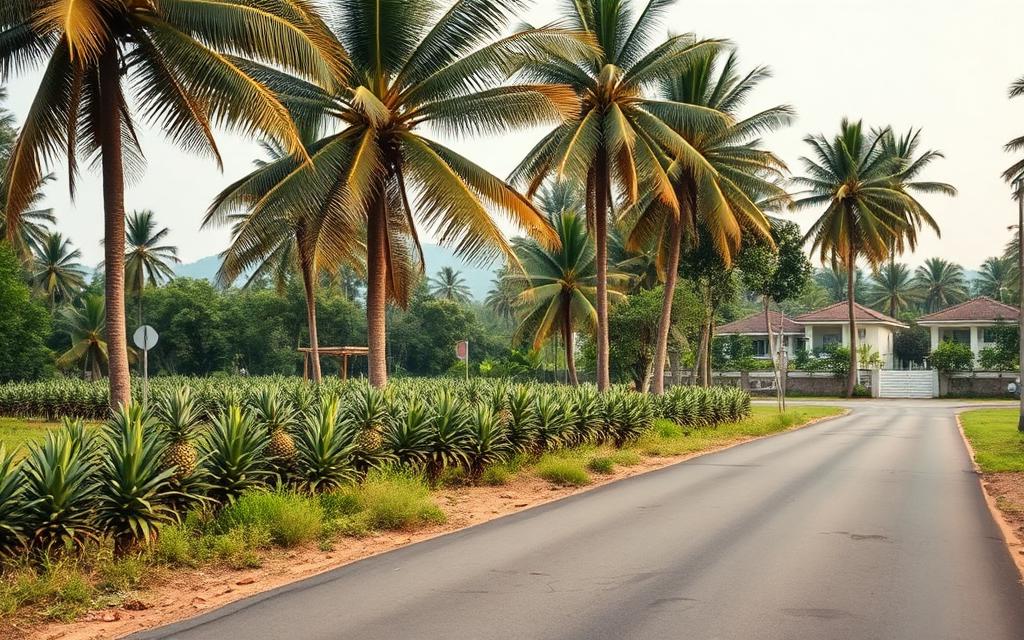
Thap Tai
Suburban Hua Hin south-west of town: newer villa projects, family housing and space, reached by a short drive down the inland sois.
- Last verified
- Last verified: August 2026
- Next review:
- February 2027
- Reading time:
- 8 min
The short verdict
Thap Tai is the inland area south-west of Hua Hin where most of the town's newer residential development has gone. It is reached along the sois that run west from Phetkasem Road, and the further you go, the more it feels like countryside with housing projects dropped into it.
The proposition is space and newness. Villas here tend to be more recently built than in Hin Lek Fai, plots are generous, projects often have a communal pool and gym, and prices are lower than anywhere with a sea view.
It is also emphatically suburban. There is no centre, no beach, and no version of the area that works on foot. Households here organise their week around the car and around which soi they live on.
How we define this area
Thap Tai covers a large inland area and listings apply the name loosely, sometimes to projects several kilometres apart. For comparison purposes, Hua Hin Compass treats it as the residential area along the inland sois south-west of town, roughly from the Soi 88 area down past the Soi 112 corridor.
At a glance
Thap Tai in summary
- Best for
- Families, newer villas, space for the money
- Less suited to
- Non-drivers, beach lovers, sociable singles
- Area character
- Suburban projects among fields and small farms
- Typical housing
- New pool villas and gated communities
- Beach access
- None — a 15-minute-plus drive
- Walkability
- Very low outside the projects themselves
- Car needed?
- Yes, and often a second vehicle
- To the centre
- Roughly 8–12 km depending on the soi
- Families
- One of the strongest choices, if you accept the drive
- Retirement
- Good value; less good if you dislike driving
Comparison scores used by Neighbourhood Compass
- Families
- 9/10
- Retirement
- 7/10
- Nightlife
- 2/10
- Walkability
- 3/10
- Transportation
- 5/10
- Shopping
- 5/10
- Schools
- 8/10
These scores exist so areas can be ranked against each other in Neighbourhood Compass. They are relative, not measurements — the sections below explain what sits behind them.
What living here actually feels like
The area feels calm and slightly unfinished, in the way growing suburbs do. Between the gated projects sit fields, small farms, roadside shops and dogs asleep in the shade.
Inside a project, life is quiet and predictable: children on bicycles, gardeners in the morning, the pool empty at midday. Outside the gate, the soi is a road rather than a place, and you drive along it rather than walk.
Evenings are dark and still. There are local restaurants along the main sois but no cluster worth wandering to, so social evenings are either at home or in town.
Rain changes the area more than it changes the coast. Some sois drain slowly and the unpaved approaches to newer projects can become difficult, which is worth seeing before you sign anything.
Where within the area?
In an area this large, the soi you choose matters far more than the neighbourhood name.
The nearer sois towards town
Closest to the shopping centres and the coast road, with the shortest drive into Hua Hin. Denser and generally more expensive.
The Soi 112 corridor
One of the main access routes into the area, lined with projects of very different ages and standards. A useful reference point, but check how far along the soi a property actually sits.
Deeper inland towards the fields
The most space and the lowest prices, with the longest drives and the thinnest services. Road quality and drainage vary noticeably out here.
Towards Nong Phlap and the golf side
Blends into the wider inland villa belt, with golf and larger plots, and a different route back into town.
Who this area suits
Families with children
Space, gardens, safe project streets and reasonable access to several international and bilingual campuses make this a common landing place for families.
People who want a new-build villa
Newer construction, modern layouts and a private pool are more affordable here than in any established coastal area.
Households with two vehicles
If everyone can drive, the area's distance stops being a constraint and the value becomes the main story.
Buyers with a long horizon
This is where Hua Hin is expanding. That brings new shops and services over time — and construction noise in the meantime.
Think twice if…
- You don't drive, or only one person in the household does. Independence here depends entirely on a vehicle.
- You want the beach in your daily routine. It is a planned trip from every part of Thap Tai.
- You want to walk out for dinner or coffee. The area has no walkable cluster of anything.
- You are moving alone and want a social life quickly. Community here is project-based and family-weighted.
- You dislike living near construction. Active development means new projects going up nearby for years.
Housing and what you tend to find
Thap Tai is dominated by gated villa projects, many built in the last fifteen years. A typical rental is a two- or three-bedroom single-storey house with a garden, parking, and either a private pool or access to a communal one.
Standards vary sharply between developments. A well-run project with maintained roads, a working pool and a majority of occupied houses is a very different experience from a half-sold one with an absent developer.
New pool villas
The core product: modern layout, private pool, garden and a management fee. Best value for space in the Hua Hin area.
Communal-pool projects
Lower cost and lower maintenance, with shared facilities and usually a more sociable atmosphere.
Larger plots and custom houses
Further inland, where land is cheaper. More privacy, more upkeep, longer drives.
Thai housing along the sois
Ordinary local homes outside the projects, much cheaper and rarely marketed in English.
Indicative rents
Listings in this area commonly sit around ฿14,000 – ฿55,000 a month for long-term rentals. Age and management of the project, and how far down the soi it sits, matter more to price and to daily satisfaction than the house itself.
Rental prices vary substantially by property type, condition, location and season. Figures are indicative rather than quotations.
Daily life
Groceries
Convenience stores and small local shops along the sois cover daily needs; anything bigger means driving to the supermarkets in town or on the highway.
Food
Local Thai restaurants and a handful of project-side places. International choice means driving in, which is the single biggest lifestyle difference from the coast.
Healthcare
No hospital in the area. The town's private and government hospitals are typically fifteen to twenty-five minutes away depending on the soi — time this before choosing a house.
Schools
One of the practical reasons families choose the area: several international and bilingual campuses are inland or south, and school buses serve parts of it. Confirm the route from the exact project.
Everyday services
Banks and administrative errands mean a trip into town. Deliveries reach most projects, though drivers sometimes struggle with newer addresses.
Remote work
Fibre reaches established projects; coverage is patchier at the edges of the area. Test the connection at the property.
Can you live here without a car?
A car or motorbike is strongly recommended
Everything outside the project gate is a drive: schools, supermarkets, hospitals, restaurants and the beach. Songthaews run along Phetkasem Road but not usefully along the inland sois.
Ride-hailing works from the nearer projects but becomes slow and unreliable further inland, especially at night.
Families here typically run two vehicles, or a car plus a scooter. Budget for that when comparing rents against a condo in town — the extra space is real, but so is the running cost.
Travel times are approximate and vary with traffic and your exact starting point. See the transport guide and Thai driving licence guide.
Community and social life
Community forms inside projects rather than across the area. A well-occupied development with a shared pool tends to be sociable, particularly among families; an empty one can feel isolating.
The wider social life of Thap Tai residents mostly happens elsewhere — schools, golf, sport, and restaurants in town — which again comes back to being comfortable in the car.
What becomes part of life hereNot a list of attractions — the places residents actually end up using.
The inland sois themselves
The access roads west from Phetkasem, lined with shops, projects and small farms.
Which soi you live on defines your commute, your neighbours and your daily routine here.
International and bilingual schools inland
Several campuses within reach of the area.
The main practical reason families accept the distance from town.
Read moreGolf courses on the inland belt
Courses a short drive north and west of the area.
A common weekly routine for residents and a way to meet people outside your project.
Read moreLocal markets along Phetkasem
Fresh markets and roadside produce stalls on the way into town.
The everyday shopping habit that stops the weekly supermarket run from dominating your week.
Shopping centres in Hua Hin
Market Village and BluPort, fifteen minutes or so away.
The anchor of most households' weekly logistics.
The road south towards Pranburi
The quick route to the quieter beaches and nature areas south of Hua Hin.
Being inland has one advantage: weekend trips south are easier from here than from the centre.
Read moreWhere it is
An approximate living area rather than an administrative boundary.
How it compares
The areas people usually weigh against this one.
Versus Hin Lek Fai
Closer to town, more established projects and hillside views, usually at a higher price for an older house.
Hin Lek Fai guideVersus Nong Kae
Far better everyday convenience and hospital access, with smaller plots and less new-build villa stock.
Nong Kae guideVersus Khao Takiab
Beach living and walkable pockets instead of space and a garden — a straight trade between coast and square metres.
Khao Takiab guideNot sure which of these fits your household? Answer nine questions and see how they rank for you.
Compare this area in Neighbourhood CompassBefore signing a lease here
Questions people ask about living here
Is Thap Tai suitable for families?
How far is Thap Tai from Hua Hin centre?
Can you live in Thap Tai without a car?
How does Thap Tai compare with Hin Lek Fai?
Is Thap Tai a good investment area?
Hua Hin Compass verified
Last verified
August 2026
Next scheduled review
February 2027
Sources checked
- · Hua Hin Compass area visits
- · School and development websites
- · Current rental and sale listings across major Hua Hin agencies
Local business and price information on this page is reviewed roughly every six months; geographic and character descriptions annually.
Where to go next
Compare areas
Housing and cost
Family and health
Everyday life