
Day trips from Hua Hin
Compare travel time, effort and the best use of your day before choosing a trip.
- Last verified
- Last verified: August 2026
- Next review:
- February 2027
- Reading time:
- 12 min
Day trips at a glance
Driving times assume your own vehicle and ordinary daytime traffic; allow longer at weekends.
| Trip | Best for | Feel | Effort | Time needed | From town |
|---|---|---|---|---|---|
| Sam Roi Yot | Landscape, marshland and quiet beaches | Wild and open | Easy to moderate | Half to full day | ±60 km south · ±1 hr |
| Phraya Nakhon Cave | The single most photographed sight nearby | Effortful, then remarkable | Demanding on foot | Half day minimum | ±65 km south · ±1 hr 10 |
| Pala-U Waterfall | Forest, shade and a walk by water | Green and cool | Easy to moderate | Half to full day | ±60 km west · ±1 hr 15 |
| Pranburi | Mangroves, seafood and a slow morning | Low-key, coastal | Easy | Half day | ±25 km south · ±30 min |
| Phetchaburi | Temples, a hilltop palace and cave shrines | Historic Thai town | Moderate walking | Full day | ±65 km north · ±1 hr |
| Kui Buri | Seeing wild elephants | Safari-like, late afternoon | Easy (you stay in a vehicle) | Full afternoon and evening | ±95 km south · ±1 hr 30 |
Sam Roi Yot±60 km south · ±1 hr
Landscape, marshland and quiet beaches
Wild and open · Effort: Easy to moderate · Half to full day
Phraya Nakhon Cave±65 km south · ±1 hr 10
The single most photographed sight nearby
Effortful, then remarkable · Effort: Demanding on foot · Half day minimum
Pala-U Waterfall±60 km west · ±1 hr 15
Forest, shade and a walk by water
Green and cool · Effort: Easy to moderate · Half to full day
Pranburi±25 km south · ±30 min
Mangroves, seafood and a slow morning
Low-key, coastal · Effort: Easy · Half day
Phetchaburi±65 km north · ±1 hr
Temples, a hilltop palace and cave shrines
Historic Thai town · Effort: Moderate walking · Full day
Kui Buri±95 km south · ±1 hr 30
Seeing wild elephants
Safari-like, late afternoon · Effort: Easy (you stay in a vehicle) · Full afternoon and evening
So, which trip would we pick?
You have a free morning and no plan
Pranburi
You want scenery without a hard walk
Sam Roi Yot
You want the photograph everyone recognises
Phraya Nakhon Cave
You want shade, forest and cooler air
Pala-U Waterfall
You want Thai history rather than nature
Phetchaburi
You are taking visitors somewhere memorable
Kui Buri
For residents, shorter trips such as Pranburi are easier to repeat. Save the longer climbs and wildlife outings for days with enough time and energy.
North, west and south
The geography is simple once you hold it in your head.
From Hua Hin, north to south
- 1PhetchaburiNorth — history and caves
- 2Pala-UWest — forest and water
- 3PranburiSouth — mangroves and seafood
- 4Sam Roi YotSouth — limestone peaks
- 5Phraya Nakhon CaveSouth — the climb
- 6Kui BuriSouth — wild elephants
Almost everything worth driving to sits on one of three axes: north along the coast towards Phetchaburi, west into the hills towards the Myanmar border, or south towards the limestone country and the national parks.
Sam Roi Yot
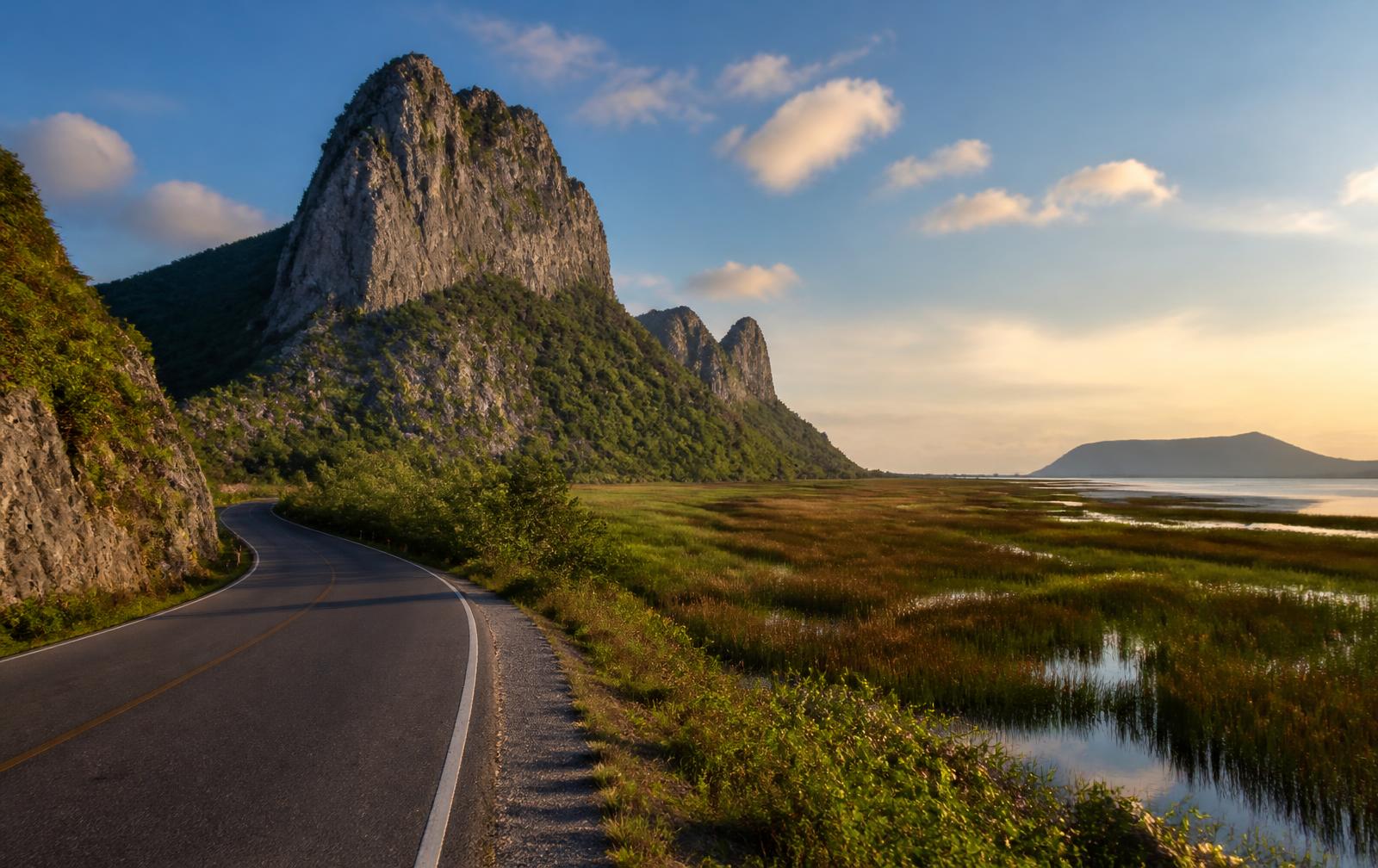
Khao Sam Roi Yot — "the mountain of three hundred peaks" — is the landscape that makes this part of the coast unusual. Limestone towers rise straight out of flat marshland and shallow sea, and the road between them is one of the more scenic drives in central Thailand. It is Thailand's oldest coastal national park, and it covers a mix of terrain that would normally be spread over several places: freshwater marsh, mangrove, beaches, caves and the peaks themselves.
It sits roughly fifty kilometres south of Hua Hin, which is close enough to be treated as a quick excursion and interesting enough that most people wish they had given it longer. The park has several entrances rather than one, so it helps to decide in advance which two or three things you want to see rather than trying to cover everything in an afternoon.
The lotus wetlands by boat
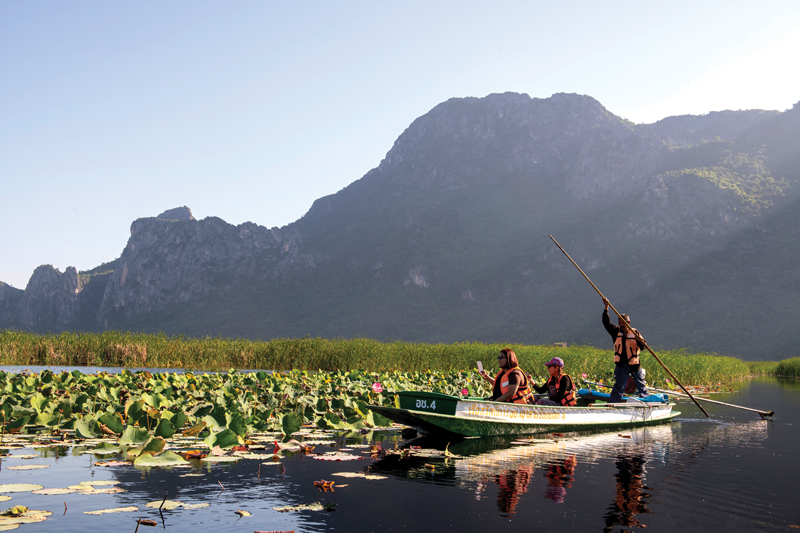
On the western side of the mountains lies a broad freshwater wetland — reeds, open water, birdlife and, in patches, pink lotus. The easiest way to see it is from a small boat, and the season for it runs roughly from October to April. The flowers open in the morning and close again around the middle of the day, so this is not a trip to do lazily after lunch.
Boats leave from the Bueng Bua area near the national park pier, about ten to fifteen minutes from Sam Roi Yot beach, and many of them stop at a wooden jetty where a boardwalk of nearly a kilometre runs out along the foot of the mountain. It is the best vantage point in the park for the peaks, and with some luck you may see spectacled langurs moving through the trees at the edge. Early morning is the light everyone hopes for; late afternoon is quieter and, for photographs, arguably better.
Mangroves at Khlong Khao Daeng
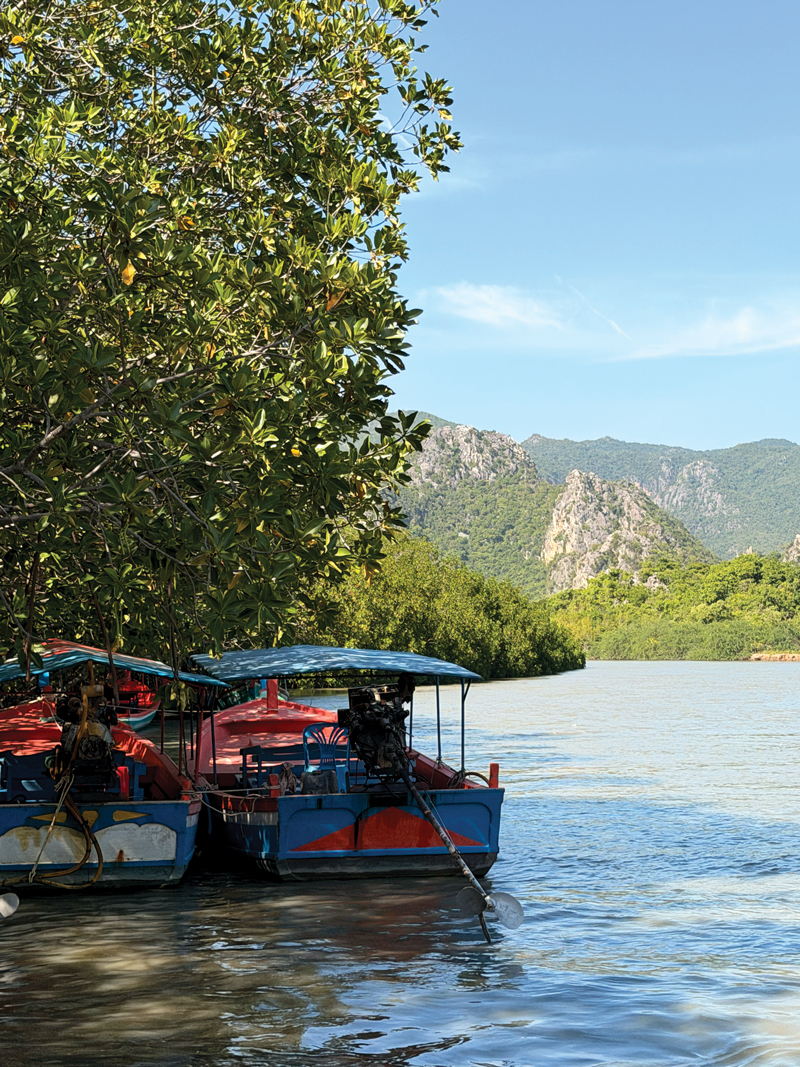
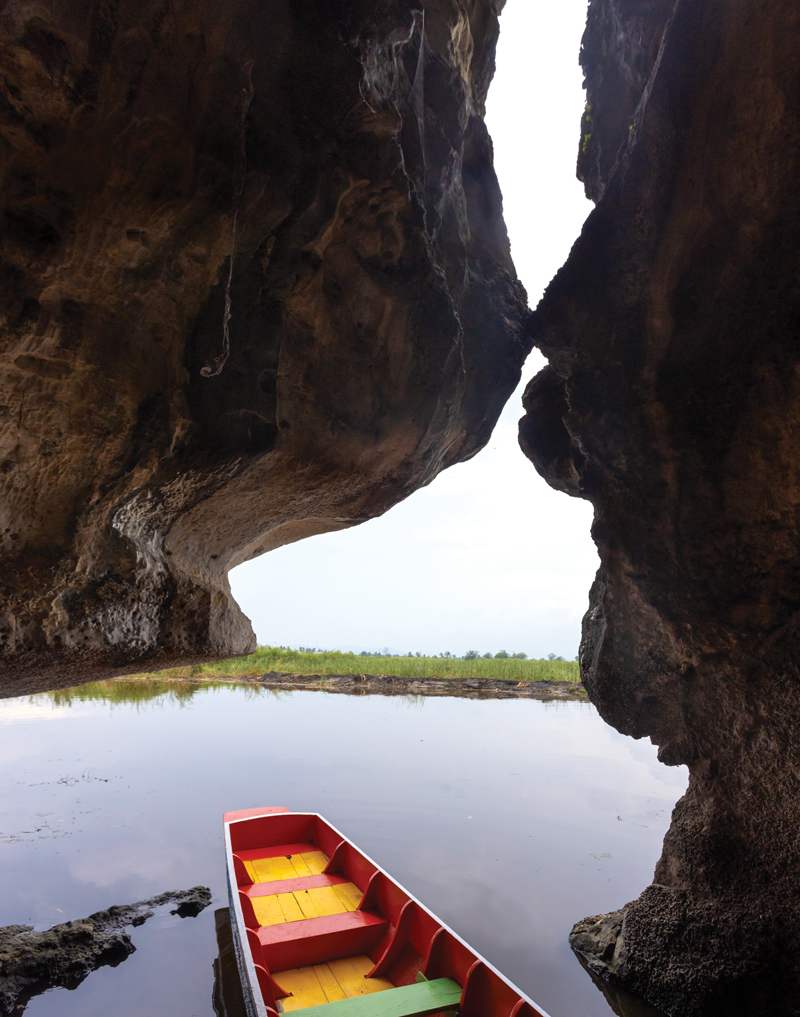
A second, quite different boat trip runs along Khlong Khao Daeng, a canal that drains out of the park into the Gulf between banks of undisturbed mangrove. Local fishermen run the boats from Wat Khao Daeng; the round trip takes around ninety minutes and is priced per boat rather than per person, so it is better value with four or five of you than alone. The turning point is the red cliff of Khao Daeng itself, and on the way your boatman will point out the rock formations that everybody is shown and nobody can then unsee.
Beaches, trails and a slow evening
The beaches at Laem Sala and Sam Phraya are quiet on weekdays and busy with Thai families at weekends. Sam Phraya has campsites, showers and a park restaurant, which makes it the simplest place to base yourself for a full day. If you want to walk, the Khao Daeng trail and the Bueng Bua nature trail are both short, and the viewpoint climbs are steep enough that you will want to be doing them before the heat arrives.
At low tide the shoreline at Sam Roi Yot beach flattens into a running surface that goes on for kilometres, and the back roads through the coconut groves are good cycling. It is also a reasonable place to try stand-up paddleboarding for the first time, either on the wetlands or on the sea when it is calm — a couple of small local outfits run lessons and rent boards.
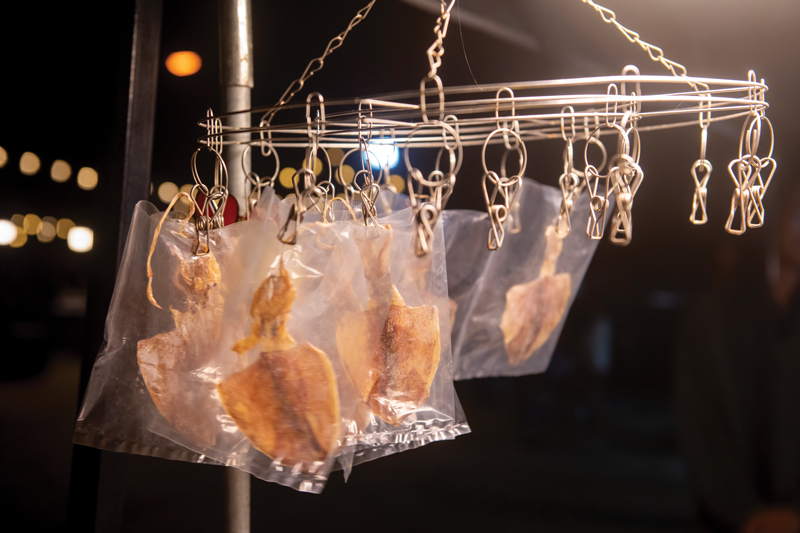
On Saturday evenings the beachfront market, Talad Long Lay, sets tables directly on the sand: grilled seafood, som tam, Thai sweets, live music and not much reason to hurry. A morning version returns to the same spot on Sundays, which is the better of the two if you dislike crowds.
Practical notes
It is a national park, so there is an entrance fee at the gates, with a higher rate for foreign visitors. Bring cash. There are several separate entrances rather than one, and moving between areas of the park means getting back in the car. Boat trips on the wetlands and the canal are arranged on the spot rather than online, and are weather-dependent. Facilities are basic but present at the main beaches.
Phraya Nakhon Cave
This is the photograph that draws people to Sam Roi Yot: a golden royal pavilion standing in a collapsed cave chamber, lit by a shaft of morning sunlight falling through the hole in the roof. King Rama V visited in the nineteenth century, and the small pavilion built to mark that visit has become one of the most recognisable images in central Thailand. On a clear morning the effect is genuinely extraordinary. It is also genuinely hard work to reach.
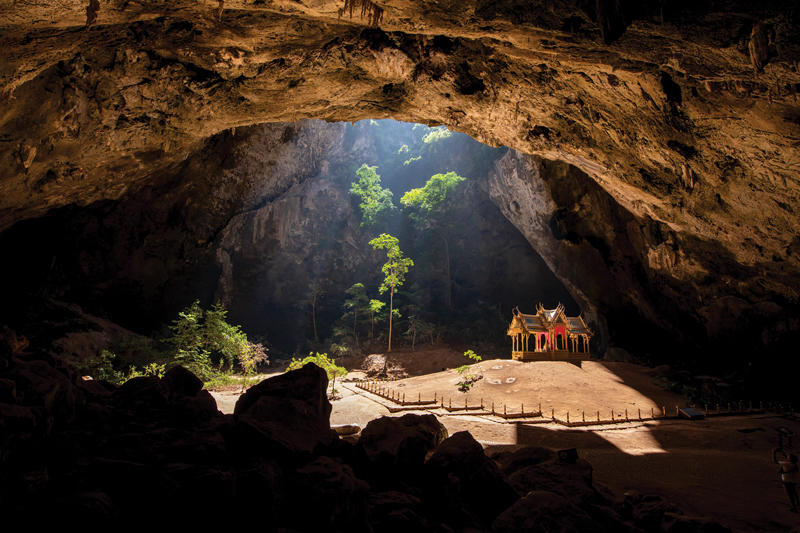
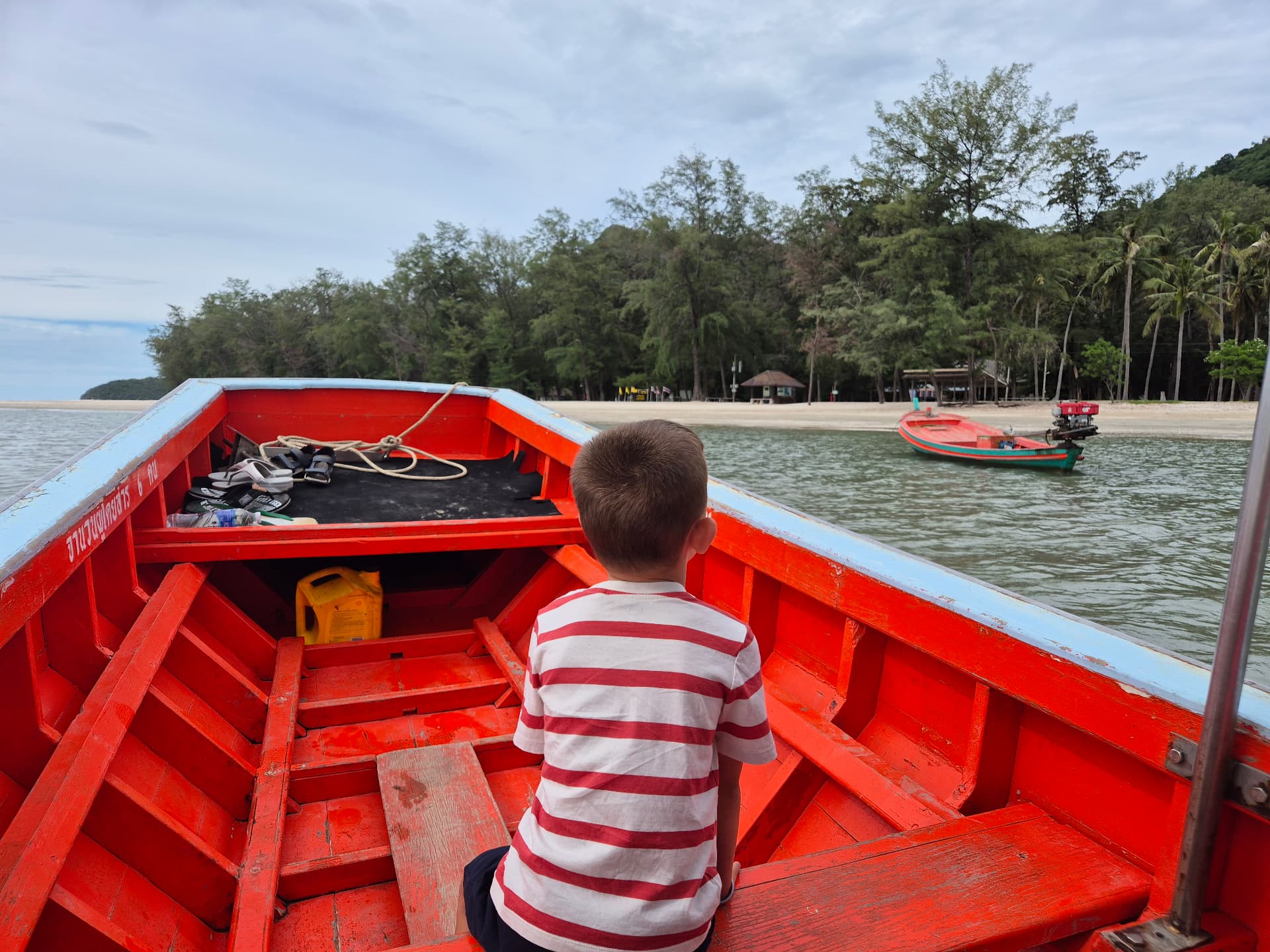
The cave sits inside Sam Roi Yot National Park, south of the main wetland area. You drive to Bang Pu, a small fishing village on the coast, and from there you have two options. Walk over the rocky headland to Laem Sala beach — a steep, uneven path of roughly half an hour — or take one of the local motorized boats around the point. The boat does not eliminate the climb; from Laem Sala there is still a steep, stepped path up to the cave mouth. It is short, but in heat and humidity it feels longer than it looks.
Timing is everything. The light beam only reaches the pavilion when the sun is high enough to pass through the roof opening, which in practice means mid to late morning. Arrive too early and the chamber is dim; arrive too late and the pavilion sits in flat shade. Setting out from Hua Hin no later than 7:30 is the single best piece of advice we can give.
Entrance and boat costs
Sam Roi Yot National Park charges 200 Baht for foreign adults and 100 Baht for children — roughly $5–6 and $3 USD. Tickets are bought at the park entrance before you reach Bang Pu. The optional motorized boat from Bang Pu to Laem Sala beach costs around 400 Baht for a round-trip that holds up to four people. Walking the headland is free, but the boat is worth considering if you want to save energy for the final climb.
Not a walk for everyone
The trail involves rock steps, loose ground and a sustained climb in heat and humidity. Anyone with knee, hip, heart or balance problems should think carefully, and small children will need to be carried in places. The boat shortens the coastal section but does not remove the climb to the cave.
Pala-U Waterfall
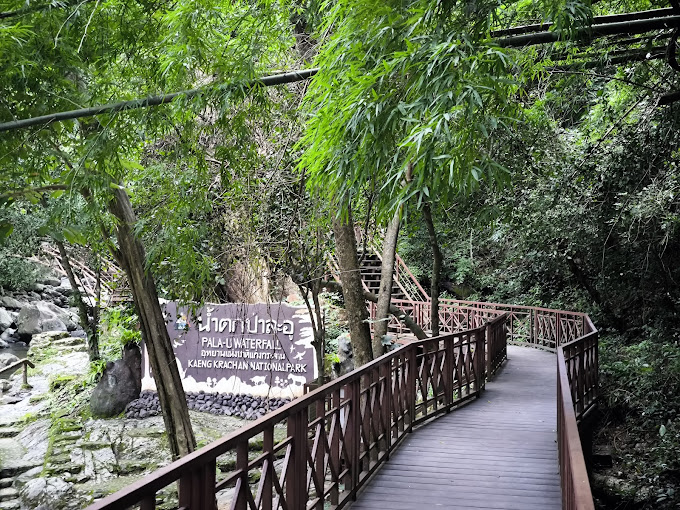
Head inland instead of along the coast and the landscape changes completely. The road west from Hua Hin climbs through pineapple fields and small villages into the southern reaches of Kaeng Krachan National Park, Thailand's largest, pressed against the Myanmar border. Pala-U sits at the end of that road: a waterfall of fifteen or sixteen tiers stepping down through old rainforest, with a shaded trail running beside the stream.
The appeal is the walk as much as the falls. You follow the water upward from tier to tier in air that is markedly cooler and greener than the coast, crossing the stream in places and climbing over rocks. The lower levels are an easy stroll; the higher ones become a proper scramble. For safety, most visitors are stopped at the fifth tier, and the section beyond the third is steep, often wet and sometimes roped. Levels three and four have the deepest, clearest pools, and if the water is high enough you can swim among the fish.
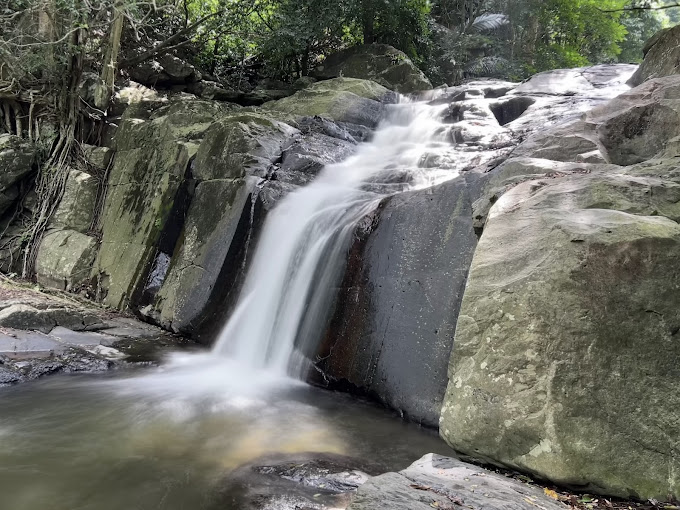
The forest here is lively in a quiet way. Hundreds of butterflies gather near the water in the morning — the dry season months are especially good for them — and the pools are full of tame carp that cluster hopefully at the edge. A small bag of fish food is sold near the entrance for a few baht.
The drive itself is part of the experience. The road passes through dense forest, and because this is real elephant country there is a genuine chance of seeing dung on the road or, if you are lucky, an animal crossing ahead. Keep your speed down and your eyes open.
Practical notes
- Foreign adults pay 300 THB to enter the national park, children 150–200 THB, plus 30 THB per vehicle. Cash only.
- The park opens at 08:00 and closes around 16:00–16:30. Arrive in the morning for cooler walking and the best butterfly activity.
- There is no mobile signal at the waterfall. Let someone know your plans before you go.
- Wear proper hiking shoes with grip. The rocks are slick with moss and water, and sandals are a bad idea.
- Food and drink inside the park are restricted to reduce litter, but there are basic restaurants and toilets near the entrance.
Closed after heavy rain
After extreme monsoon rain or sudden flooding the park rangers may close the waterfall for safety. The falls are at their most powerful from June to October, which is dramatic but also when closures are most likely. November to April is drier, the paths are less slippery and butterfly numbers are high.
Pranburi
Pranburi is the easiest trip on this list and the one residents repeat most often, partly because it barely counts as a trip. Half an hour south of town, it is a small riverside and coastal district that has kept a working, unglamorous character even as boutique resorts appeared along its beaches.
The reason most people drive down is Pran Buri Forest Park, a small mangrove reserve of around three square kilometres where the Pran Buri River meets the sea. The land was shrimp farms until a recovery project began replanting it in the early 1980s; what grew back is now mangrove, mixed deciduous woodland and pine along the shore. A kilometre-long wooden boardwalk loops through it, and because there are no side paths you cannot get lost. Most people take between thirty and fifty minutes, longer if they stop.
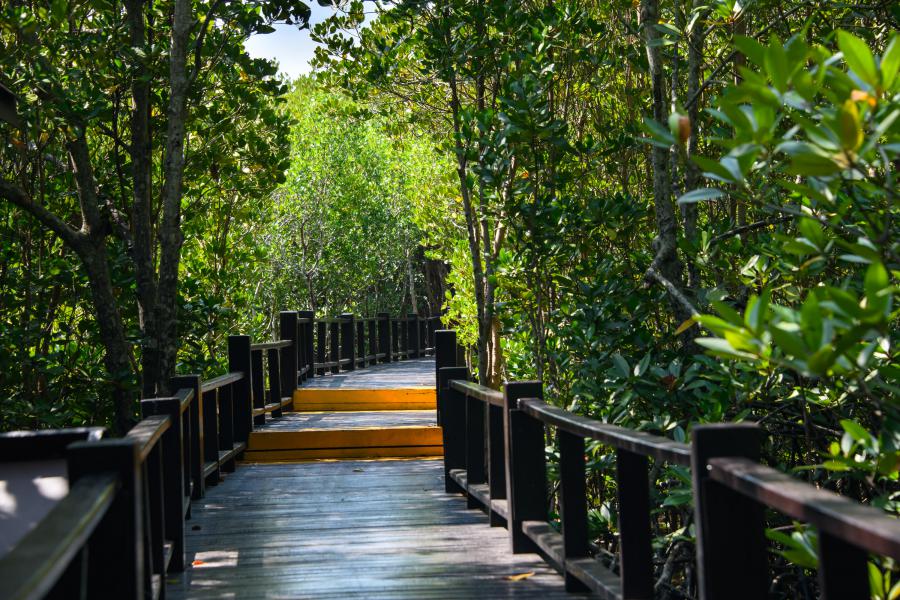
It is more interesting than a flat wooden path sounds. The habitat shifts every few hundred metres, the walkway climbs to canopy height at one point for a view over the treetops, and at low tide the mud below fills with crabs and mudskippers. Over 110 bird species have been recorded here, including four kinds of kingfisher, and there is a watchtower along the route for anyone who wants to sit and look properly. Monitor lizards and long-tailed macaques are common enough that you should keep food out of sight.
Halfway along the boardwalk, long-tail boats run river and canal trips when the tide is high enough — roughly forty minutes, arranged on the spot, up to eight people for 500 THB. There is no schedule and no booking; if the water is low, it simply does not happen that day.
The rest of a Pranburi morning writes itself. The fishing harbour at Pak Nam Pran is busiest early and gives you the least sanitised look at coastal Thai life nearby, and the seafood restaurants along the river are where people from Hua Hin drive down to eat at weekends. The park has its own restaurant by the headquarters, open 08:30 to 17:00 and closed on Mondays.
Practical notes
- Pran Buri Forest Park is open 08:00 to 17:00 daily. Entry is 100 THB for foreign adults and 50 THB for children aged 3–14 (20 and 10 THB for Thai nationals).
- There is no public transport to the park and the signage is poor. Navigate to the coordinates 12.4136, 99.9851 rather than trusting road signs.
- Driving from Hua Hin: south on Highway 4, left onto Route 1019, then left again about 200 m later immediately after the railway crossing and follow the small road to the end.
- The boardwalk is flat and wide enough for a stroller, and mostly in shade — one of the few outings here that works with small children in the middle of the day.
- Camping is allowed near the beach; rental tents cost 300 THB a night, or 30 THB to pitch your own.
Phetchaburi
Phetchaburi is the trip for people who want something other than nature. It is an old provincial capital with a long royal history, and it has the density of temples, shophouses and craftsmanship that Hua Hin — a resort town by origin — simply does not have. It is barely an hour north, and still sees remarkably few foreign visitors.
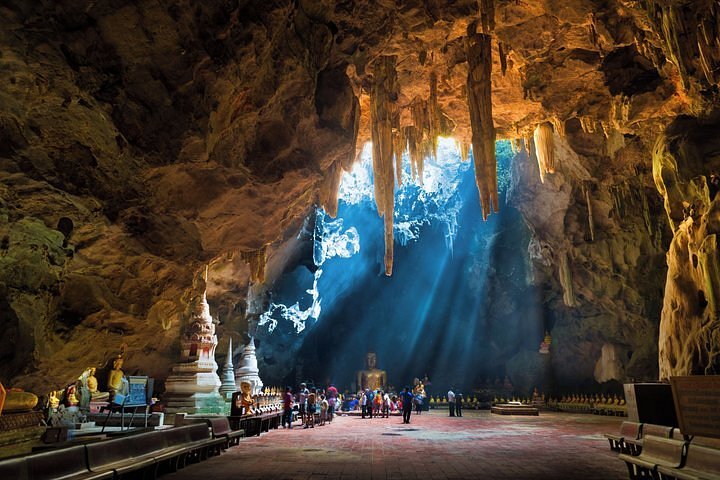
Start with Khao Luang, a cave shrine in a hill a few kilometres outside town. A short flight of steps drops you into a large chamber holding well over a hundred Buddha images, from full-size reclining figures to small ones tucked into the rock. What makes it is the roof: openings in the limestone let daylight fall straight into the chamber, and in the morning the light lands in defined shafts. It is the same effect people climb an hour for at Phraya Nakhon, without the climb.
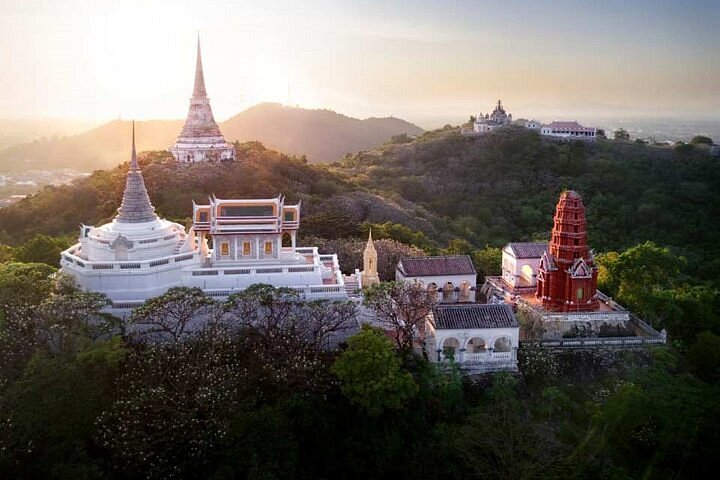
The other set piece is Phra Nakhon Khiri, the hilltop palace built for King Mongkut in the mid-nineteenth century and now a historical park. Halls, a white chedi, a royal observatory and temple buildings are spread along a ridge above the town, with views in every direction. A funicular saves the climb; the walking route is steeper than it looks and unshaded in parts.
Then there are the macaques. They live on both hills and they are not shy. Bags, bottles and anything that rustles are fair game, and around the historical park they can be pushy rather than merely curious. Loudspeakers playing classical music have been used to keep them at a distance, with mixed results. Carry as little as possible, keep food and shopping out of sight, and don't stop to feed them.
Beyond the two headline sights, the town rewards wandering: temple compounds with old murals, a market known for Thai desserts, and Wat Khoi on the way back from the historical park — a modern, photogenic temple with unusual statuary and, usefully, no monkeys. If you want the sea afterwards, Hat Chao Samran is a long, plain fishing beach twenty minutes east, where the Thai swim fully clothed and nobody is trying to sell you anything. You need your own transport to reach it.
Making a day of it
Khao Luang opens from around 07:00 to 18:00 and entry is free, though a donation is normal. Phra Nakhon Khiri keeps shorter hours, roughly 08:30 to 16:00, and charges an entrance fee of around 150 THB, with the funicular ticketed separately. Take cash.
Phetchaburi genuinely needs a full day if you want the cave, the hilltop palace and lunch. It is also the one trip on this list that works without a car: trains and minivans run north from Hua Hin regularly, and the town is small enough to get around by tuk-tuk once you are there.
Kui Buri
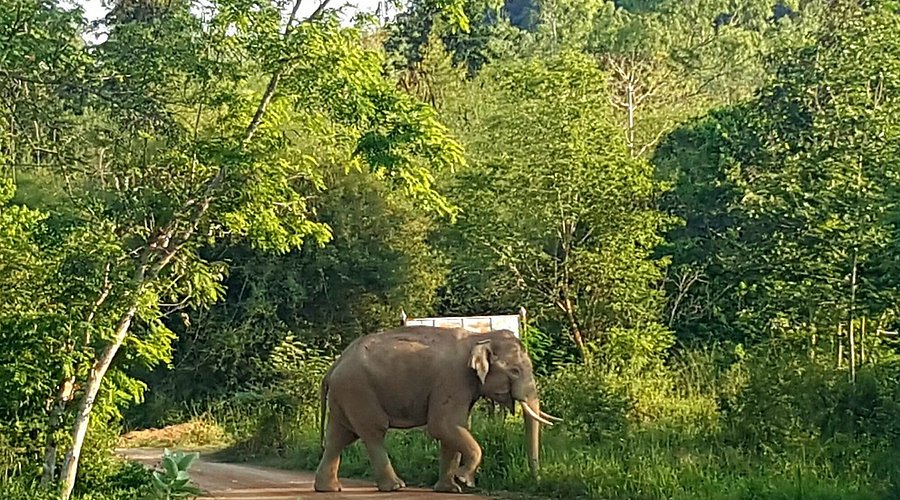
Kui Buri National Park is the most reliable place in Thailand to see wild Asian elephants in their own environment. The park covers 969 km² in Prachuap Khiri Khan province, about an hour and a half southwest of Hua Hin, and the chances of a sighting here are unusually high — most afternoons deliver.
The viewing itself is tightly controlled, which is the point. You cannot drive your own vehicle into the wildlife watching area around Huai Luek ranger station. Instead, you hire an open 4x4 pickup with a local driver and a ranger who reads tracks and knows where the herds have been moving. The vehicles run from 14:00 to 18:00, because the animals only emerge from the forest once the worst of the afternoon heat has passed.
Elephants are the main attraction — the park holds more than three hundred — but the grassland and forest also support Thailand's largest population of gaur, the world's biggest wild cattle, plus deer, wild boar and more than 260 bird species. It is not a zoo: the animals are wild, the terrain is real, and a quiet afternoon is always possible. But the odds are heavily in your favour.
Costs and practical notes
- Entrance fee: 200 THB for foreign adults, 100 THB for children. Thai citizens pay 40 THB.
- Safari truck: 1,200 THB per vehicle, seating up to six people. Solo travellers can usually wait at the entrance to share with others.
- Timing: The wildlife watching area is open from 14:00 to 18:00. Arrive early to secure a truck, especially at weekends.
- Transport: There is no public transport to the park. You need your own car or scooter, or a booked organised day tour from Hua Hin or Pranburi.
- Rules: Private vehicles are not allowed inside the wildlife area. Stay in the truck and follow the ranger's instructions — wild elephants are dangerous at close range.
Self-drive or organised tour?
If you already have a rental car, driving yourself is the cheapest and most flexible option. The downside is the return journey, which is partly on rural roads after dark, and the local safari staff often speak little English. An organised tour from Hua Hin costs roughly 1,300 to 2,600 THB per person, but includes hotel transfer, an English-speaking guide and the comfort of not driving back at night.
| Option | Pros | Cons |
|---|---|---|
| Self-drive | Cheapest and most flexible schedule. | Return drive after dark; local staff may speak limited English. |
| Organised tour | English-speaking guide, hotel transfer, no night driving. | More expensive; you usually travel in a convoy with other vehicles. |
Getting there and back
How you travel changes which of these trips are realistic.
Your own car or motorbike. The only option that makes all six of these straightforward. Sam Roi Yot, Kui Buri and Pala-U in particular involve moving between points that no public transport links, and returning after dark from the southern parks is a car journey rather than a motorbike one.
Car with driver for the day. Common here and, for a full-day trip shared between two or more people, often the sensible choice — particularly for Kui Buri, where the return is in the dark, and for Phraya Nakhon, where you will be tired afterwards. Agree the route, the waiting time and the price before you set off rather than on arrival.
Train and minivan. Realistic for Phetchaburi, which sits on the main route north. Less useful for anything else on this list.
Organised tours. Widely offered locally for the cave, the parks and the elephants. They remove the logistics and the driving, at the cost of setting the pace for you. We do not name operators we have not verified.
What to take
Cash for park fees and small restaurants, more water than seems necessary, shoes you can climb in, sun protection, and something with long sleeves for the late afternoon at Kui Buri. Phone signal is patchy inside the parks, so download your route before leaving.
Seasons and timing
The same trip can be excellent or disappointing depending on the month and the hour.
From roughly November to February the weather does most of the work for you: cooler air, clear light and comfortable walking. That is the window in which Phraya Nakhon and the Sam Roi Yot viewpoints stop being an endurance test, and it is also the busiest period at the beaches and parks on weekends.
Waterfalls run the other way round. Pala-U depends on rainfall, so it is at its best during and shortly after the wet months and at its weakest at the end of the dry season. Wildlife viewing at Kui Buri tends to be more reliable in drier periods, when animals come out to the open grassland.
Time of day matters as much as season. Early morning suits the marshland, the harbour at Pranburi and any climb. Late morning is when the light beam reaches the pavilion at Phraya Nakhon. Late afternoon is the only time that makes sense at Kui Buri. The middle of the day, in the heat, suits sitting somewhere with food and shade — which is what Pranburi is for.
Common questions
Do you need a car for day trips from Hua Hin?
What does it cost to enter the national parks?
Are you guaranteed to see elephants at Kui Buri?
How hard is the walk to Phraya Nakhon Cave?
When is the best time of year for day trips?
Which day trip is best with young children?
Continue planning your move
Everyday life
Where to live
Hua Hin Compass verified
Last verified
August 2026
Next scheduled review
February 2027
Sources checked
- · Department of National Parks information on Khao Sam Roi Yot, Kaeng Krachan and Kui Buri
- · Tourism Authority of Thailand listings for Phetchaburi and Pranburi
- · On-the-ground observation of access routes, driving times and facilities
National park fees, opening hours, boat services and wildlife-viewing arrangements change without notice, and we deliberately do not publish figures that date quickly. Check the current rate and opening times locally before you set off, and carry cash.